

WATCH: World leaders address UN General Assembly in New York
US president, Rouhani, Jordan’s King Abdullah II, Putin speaking in morning session as over 160 world leaders attend annual event
 Add ToI as a Preferred Source on Google
NEW YORK — The annual United Nations General Assembly debate began Monday morning in New York, bringing together some 160 world leaders at this year’s ministerial meeting, according to UN officials
UN Secretary-General Ban Ki-moon, US President Barack Obama, Iranian President Hassan Rouhani, and Jordan’s King Abdullah II were among Monday morning’s speakers, with addresses by Russian President Vladimir Putin, France’s Francois Hollande and Egyptian President Abdel-Fattah el-Sissi scheduled for later in the day.
This is the 70th anniversary of the United Nations and it is bringing an unusually large number of presidents, prime ministers, kings and heads of state to UN headquarters in New York. The high turnout is also a result of a preceding three-day UN summit that ended Sunday, which calls on countries to adopt new UN development goals for the next 15 years to eradicate poverty and preserve the planet. There are 17 goals and 169 targets.
Among the many issues world leaders are set to address at the General Assembly, the nuclear deal between the P5+1 states and Iran will likely take center stage, as well as the ongoing civil war in Syria, the spread of extremism in the Middle East and Africa and how to deal with the upsurge in migrants fleeing from Syria and other conflicts including in Iraq, Yemen and Afghanistan.
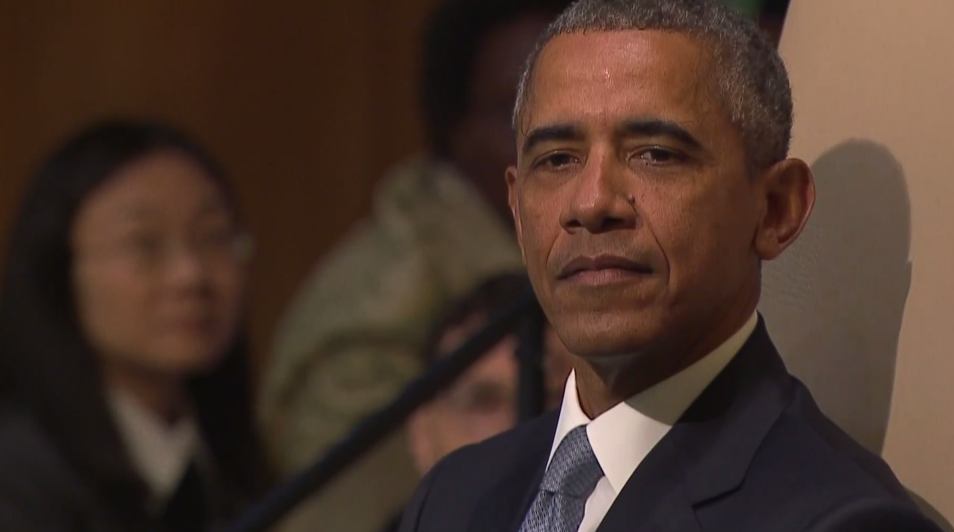
Obama took the podium as the fourth speaker at the General Debate. He emphasized the importance of nations working cooperatively while arguing that those states that pursue a path of aggression are weaker and will ultimately fail.
Obama defined appropriate leadership on the international stage as one that confronts threats while pursuing diplomacy, seeking the fulfillment of democratic principles and establishing support for international institutions and laws.
The president highlighted the nuclear deal with Iran, reached in July of this year, as an example of international cooperation in order to hold states accountable for flaunting international laws. The deal, the president said, can serve as an example of how diplomacy can be used to achieve international objectives.
A similar theme was unfurled by Iran’s Rouhani, attending meetings at the UN facility in New York in advance of the General Debate.
On Saturday, the Iranian president touted the deal as an example of Iran’s willingness to work in partnership with other states, and on Sunday, Rouhani recorded a lengthy radio interview with America’s National Public Radio in which he sounded themes strikingly similar to those expected to come from Obama during his Monday speech.
Rouhani tweeted during the interview that “#IranDeal revived hope that negotiations, though not easy, can resolve complicated cases.”
Despite their common affirmation of the virtue of the nuclear deal, the odds of Obama and Rouhani holding a meeting — or even a brief encounter — on the sidelines of Monday’s debate seemed to decline slightly Sunday. Iran’s state news agency, IRNA, indicated that Rouhani will leave earlier than anticipated — shortly after his speech on Monday — in order to return to Tehran for a mass funeral of Iranian pilgrims killed during last week’s hajj stampede in Mecca.
During last year’s General Debate, journalists waited with baited breath to see whether Rouhani and Obama would have a carefully choreographed “chance meeting” in the midst of the ongoing nuclear talks. No such meeting transpired, but upon returning to Iran, Rouhani still faced criticism for appearing too warm toward the West in general — and the United States, specifically.
Rouhani has been vocal on Iran’s position on Syria during his weekend in New York, arguing that while Iran is reticent to discuss the end game of the Syrian conflict — Tehran is a major supporter of the Assad regime — it will work in concert with the international community to defeat the Islamic State group.
“We must all act in unison and have a formula that is required to drive out the terrorists, immediately,” he told NPR during the interview.
AP contributed to this report



The Times of Israel Community.