

Amid religious violence in Israel, American leaders celebrate interfaith success
On day Palestinian terrorists killed Jews at prayer in Jerusalem, a New York gathering brought together Jewish and Muslim leaders
 Add ToI as a Preferred Source on Google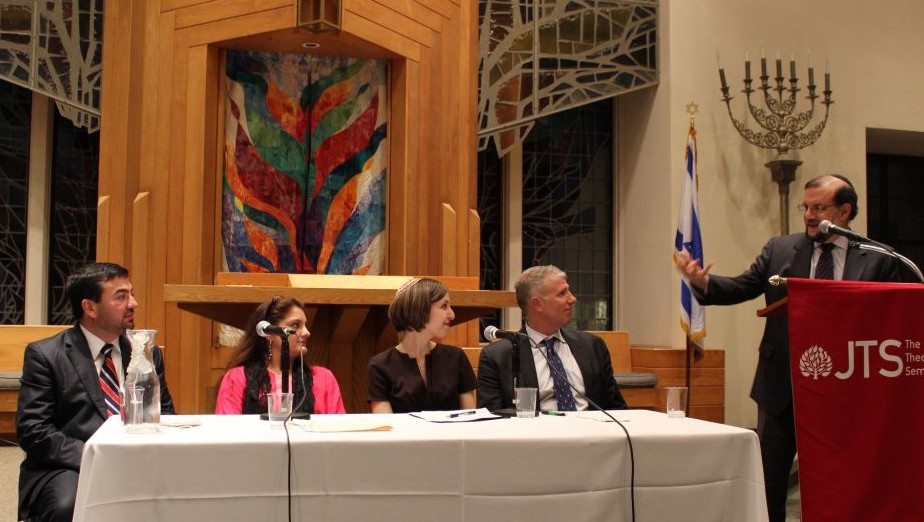
It was just hours after two Muslim terrorists entered a Jerusalem synagogue and killed four Jews at a morning prayer service, but it was a world away.
On Tuesday about 30 high-profile Muslim and Jewish scholars and leaders came together for a kosher-halal lunch (arugula salad, salmon with a fried potato on top, tiramisu for dessert) at New York’s Jewish Theological Seminary (JTS) to celebrate their work bridging the gaps between the two communities.
The violence in Israel wasn’t mentioned, specifically. But it was felt, undoubtedly.
“Our work is the work of peace, and yet, as the prophet says, ‘shalom, shalom, v’ein shalom,’ we pray for peace, we work for peace, and yet, we still don’t have peace,” said Burton Visotzky, a professor of Midrash and Interreligious Studies at JTS.
Visotzky is short but not quite stout with a beard that’s black around his chin but begins to gray as it travels up toward his kippah-covered head.
His exuberance couldn’t be clipped by the day’s tragic beginning, and he bounced around from table to table, greeting some with ‘shalom’ and others with ‘As-salamu alaykum,’ the Arabic counterpart.
The escalating conflict in Jerusalem did not dampen Visotzky’s joy about what he feels is a momentous step in advancing Muslim-Jewish relations in the United States. Together with the Hartford Seminary and the Islamic Society of North America (ISNA), JTS just published “Sharing the Well: A Resource Guide For Jewish-Muslim Engagement.” The guide (available for free PDF download) is the outgrowth of a series of annual conferences titled “Judaism and Islam in America” that began in 2010 under Visotzky’s leadership.
“Sharing the Well” includes guidelines on how to begin and maintain interreligious dialogue, as well as essays on shared values between the two religions and a list of 24 Muslim-Jewish projects around the country, from a Muslim-Jewish “speed dialogue” modeled after speed dating to an interfaith Thanksgiving service. The authors hope the book inspires Jews and Muslims to reach across religious divides at a time when world events are increasingly pitting them against one another.
‘If anywhere is going to be a model for Muslim-Jewish relations, the U.S. really can and should be’
Despite, or maybe because of, the strained relationships between Muslims and Jews across the globe, a number of American educators like Visotzky are assigning themselves the responsibility to forge bonds.
“Unless people like us around the world do what we are doing, we are in bad shape. We are in bad shape anyway, but we are in worse shape if we don’t tackle this. If we can’t do it here, in the U.S., in New York, where is this going to be possible?” said JTS Chancellor Arnold Eisen at the lunch.
Mehnaz Afridi, a Pakistani-born Muslim woman who directs the Holocaust, Genocide and Interfaith Education Center at Manhattan College (in the Bronx) echoed Eisen in a recent phone interview with JTA: “If anywhere is going to be a model for Muslim-Jewish relations, the U.S. really can and should be,” she said.
Afridi contends that interfaith study, Muslim-Jewish in particular, is a “small but burgeoning field,” both in terms of community and academia.
“There is an invisible link bonding people in this field across the country,” she said.
“The whole point of study is to go out and do it, you need to go and make human contact, one on one, this is the way we advance,” Visotzky said.
Visotzky has done local, national and international interfaith work, producing scholarship and advising communities. It’s not easy, and sometimes, he says, it can feel like “pushing against the tide.”
“But if we have the God-given ability to bring people together to try to make peace, I think that it’s our sacred obligation to do so,” he said.
He scanned the room, at his colleagues, among them Dr. Mohamed Elsanousi, ISNA’s director of community outreach, and a man Visotzky greets as “brother.”
“We all hope, we pray that what we do here can have some affect there too,” Visotzky said, “in the Holy Land.”






The Times of Israel Community.