

As AIPAC is out-hawked by Trump, settlers reevaluate ties to pro-Israel lobby
The US group’s support for two states exposes discord among West Bank Israelis, with one rogue council head garnering Likud support by going on the offensive

 Add ToI as a Preferred Source on Google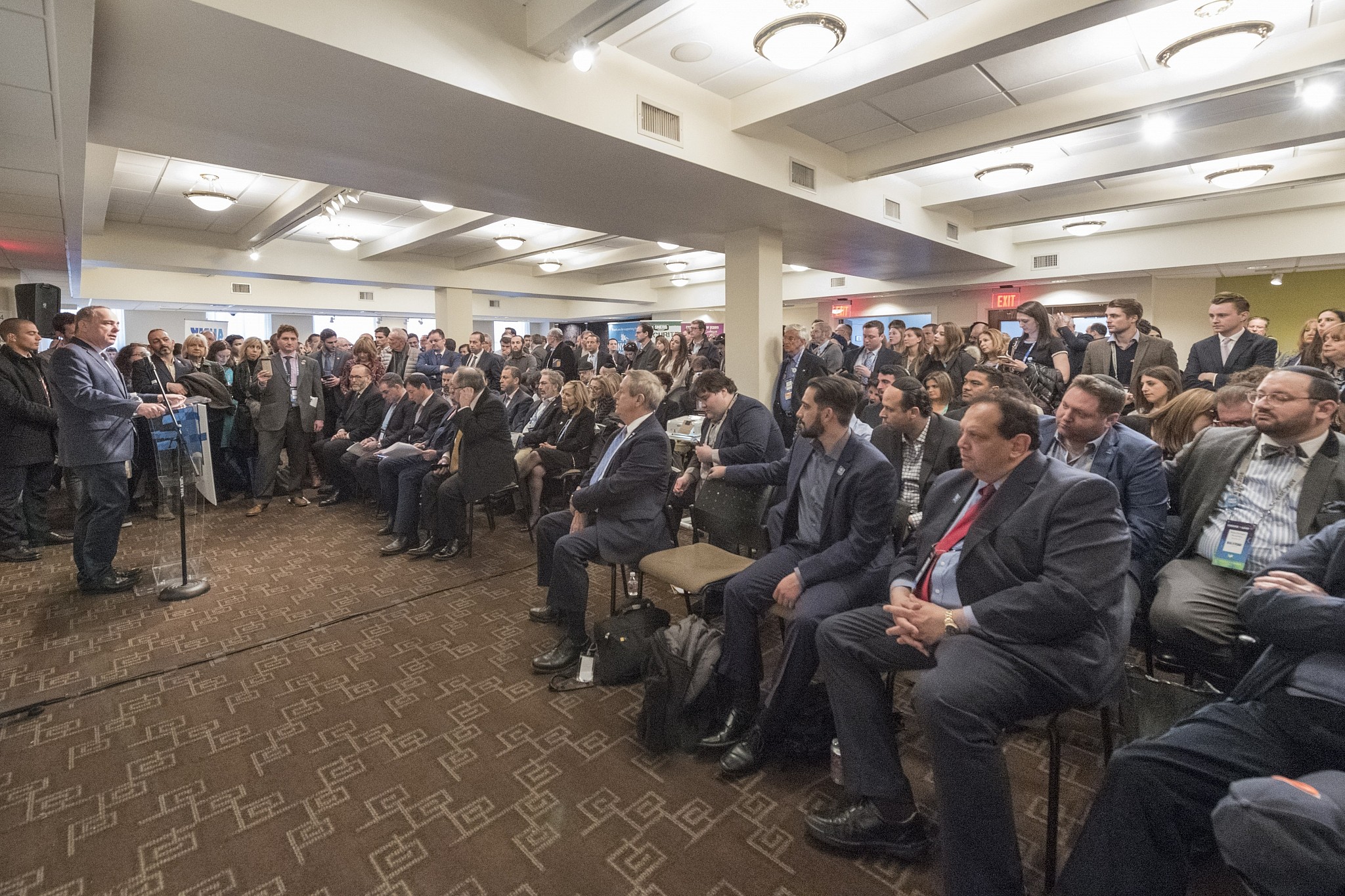
The past year has given rise to a US administration that recognized Jerusalem as Israel’s capital, refrained from condemning any particular settlement project approved for construction in the West Bank, and withheld millions of dollars in aid to the Palestinians.
In this post-Obama climate, settlers leaders have identified an opportunity to advance their agenda, successfully lobbying the Israeli government to advance three times as many housing projects in the settlements as in the year prior, and making their strongest legislative push yet for applying Israeli sovereignty over all Jewish communities beyond the Green Line.
As 18,000 pro-Israel supporters converged on Washington for the American Israel Public Affairs Committee’s annual policy conference this week, settler leaders too focused their attention on the US capital.
But strategies for how to tackle the American audience have been split: on the one hand an umbrella organization that has worked to quietly develop its relationship with the US’s most powerful Israel lobby; and on the other a rogue West Bank regional council head, who has managed to garner the support of a noteworthy amount of coalition lawmakers thanks to a combative letter he sent to AIPAC leadership.
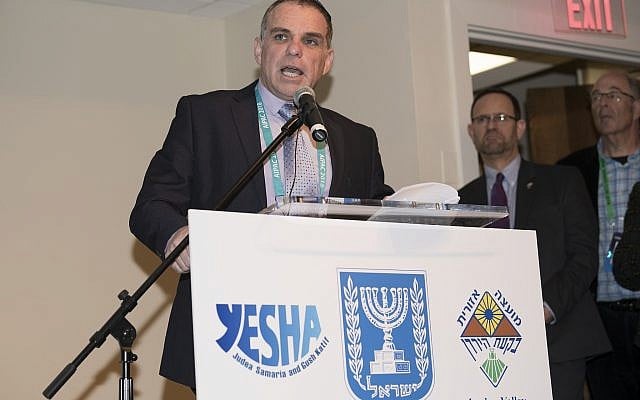
On Monday afternoon, the Yesha settlement umbrella group held an event on the conference’s sidelines on “Combating the de-legitimization of Israel through the embrace of Judea and Samaria.”
Joining senior Yesha and US officials at the session were Israeli ministers Naftali Bennett, Ayelet Shaked, Tzachi Hanegbi and Yuval Steinitz in addition to Likud MK Sharren Haskel and Israel’s consul general in New York Dani Dayan (a former Yesha chief himself). The event was co-sponsored by Israel’s Strategic Affairs Ministry and the Jordan Valley Regional Council.
Over 400 people stuffed into a basement room at the historic Sixth and I Synagogue. Dozens more waited outside the building, unable to squeeze in.
One after the other, the event’s twelve speakers took to the podium to reiterate — to rousing applause — the same message: that the West Bank is an inseparable part of Israel.
Hebron Jewish community spokesman Yishai Fleisher, who emceed the event, said it was part of an “education campaign” aimed at American Jewry and AIPAC members in particular.
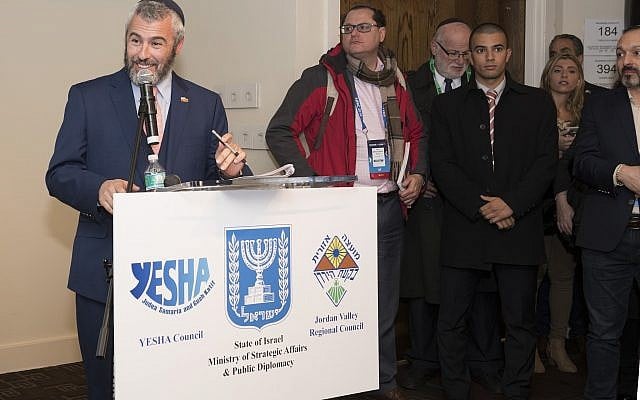
“We want people who may have been misled to better understand how important Judea and Samaria is to Israel’s defense, to its history and to combating de-legitimization,” Fleisher told the Times of Israel.
“Everyone understands that AIPAC is an organization that you want to form a relationship with. We don’t want to divorce, we want to engage,” he added.
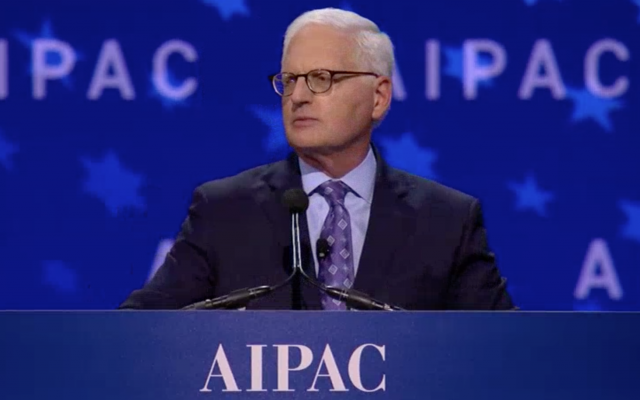
But Fleisher did not ignore profound disagreements he had with the lobby, which were highlighted in the speech given by AIPAC Executive Director Howard Kohr on Sunday in which he issued an explicit call for “two states for two peoples” and said it was “tragic” that this scenario currently seems so distant.
The Hebron leader argued that Kohr’s speech was “not reflective of all of AIPAC.”
“We have found that there are a lot of people at AIPAC that are interested in discussing these issues,” Fleisher said, before going on to question why other policy options weren’t being raised at the policy conference.
Still, speakers at the Yesha event avoided criticizing AIPAC explicitly.
“Our approach at the event was non-combative. It was not to say ‘How dare you.’ However, the tides have shifted on this issue in Israel and we think its time for the organization (AIPAC) to reflect that,” Fleisher explained.
Yet, an elephant remained in the room: its location blocks away from the convention center. While Jordan Valley Regional Council chairman David Elhayani said the event was not officially made part of the conference because the Yesha organizers registered late, he admitted to feeling that AIPAC leaders “were looking for an excuse not to have us there.”
Nobody sidelines Yossi Dagan
Meanwhile, Samaria Regional Council chairman Yossi Dagan chose a different path to convey his frustration with the powerful Israel lobby.
Hours before the Yesha event, the fiery settler leader penned a letter to AIPAC leadership in which he asserted that the positions of the pro-Israel lobby have “no basis in fact.”
Dagan argued that the group was inaccurately claiming the two-state solution as a policy supported by both Washington and Jerusalem.
“The official government of Israel guidelines… contain not one word or even hint of support for the ‘two-state solution,’” he said of the coalition agreements signed after the 2015 elections — that for the first time omitted any reference to the peace process.
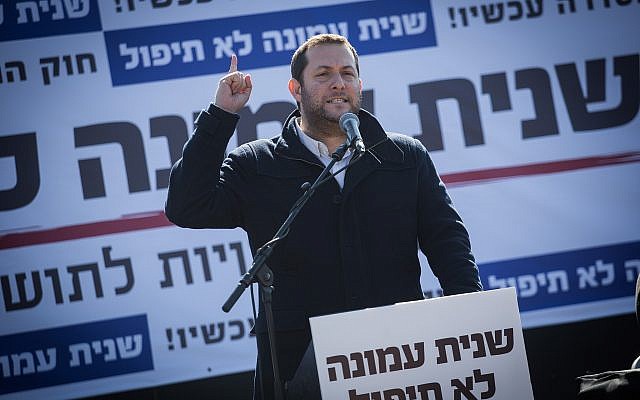
The settler leader said that while the US National Security Strategy under former president Barack Obama had expressed support for two states, the platform published by the Trump administration in December made no mention of the proposal.
“I am astounded as to why such a great, meaningful organization as AIPAC… would represent the positions of the state of Israel (and of the United States) so inaccurately before senior government officials, senators and congressmen, and the general pro-Israel public,” Dagan wrote.
The letter quickly gained backing of lawmakers from Prime Minister Benjamin Netanyahu’s ruling Likud party, including Welfare Minister Haim Katz, deputy foreign minister Tzipi Hotovely, and MKs Yehudah Glick, Yoav Kisch and Miki Zohar.
In a telling testament to Dagan’s influence among members of the coalition, each of them called on AIPAC to update its talking points to reflect the positions of the increasingly hawkish Israeli government.

Speaking with the Times of Israel, Dagan recognized that it wasn’t just the two-state solution that earned no mention in the guidelines of the current Israeli government, but also any one-state solution that the Samaria head might be willing to accept.
“They should say that too!” he argued emphatically. “Instead they’re lying to members of Congress in order to remain bipartisan, and I know many Republicans who are frustrated by this.”
Dagan emphasized that he has “deep respect” for AIPAC, citing its efforts against the Iran nuclear deal promoted by the Obama administration.
“But a clear message also has to be sent against this absurdity,” he added.
Not everyone in the settler camp appreciated the storm Dagan had caused.
Elhayani asserted that the letter’s purpose had only been to get the Samaria Regional Council chairman headlines back home.
“AIPAC completely disregards him. He wasn’t even invited to the conference,” he said.
But another West Bank council chairman who requested anonymity came to Dagan’s defense and mocked the event that Elhayani helped organize. “They’re relegated to the sidelines and they just take it like obedient children? It’s embarrassing!”
Yesha’s chief foreign envoy Oded Revivi defended his organization, suggesting that the location of its event only told part of the story.
“The Yesha Council has a very warm and longstanding relationship with AIPAC and its leadership. Like fine Judean wine, it has only improved with age,” he boasted.
Revivi added that he meets “with multiple high-level AIPAC delegations every month” and pointed out that attendance at Yesha’s event had doubled since last year.
Continuing his wine metaphor, the foreign envoy and Efrat settlement mayor said “people are thirsty to hear our voice and we are happy to share it.”
Best not to say anything
While that may be true, Howard Kohr’s opening night address calling for the establishment of a Palestinian state suggested that significant gaps remain between AIPAC and settler leaders on the conflict’s most central issue.
Moreover, with polls suggesting increased queasiness among Democrats with Israeli policies as of late, the lobby which prides itself on bipartisanship cannot be seen as warmly embracing the settlement movement rejected by the Israeli left.
“Pretty much everyone in the organization agrees that Israel is going to have to pull out of some of the settlements,” said one former AIPAC staffer. “But the costs of taking a position on such a controversial issue outweigh the benefits, so they avoid doing so.”
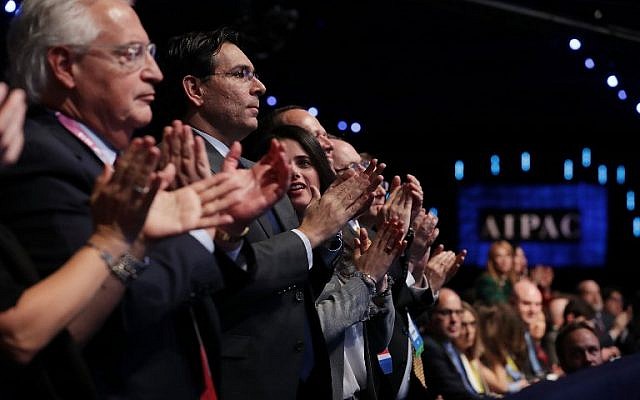
And that’s exactly what the lobby’s spokesman Marshall Wittman did minutes later, declining to comment on his organization’s relationship with Yesha and instead only stating that “AIPAC does not take a position on settlements.”
In the new Trump era, however, the question becomes whether settler leaders actually need AIPAC to stand by them at all.




The Times of Israel Community.