

At UN, PM will dish out, but offer little else
Netanyahu aims to ‘refute all of the lies’ directed at Israel, will likely disappoint those hoping for fresh approaches to peace-making
 Add ToI as a Preferred Source on Google
Raphael Ahren is a former diplomatic correspondent at The Times of Israel.
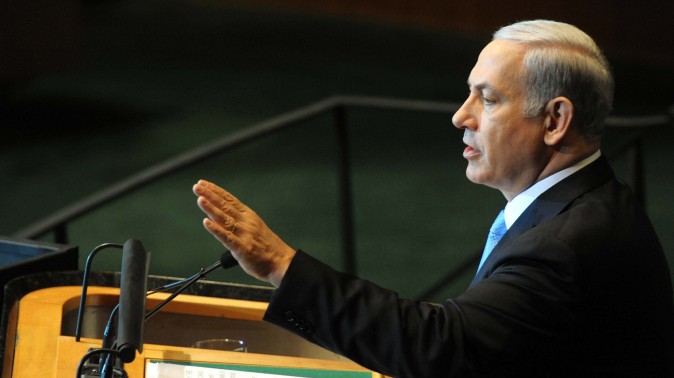
As usual, Prime Minister Benjamin Netanyahu, who left Sunday for a week-long visit to the United States, will deliver a well-written speech at the United Nations. This year he will seek to refute the Palestinians’ accusations of “genocide” and warn the world — yet again — of the dangers of a nuclear Iran. But judging from interviews and statements he made in recent days, his visit will be thoroughly reactive rather than proactive.
Netanyahu is not expected to announce any new diplomatic initiatives, nor present novel ideas that could lead to a breakthrough in any of the issues on the table, neither at the UN General Assembly Monday in New York, nor during his meeting with President Barack Obama in Washington on Wednesday. Rather, his self-imposed mission for this trip appears to be merely to respond to what others have said before him.
“I will refute all of the lies being directed at us and I will tell the truth about our state and about the heroic soldiers of the IDF, the most moral army in the world,” he said Sunday morning before boarding the plane to New York. Earlier during the weekend, he indicated that the main purpose of his trip was to “tell the truth of Israel’s citizens to the entire world.”
At the UN, the prime minister will respond to the “deceptive speech” made last week by Iranian President Hassan Rouhani, he announced before taking off. No one is expecting him to present creative ways to solve the nuclear standoff between Tehran and the West. Rather, he will likely reiterate Jerusalem’s (not unreasonable) position that the insidious regime must not be allowed to retain any enrichment capability, and that no deal is better than a bad deal.
Netanyahu will undoubtedly also hit back hard at Palestinian Authority President Mahmoud Abbas, who on Friday accused Israel of having carried out a “series of absolute war crimes” and a “war of genocide” in Gaza.
But while Abbas, in his address to the UN, threatened to take unilateral steps to advance Palestinian statehood — going to the Security Council with a resolution aimed at forcing an Israeli withdrawal from the West Bank — Netanyahu will not make any dramatic announcements. He will suffice with a speech portraying Israel as an island of stability in a tumultuous region, a bastion of civilization surrounded by bloodthirsty barbarians, in the hope that the world will finally understand who the good guys are and who the bad guys are.
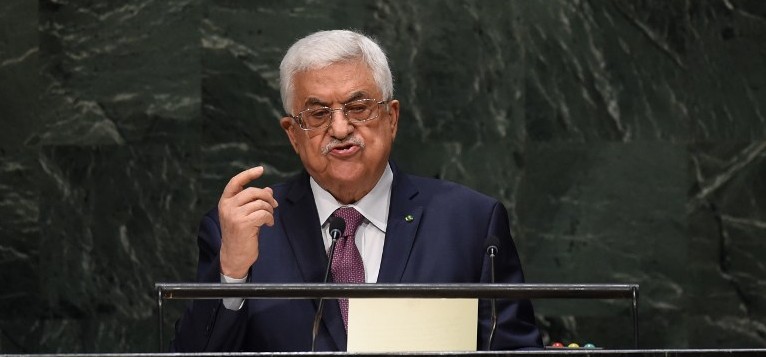
He will reiterate Israel’s yearning for peace with all its neighbors, but will refrain from explaining how he aims to get any closer to this goal. He will castigate Abbas for having chosen peace with Hamas over peace with Israel during last year’s US-brokered peace talks. He will declare that Hamas is ISIS and ISIS is Hamas — all branches of the same poisonous tree, as he likes to say. (With the world’s attention firmly focused on the Islamic State, expect Netanyahu to make a particular effort to link the group with Hamas, to drive home the point that Israel is dealing with ruthless terrorists.)
Abbas, with his fiercely combative speech, signaled that he is fed up with the formula of US-brokered negotiations. Instead, he is opting for direct confrontation, choosing to act unilaterally, and if necessary force a US veto in the Security Council and threaten Israel with lawsuits at the International Criminal Court. Netanyahu has no discernible strategy to counter Abbas’s diplomatic offensive, no vision for Israel’s future besides seeking to safeguard its security by refraining from hasty territorial withdrawals.
There are those who remain hopeful that the prime minister will take the initiative. “I was disappointed by the harsh character of President Abbas’s speech at the UN General Assembly. I hope that Prime Minister Netanyahu will seize the opportunity to hold a more constructive speech,” said Caspar Veldkamp, the Netherlands’ ambassador to Israel, for instance. Netanyahu could, for example, announce that he would take “a fresh look” at the Arab Peace Initiative, Veldkamp suggested. “This would show the Palestinians and the world that a positive attitude is possible. It would also reinforce Israel’s relations with an emerging regional alliance against Islamists and other revanchist powers,” the ambassador told The Times of Israel. “It is of course up to him, but this would be my advice.”
Veldkamp, and many others in the international community, will very likely be disappointed. After this summer’s conflict in Gaza, Netanyahu did speak repeatedly about a new “possible diplomatic horizon,” hinting at growing potential for rapprochement with the moderate Arab states. Many Sunni nations are “reevaluating their relationship with Israel and they understand that Israel is not their enemy,” he said, explaining that this presents not only a chance for cooperation, but “perhaps an opportunity for peace.”
Last week, Netanyahu said in an interview that translating this opportunity into a concrete peace plan is “something worth exploring,” but added that the two sides have not yet “crossed the divide.” But the Arab Peace Initiative, he clarified, “was set up in another period” and is thus no longer relevant.
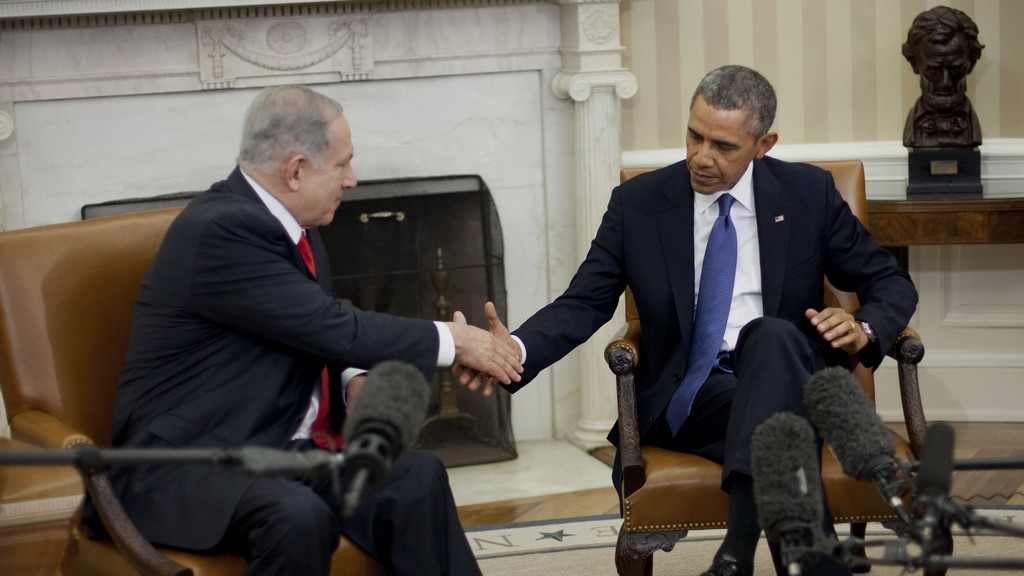
During his meeting Wednesday with Obama in the Oval Office, Netanyahu will want to discuss the Iranian nuclear threat, and especially a US proposal that would reportedly leave Iran with some 4,700 active centrifuges in the framework of a deal.
But the American president is unlikely to be swayed on Iran, and doesn’t intend to abandon the Palestinian issue, as he made plain during his own speech at the UN last week. “As bleak as the landscape appears, America will not give up on the pursuit of peace.” The status quo in the West Bank and Gaza is “not sustainable,” Obama warned.
The violence currently plaguing the Middle East “has made too many Israelis ready to abandon the hard work of peace. And that’s something worthy of reflection within Israel,” Obama said. Perhaps he had one person in particular in mind.
Still, some officials in Jerusalem feel that Netanyahu is going to have a relatively easy time in the US. Despite this summer’s war with Hamas, the world’s eyes are fixated on ISIS, they note, and the vicious tone and content of Abbas’s speech, which was heavily criticized by the State Department, may make it easier for the Israeli leader to deflect blame for the stalemate in the peace process.
There is actually little daylight between Netanyahu’s government and the US administration, some of these Israeli officials insist. Besides Washington being dismayed at the high number of casualties during Operation Protective Edge, they said, the two allies fundamentally agree on Israel’s right to defend itself, on the threat of Islamic extremism, on the danger of a nuclear Iran, and on many other issues.
That is probably something Netanyahu and Obama will highlight during the public part of their meeting. The subsequent tête-à-tête discussion will likely be a bit more contentious.







The Times of Israel Community.