

Breakthrough Israeli cancer study finds mutations break DNA when it doesn’t bend
Weizmann Institute of Science and Rowan University researchers show that repair enzymes fail to fix gene structures of certain shapes, in discovery that may lead to new therapies
 Add ToI as a Preferred Source on Google
Reporter at The Times of Israel
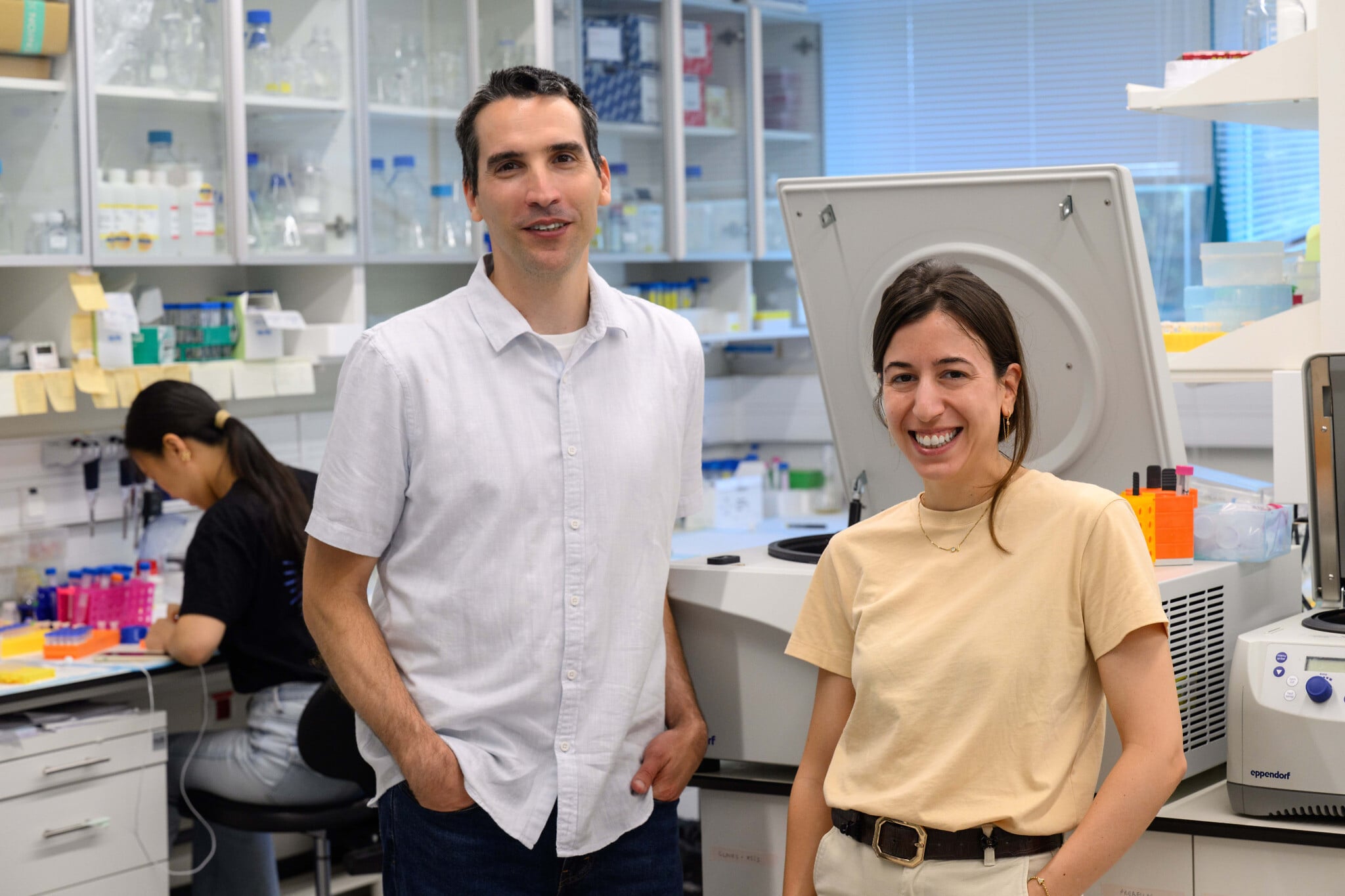
Israeli scientists have published research upending the long-held assumption that DNA mutations occur at random, a potentially major genetic breakthrough that could eventually lead to customized treatments for cancer and other diseases caused by genetic issues.
The peer-reviewed study by a Weizmann Institute of Science research team showed that when DNA strands are damaged, a repair enzyme’s ability to fix the site depends heavily on the DNA’s physical shape and structure, which can either attract repair enzymes or physically block them from working.
“The local physical environment around DNA damage can strongly affect how it is repaired,” Weizmann’s Dr. Ariel Afek, who supervised the research, told The Times of Israel. “If it bends in one direction or twists in another, it could make the efficiency of the repair a hundred times easier or harder.”
Noga Levy led the research at Afek’s lab at Weizmann along with other Weizmann researchers and Prof. Brian P. Weiser and other scientists at Rowan University in New Jersey.
The scientists’ findings, which appeared in July in Nature Communications, relied on specialized DNA microchips developed by the team to test thousands of genetic strands simultaneously.
The researchers combined their experimental results with computer simulations that modeled atomic interactions, using genomic algorithms to cross-reference their findings with human cancer databases.
“Some researchers look at the mutation in cancer patients,” Afek said. “But we wanted to go back and look at the process that actually initiated the mutation at an atomic level a long time ago to really understand the mechanism and the molecular causes.”
According to Afek, these insights could eventually enable scientists to customize repair enzymes and to develop targeted therapies for diseases linked to genetic damage, including cancer and neurodegenerative disorders.
“Why do damaging agents like UV light from the sun, or oxidation from the air, hit specific places in the genome more than others, and why do repair enzymes fail to fix the damage in certain spots?” Afek asked. “Mutations stand at the essence of many genetic diseases, and we are trying to understand the building blocks that make mutations happen or not.”
Bending DNA
Human beings are all complex and unique, but like every living thing on Earth, we are all composed of only four chemical building blocks — known as A, T, C and G — which are paired together in different sequences to form a genetic code billions of letters long.
The Human Genome Project finished mapping the full genetic blueprint for human life in 2022. Since then, scientists have worked to understand how special repair enzymes fix the code when damage occurs in the DNA.
If the repair enzymes do not fix these damaged spots, they can turn into permanent mutations that can trigger diseases like cancer. What Afek and his colleagues set out to figure out was why some breaks get patched up but others don’t, and whether what is happening near the damaged area has anything to do with the answer.
“People have usually thought that if there’s damage, it doesn’t really matter what surrounds it, and that the nearest neighbor might have a small effect,” he said.
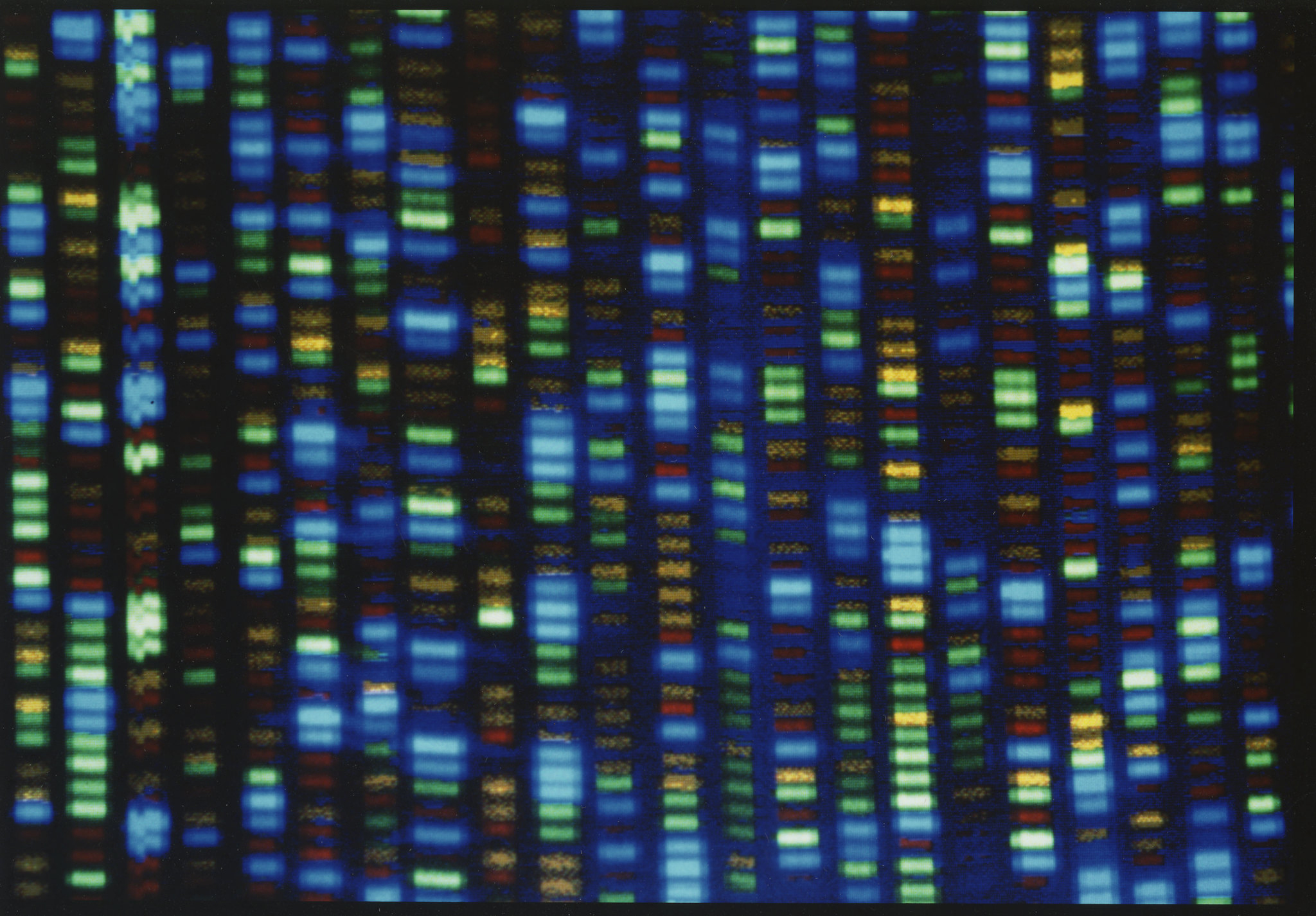
Afek’s team set out to isolate the initial steps to understand the process.
The scientists hypothesized that repair enzymes check the five letters before the damaged letter, and the five letters after it. They also suspected these wider sequences dictate the DNA ladder’s physical shape and electrical charge, directly affecting the enzyme’s ability to repair the damaged area.
“Usually in the cell, if there is some damaging agent, maybe one place in the genome gets damaged and not another,” Afek said. “It’s very hard to control, but under lab conditions, we made millions of different DNA sequences, placing the damage in the same location.”
This allowed the scientists to follow the activity of the repair enzymes based on the surrounding sequences.
“For the first time, we could characterize all the preferences of the repair enzymes, and we started to understand what governs the binding and repair efficiency, and what leads to mutations,” Afek said.
Collaborating researchers at Rowan University in New Jersey then used advanced molecular modeling tools to build 3D atomic simulations of the interactions.
The simulations showed that when the mutation bent the DNA and made it more narrow, a concentrated negative electrical charge was created within the bend.
When the enzyme is strongly attracted to that electric charge — like opposing poles of a magnet — it is likelier to successfully repair the damage.
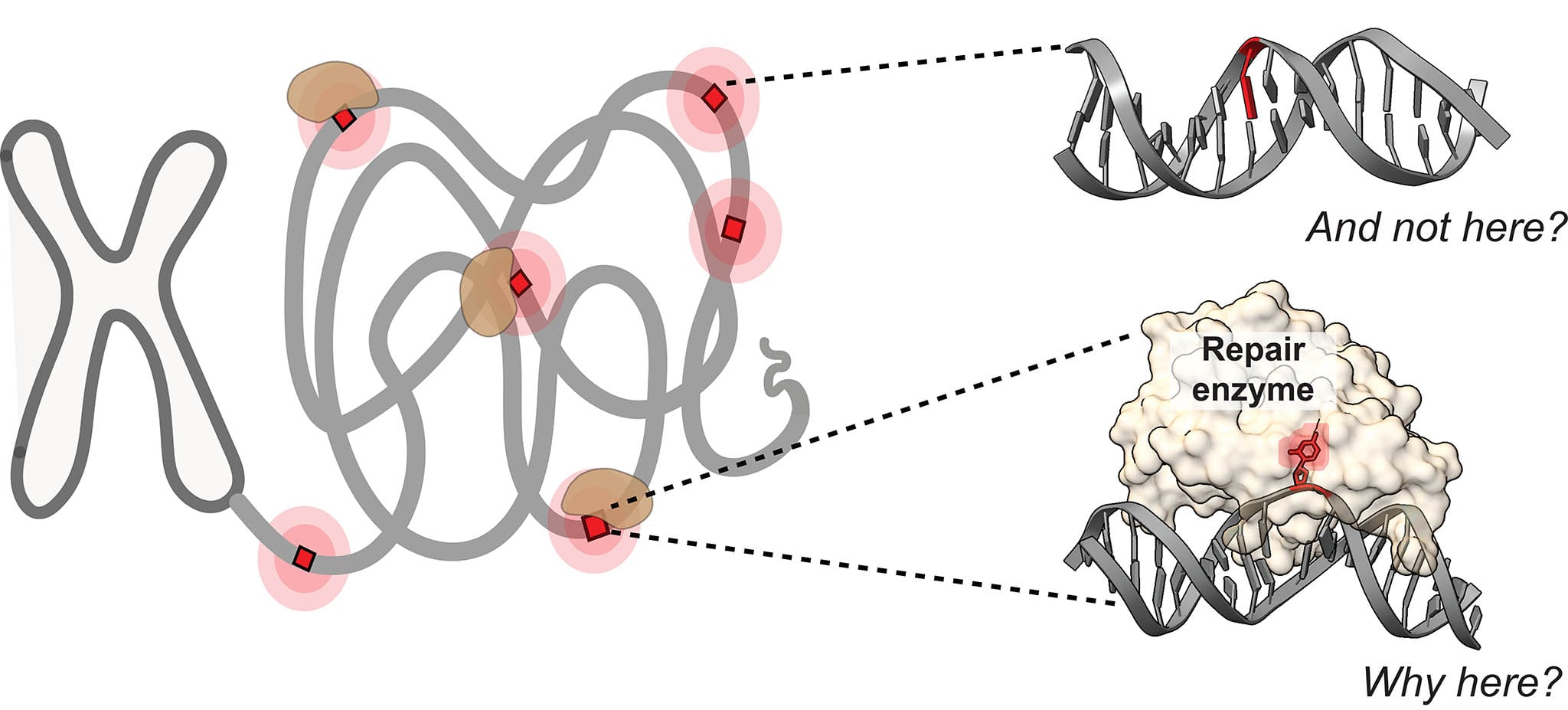
However, if surrounding sequences create a flatter shape that lacks a negative charge, the enzyme is more likely to leave the mutation unrepaired.
The scientists also labeled the enzymes and DNA strands with microscopic fluorescent tags to measure how quickly repair enzymes latched onto damaged DNA.
Using high-resolution optical scanners, the researchers could see the 3D structure and how the various shapes had an effect on the repair enzymes.
‘Lasting impact’
Afek’s team matched their lab findings against real-world databases, such as the Cancer Genome Atlas. They discovered that the exact sequence contexts that hindered repair enzymes in the lab aligned precisely with mutational hotspots in actual human tumors. This offered evidence that an enzyme’s sequence preference predicts where genetic mutations accumulate in human disease.

Prof. Bennett Van Houten of the Pharmacology and Chemical Biology department at the University of Pittsburgh told The Times of Israel that the discovery “will have a long and lasting impact on the field.”
“By revealing that surrounding genetic code alters the physical structure of DNA to directly affect how well these enzymes recognize and fix damage, the findings help explain why specific sequences are especially prone to high mutation rates in tumor cells,” said Van Houten, who was not involved in the study.
While the breakthrough will help scientists understand why some mutations stick, there remains a long road ahead before those findings can be transformed into actionable progress on new therapies, Afek noted.
“The research helped solve a part of the puzzle, but there is so much that is still unknown. This is just the tip of the iceberg,” Afek said. “There’s still room to understand many other factors that shift mutations and repair in our bodies.”










The Times of Israel Community.