

Erdogan in US: Istanbul attack not solely aimed at Israelis
Turkish president says in DC speech that Gaza blockade must be lifted; discusses IS with Obama on sidelines of nuclear meet
 Add ToI as a Preferred Source on Google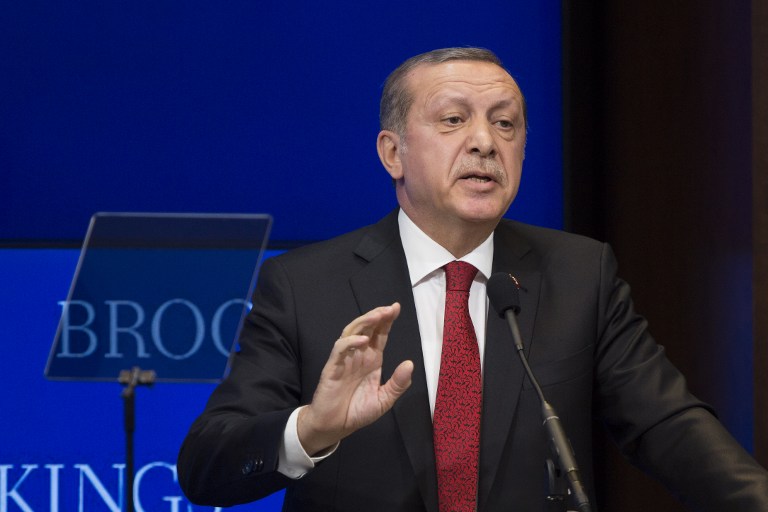
The recent terror attack in Istanbul that killed three Israelis and an Iranian was not solely aimed at Israel, Turkish President Recep Tayyip Erdogan said in a speech in Washington, DC on Thursday, and expressed the hope that the tragedy had brought the two once-close allies closer together again.
“In Istanbul, there was a bomb attack which cost the lives of three Israeli visitors in our country, and we have communicated our regret and condolences to the Israeli government and their families,” Erdogan said, according to the simultaneous translation provided on the Brookings Institution website.
“But I have to specify that this act of Daesh in Istanbul didn’t only target Israeli tourists,” he continued, referring to the Islamic State group by an Arabic acronym.
“Daesh continues its actions in several parts of our country and we continue to intensively fight against Daesh and its operatives and their actions.

“Israel communicated her gratitude to Turkey for our efforts and we are in communication, and we have also expressed our feelings for mutual cooperation and we believe that we are going to ensure positive developments and improve our relations with Israel.”
https://www.youtube.com/watch?time_continue=2526&v=lxJ9N6Vo9mA
The president also touched on the two issues that triggered the downturn in ties — the Israeli blockade on the Gaza Strip, which is ruled by Palestinian terror group Hamas; and an Israel Defense Forces raid on a Gaza-bound flotilla in 2010 that led to the deaths of 10 Turkish nationals.
“The Palestinian brothers and sisters are suffering under the unfair treatment of Israel,” Erdogan said. “We believe that the invasion of the Palestinian territories should be terminated, and we need to have a Palestinian state formed, with East Jerusalem being its capital.”
It is, Erdogan said, imperative to “remove the embargo” on Gaza and allow Turkey to step in to resolve some of the issues facing the Strip.
“Palestine is facing energy problems, it receives power only four hours a day. If we can have a power generator vessel anchored in its harbor, we will be able to supply Gaza with electricity and this is going to facilitate the lives of the people in Gaza. This was something that we communicated to the Israeli government, and Israel also knows that Palestine, Gaza is facing a very severe water supply problem.”
He said that current reconciliation talks between Jerusalem and Ankara included some discussion on the situation in Gaza.
“We also are ready to help in their needs for schools and hospitals, and we also have applied for supplying some assistance in kind, like food supplies or construction material, and are working on these in our negotiations. And I believe that the parties are going to reach an agreement as a result of these negotiations.”
These talks, he said, were on their way to a successful conclusion, although Israel is apparently unwilling to give ground on the unresolved issue of Turkey’s reluctance to shut Hamas’s Turkish offices.
“After the flotilla incident our expectations from Israel were very expressively stated to them. Prime Minster [Benjamin] Netanyahu called in 2013 and apologized, and after that we started our negotiations for a settlement. President Obama specifically took initiative and he placed a call to Netanyahu, and I heard the apology through that call and this started the process. The compensation process is now in progress and I think it will be resolved without any problems.
Erdogan met later with Obama in Washington, the White House said, amid serious tensions over press freedom and the war in Syria.
Having previously stated the pair were unlikely to hold sit-down talks — a decision widely perceived as a snub by Washington — the White House said the two men had in fact met on the margins of a nuclear security summit.
They discussed “US-Turkey cooperation on regional security, counter-terrorism, and migration,” it said.
The absence of a presidential meeting on Erdogan’s trip to the US capital had been glaring.
The two countries are meant to be close NATO allies in the thick of a fight against IS in Syria, but tensions have been stirred by Ankara’s attacks on Kurdish militants, some of whom are seen by Washington as the best bet for tackling IS in Iraq and northern Syria.
Turkey says the groups are linked to the outlawed Kurdish Workers Party (PKK), which has fought a long battle for Kurdish independence. Turkish forays into northern Iraq have also strained ties.
The White House has been increasingly outspoken in recent months about threats to free speech and democracy in Turkey, and on Thursday it restated its belief in the need for press freedom in Turkey, amid ugly scenes at Erdogan’s speech at the Brookings Institution.
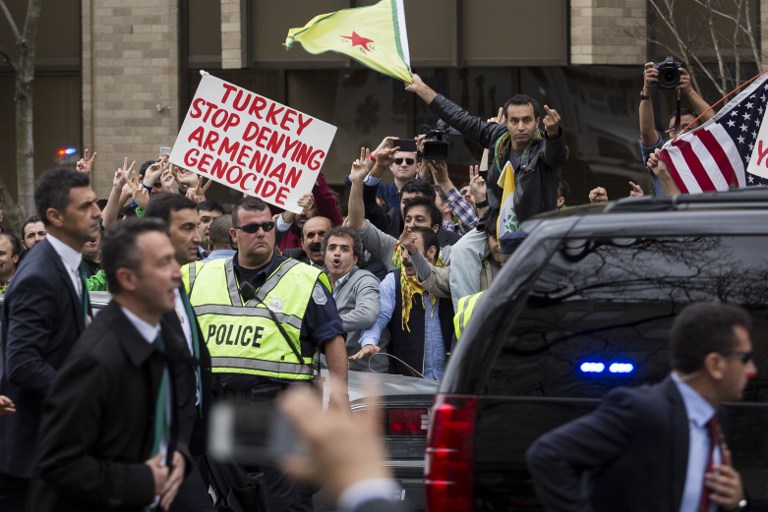
Ahead of Erdogan’s arrival at Brookings, Turkish security officials clashed with protesters — both sides exchanging insults and scuffling — before police were able to separate them.
The Turkish guards also set about the press. One aimed a chest-high kick at an American reporter attempting to film the harassment of a Turkish opposition reporter while another called a female foreign policy scholar a “whore.”
The US National Press Club accused Erdogan of trying to export oppression.
As the Turkish leader flew in to Washington ahead of the nuclear safety summit, news broke of another deadly bomb attack targeting police in his country’s southeast, where his forces are battling Kurdish militants.
According to the White House, Obama “extended condolences to President Erdogan on behalf of the American people for those killed and injured in today’s terrorist attack.”
He also “reaffirmed the support of the United States for Turkey’s security and our mutual struggle against terrorism.”





The Times of Israel Community.