

Hurtling toward a renewed Gaza conflict?
Two weeks after the fighting stopped, there’s been no progress in rehabilitating Gaza or resuming Israeli-PA talks. Abbas and Hamas are getting impatient

 Add ToI as a Preferred Source on Google
Avi Issacharoff, The Times of Israel's Middle East analyst, fills the same role for Walla, the leading portal in Israel. He is also a guest commentator on many different radio shows and current affairs programs on television. Until 2012, he was a reporter and commentator on Arab affairs for the Haaretz newspaper. He also lectures on modern Palestinian history at Tel Aviv University, and is currently writing a script for an action-drama series for the Israeli satellite Television "YES." Born in Jerusalem, he graduated cum laude from Ben Gurion University with a B.A. in Middle Eastern studies and then earned his M.A. from Tel Aviv University on the same subject, also cum laude. A fluent Arabic speaker, Avi was the Middle East Affairs correspondent for Israeli Public Radio covering the Israeli-Palestinian conflict, the war in Iraq and the Arab countries between the years 2003-2006. Avi directed and edited short documentary films on Israeli television programs dealing with the Middle East. In 2002 he won the "best reporter" award for the "Israel Radio” for his coverage of the second intifada. In 2004, together with Amos Harel, he wrote "The Seventh War - How we won and why we lost the war with the Palestinians." A year later the book won an award from the Institute for Strategic Studies for containing the best research on security affairs in Israel. In 2008, Issacharoff and Harel published their second book, entitled "34 Days - The Story of the Second Lebanon War," which won the same prize.
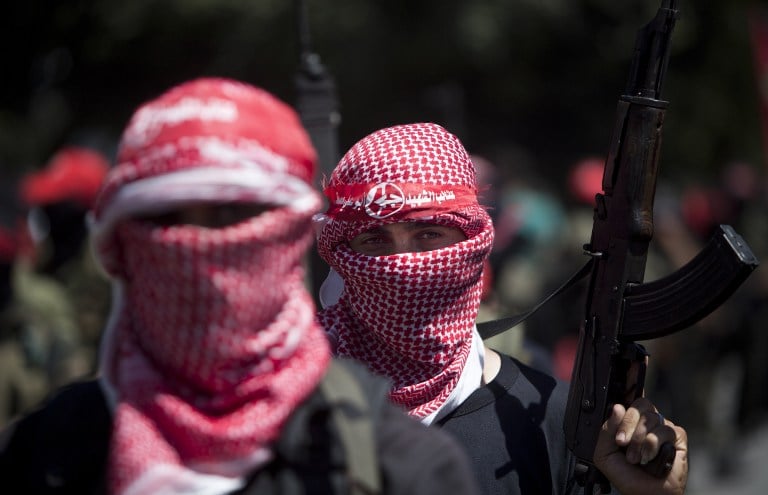
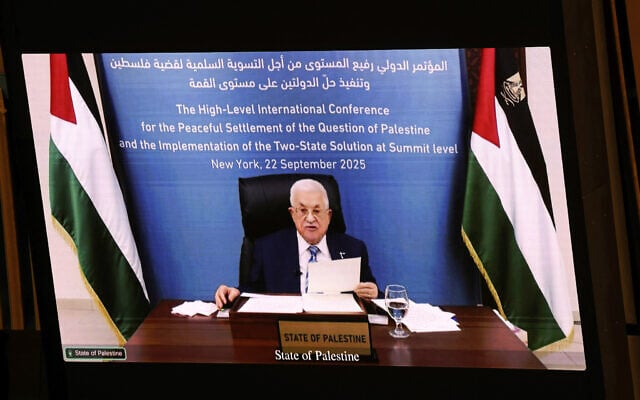
Palestinian Authority President Mahmoud Abbas began a visit to Egypt on Saturday with a dramatic pronouncement. Meeting with Egyptian journalists, Abbas declared, “If there is not one government, one authority empowered to carry arms, and one rule of law in the West Bank and Gaza, there’ll be no partnership or discussion with Hamas.”
Abbas was sending a message to Hamas that if its military wing insists on retaining its weapons and on defying the directives of the Palestinian “unity” government headed by Abbas, the rehabilitation of Gaza will be at risk.
Abbas also said that later Sunday he intends to present to the Arab League his plans for negotiations with Israel toward Palestinian statehood. If Israel refuses to cooperate, he said, “All options will be open.” A senior PA official in Ramallah told The Times of Israel last week that if Israel does not work with Abbas on the diplomatic program, PA-Israeli security coordination will come to a halt — perhaps not in the next few months, but in the course of 2015.
Israel’s inclination in recent years has been to ignore Abbas’s diplomatic initiatives. Abbas has been brushed aside as ostensibly not a partner, and was even described (by Strategic Affairs Minister Yuval Steinitz) as the biggest anti-Semite in the Middle East. But the Israeli government might do well to internalize that Abbas’s latest threats are not empty.
He and his people are determined to make dramatic moves in relation to both Hamas and Israel. For Hamas, an ultimatum: there will be partnership in Gaza and the disarming of the military wing, or Abbas will announce the failure of Palestinian reconciliation, and the rehabilitation of Gaza will go nowhere. And at the same time, a timetable will be laid down for Israel to respond to his diplomatic initiative, and if it is not accepted the PA will join various international forums and cease security cooperation with Israel.
This is a decisive year for Abbas, and the relevant decisions have already been taken in the Muqata’a.
No less significant a challenge for Israel is that in a little more than two weeks a month will have passed since the Israel-Hamas ceasefire took effect, and nothing is moving. This would appear to be a problem principally for Hamas, but it has significant implications for Israel.
The reconstruction of Gaza has not even begun. Hamas salaries have not been paid — and Abbas has made clear that he has no intention of paying them any time soon. Building materials are not entering Gaza in large quantities — indeed, there are new restrictions on the supplies of iron. The various crossing points are functioning in the same limited fashion as they were before the conflict. In short, the situation is just like it was two months ago, if not worse.
Furthermore, the idea of Palestinian “unity” is proving to be empty of significance. The PA security forces in the West Bank continue to arrest key Hamas activists. The victory celebrations organized by Hamas in the West Bank and Gaza after the ceasefire are proving to the Palestinian public to have been a bad joke.
What does this mean for Hamas? The former Gaza prime minister, Ismail Haniyeh, gave a hint of the answer in a speech Friday in a partially destroyed mosque in the Shati refugee camp, where he lives. “Our conflict with the enemy was not the last,” he said, of the 50-day war.
According to Palestinian sources in Gaza, indeed, the Hamas military wing has made clear to the political leadership that if nothing has changed and no steps have been taken to ease the blockade of Gaza by September 25, its men will renew rocket fire at Israel — despite the fact that the Hamas political leadership opposes such a move.
It’s hard to tell if this threat by the Hamas military wing is an empty one. But given the crisis in Hamas’s dealings with Fatah, the diplomatic deadlock between the PA and Israel, and the absence of any sign of Gaza’s rehabilitation, it won’t be a major surprise if in a little more than two weeks, Hamas does indeed restart the conflict.





The Times of Israel Community.