

How vulnerable is Netanyahu? A right-wing backbencher gives PM cause for worry
How a marginal opposition MK managed to push a seemingly invincible leader into a corner, with a transparently disingenuous proposal in the midst of a crisis

 Add ToI as a Preferred Source on Google
Haviv Rettig Gur is The Times of Israel's senior analyst.

Conventional wisdom about the current government holds that the great winner and dominant actor in Israeli politics is Prime Minister Benjamin Netanyahu. Eleven years on the job, he is, after all, still the prime minister.
But a sudden legislative row in the Knesset on Wednesday demonstrated the limits of Netanyahu’s power and laid bare his growing political vulnerability.
The row began with an obvious trap laid for Netanyahu by the right-wing Yamina party.
Yamina made the fateful choice back in May to walk away from their alliance with Netanyahu and Likud, deeming their unity government with Blue and White “leftist” and vowing to serve as a fighting opposition. It was the first time in the opposition for the faction’s five MKs, but they’ve taken to the role with relish.
Yamina has thrived outside the government, as expected. The faction’s leader, former defense minister Naftali Bennett, spent the past three months railing against the government’s lackadaisical approach to coronavirus testing. It was bad policy, not the virus itself, that was wreaking so much havoc on the Israeli economy, he claimed.
Bennett has urged a shift from what he called the “hammer” approach of disastrously shutting down the economy and wiping out businesses and livelihoods each time the virus surges, to the “tweezers” approach of instituting a mass-testing regime to identify virus carriers, then plucking them and their immediate contacts out of society and placing them in isolation hotels, allowing the rest of the population to get on with its business. The switch would “save the economy, save the livelihoods of families,” he has argued.

By early July, one of the government’s top advisers on the coronavirus response, physicist Eli Waxman, who chairs the expert advisory panel helping the National Security Council develop the government’s policy on the virus, lamented that even “four months into the crisis” nothing of the sort “has been built yet.”
Bennett’s campaign has included visits to hospitals and laboratories, and his efforts have been richly rewarded in polls. The five-seat Yamina faction is polling this week at 11 seats, including in a Tuesday Channel 12 poll, with most of that surge taken from Netanyahu’s Likud.
Enter Smotrich
On Wednesday it was Yamina MK Betzalel Smotrich’s turn to shine.
The lawmaker submitted a bill for a Knesset vote that would set up a parliamentary inquiry into allegations that High Court justices have ruled in cases where they have conflicts of interest. Decried by the center and left, the bill is part of a longstanding right-wing effort to reform and rein in what the right views as an activist and unethical judiciary, an effort that includes various proposals for strengthening oversight by the other branches of government and giving elected politicians more say in the selection of judges.
But this particular bill was none of those. It was a public relations stunt calculated to drive a wedge between Netanyahu and his right-wing base.

One sign of that fact is the timing. Wednesday was day 53 since the swearing-in of the 35th Government. The coalition agreement between Likud and Blue and White commits both parties to deal with just three issues in their legislation during the first 100 days of the government: The coronavirus, its economic fallout, and Netanyahu’s insistence on a West Bank annexation.
Smotrich put Netanyahu in a difficult bind: push ahead on legislation his base approves of, or keep his written commitments to his Blue and White coalition partners and thus ensure they keep theirs.
The bind is real. While Netanyahu is polling well, enough for a fairly easy election win even after the steep dip of the past week, the numbers are declining, the numbers of Israelis becoming convinced he has mishandled the recovery are growing, and now include significant percentages of right-wingers.
If Smotrich had wanted the bill to pass, he would have presented it in a few months’ time, when Likud would have been free to consider the issue seriously.
It’s hardly news that opposition backbencher Smotrich would try to embarrass the prime minister. The shocking thing was that he succeeded.
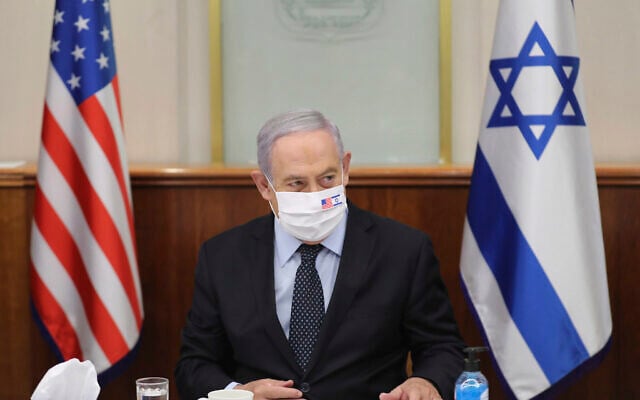
As he tried to maneuver his way out of the trap, Netanyahu managed to anger every side. Blue and White openly accused him of seeking new elections, his ultra-Orthodox allies savaged his behavior and vowed openly to take their revenge, and the right-wing base whose favor he had so earnestly sought derided his failure to pass the measure.
There is an open question surrounding Netanyahu’s premiership: Is he a powerful leader who is shaping the political system in his image, or a wily but ultimately weak chameleon whose primary achievement can’t be found in any hard accomplishments, but rather in the mere fact of his political survival? The answer is probably somewhere in between, but there’s little doubt that Wednesday’s drama is a data point in favor of the latter.
Angering everybody
Netanyahu’s solution to Smotrich’s trap was simple: Let the vote advance so as not to anger his base and drive more voters to Yamina, but ensure the measure nevertheless fails to endanger his unity coalition with Blue and White.
It didn’t work. The measure was defeated by a vote of 54 to 43 against.
Ultra-Orthodox lawmakers were enraged when the votes were counted.
They had told Netanyahu going into the vote that they wouldn’t be responsible for breaking up the government and forcing new elections. Shas and United Torah Judaism are both desperate to pass the 2020 state budget, which will finally transfer funding to their schools and seminaries delayed for over a year by the recurring elections.
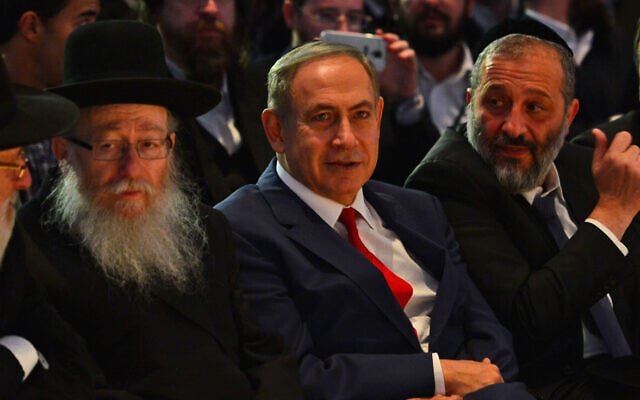
“We will vote against an investigative committee just to signal to Netanyahu we’re opposed to new elections,” an anonymous UTJ official told the Kan public broadcaster.
Shas leader Aryeh Deri even reminded Netanyahu that he had given his word to Blue and White head Benny Gantz that he would oppose any steps by Netanyahu that might destabilize the coalition.
But besides their general preference for stability, the Haredi parties were wary of being left in the lurch. Their voters are as critical of the judiciary as Smotrich and the Likud’s activist base. Ultra-Orthodox MKs warned Netanyahu not to leave them voting against while he voted for, making them appear soft on the issue, nor to ask them to vote for while he voted against, putting the onus for the betrayal of Blue and White on their unwilling shoulders.
Netanyahu agreed that Likud, Shas and UTJ would vote together, and Likud announced “faction discipline” would be invoked, the rule by which coalition MKs are required to vote as their faction decides or risk having their own legislation frozen down the road.
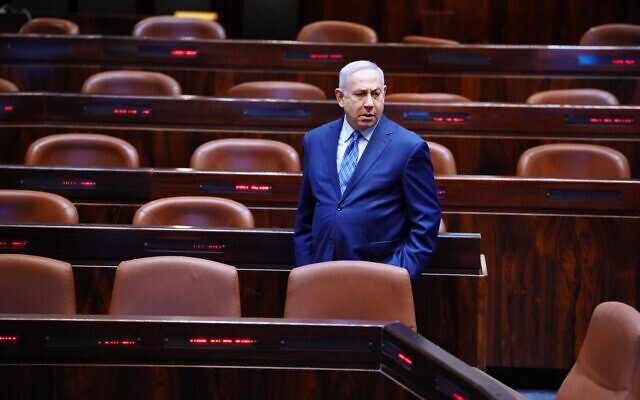
Mollified, the Haredi parties voted for the measure on Wednesday afternoon — only to find in the roll call that 12 Likud lawmakers, including Netanyahu himself and some of his most loyal lieutenants in the party, were missing from the plenum.
‘He tricked us’
Netanyahu tried to send different signals to at least three different parties all at once: To show Gantz he regretted that the vote was taking place by absenting himself from it; to show his right-wing base he would not stand in the way of judicial reform, in the hopes of keeping that base from defecting to Yamina; and to show the Haredi parties he would stick by them by ensuring that all Likud MKs who bothered to be present voted alongside them.
No one appreciated the effort, it seemed.
“It’s sad that Netanyahu, the MKs and the ministers who talk night and day about the judicial system just didn’t show up,” said conservative judicial reform activist Simcha Rothman in a tweet. “I’m not talking about those in [coronavirus] isolation. If this had failed because Uzi Dayan or Amir Ohana [who are in isolation] weren’t there to vote for it, no one would be upset. We will remember!”
Boaz Golan, a populist far-right media personality who is usually a fervent backer of Netanyahu, said the vote showed “who is right and who is left.”
“Netanyahu tricked us. He made sure we’d vote, but didn’t show up himself and didn’t bring all of Likud,” UTJ MK Moshe Gafni raged in comments quoted by the ultra-Orthodox news site Behadrey Haredim — where Smotrich had bought top-of-the-site banner ads on Wednesday urging UTJ and Shas to vote for his measure.

“We’re going to plan steps against him,” a livid Gafni was quoted as saying. “We’ll show him.”
Some in Blue and White railed against Netanyahu’s priorities.
“Israel has a million unemployed, and every day there are over 1,000 new Israelis diagnosed with the coronavirus,” tweeted Justice Minister Avi Nissenkorn. “Yet there are those who think the most urgent thing now is to demolish the rule of law. Anyone who votes for an investigative committee of judges votes for the elimination of Israeli democracy. I won’t allow it.”
For his part, Gantz seemed to take the crisis in stride.
Perhaps it was the fact that Knesset bylaws stipulate that parliamentary inquiries are handled through the Knesset House Committee, whose chair is Blue and White’s MK Eitan Ginzburg. Gantz had the power to bury the committee even if the plenum vote had succeeded.
Or perhaps it was the fervent signaling from the Haredi parties, including their open rage at Netanyahu, that suggested to the Blue and White leader that Netanyahu had scored an own goal and didn’t need any help to clarify that fact.
At the pro-Netanyahu daily Israel Hayom, the order was given to get the conversation moving to other topics. It was the only newspaper that saw no mention of Wednesday’s dramatic Knesset skirmish on the front page of its Thursday morning edition.
The paper’s diplomatic correspondent, Ariel Kahana, tweeted what amounts to a dismissive insistence that the whole episode was a momentary distraction, Haredi vows of vengeance notwithstanding.
“Likud would vote for it,” he wrote, “satisfy the base, but then agree with Blue and White to kill Smotrich’s committee quietly. In other words, we can get back to the coronavirus.”
Crisis to crisis
Is Netanyahu leading the Israeli political system, or is he adept mainly at dancing between its fast-moving raindrops? Can he pull off a West Bank annexation as he limps from one political crisis to another? Does he have the bandwidth and desire to set aside the political maneuvers and devote his full attention to the virus crisis?
The 35th Government responded relatively well to the first wave of the pandemic. Then, apparently satisfied with its performance, it got back to its usual bickering and rancor, neglecting the expert advice to build the mass-testing infrastructure the country would need to successfully weather future waves. Netanyahu now leads the most bloated, expensive and inefficient government in Israel’s history at a time of almost unprecedented economic pain for millions, including Netanyahu’s own voters, who tend to be working-class and, on average, were hit harder by the virus than those who voted against him.
On Wednesday, a backbencher from the margins of Israeli politics, wielding a transparently disingenuous proposal, managed to throw the great Netanyahu for a spin and to raise questions at the highest echelons of Israeli politics over the viability of the government in the midst of a dire national emergency.
The irony escaped no one in the political system. Having finally triumphed over his opponents and set himself as the unassailable, indomitable leader of Israel, Netanyahu somehow still finds himself vulnerable at every turn.







The Times of Israel Community.