

Israelis appreciate Berlin’s refugee policy, new poll finds
Germany more admired than any other European country; Merkel the only leader trusted to make valuable contribution to peace process
 Add ToI as a Preferred Source on Google
Raphael Ahren is a former diplomatic correspondent at The Times of Israel.
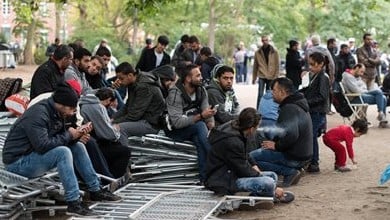
Israelis generally support Germany’s welcoming of refugees from the Middle East, according to a new poll.
Fifty-six percent of Israelis said that Berlin’s acceptance of refugees from Syria positively influences their view of Germany, while 36% view the policy negatively, the survey, released last week, found.
A quarter of respondents said they have a “much more favorable” view of Germany due to the government’s intake of more than a million refugees, while 31% had a “somewhat more favorable opinion. Only 17% judge Germany “much less” favorably.
On Sunday, German Chancellor Angela Merkel’s center-right CDU party took heavy losses in three regional elections, presumably over her open-border policy. At the same time, the elections saw the steep rise of the anti-migrant Alternative for Deutschland party.
The country’s Jewish community has taken a somewhat ambivalent position on the refugee question, officially supporting Merkel’s policy and recognizing the moral imperative to help those in need, but at the same time remaining wary of anti-Semitic sentiment the migrants might import to Germany.
The survey, conducted in mid-February, found much Israeli sympathy for Germany in general and for its chancellor in particular. A quarter of respondents said they have “very favorable” view of the country. Nearly 45% have a “somewhat favorable” opinion of Germany, while only 26% hold negative views.
Asked which European country Israel should seek to have the closest relationships with, Germany came in at top place with 33%, followed by Great Britain (25%) and France (14%).
Sixty-six percent of Israelis could correctly answer — without any prompt — who the current German head of government is, and a large majority (61%) have a high or very high opinion of Merkel.
The chancellor is also the only European politician trusted by Israelis to contribute to a sustainable peace agreement between Israelis and Palestinians. Forty-two percent of respondents said she can have “a helpful effect” in that area, while only 10% said the same of UK Prime Minister David Cameron and 6% of French President Francois Hollande.
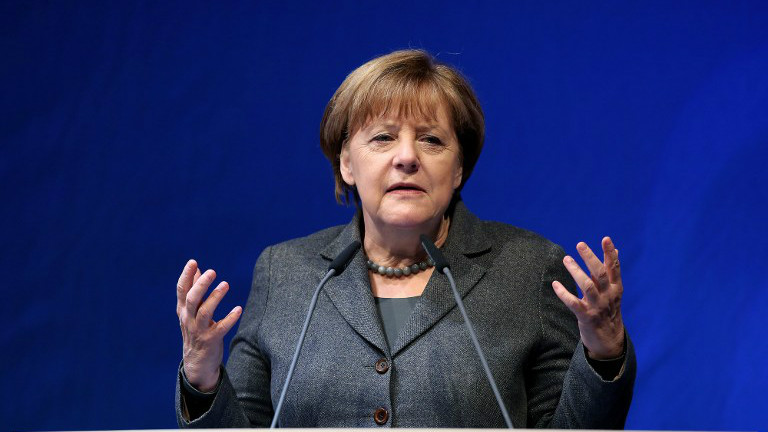
“This obvious admiration for Germany and the policy of the German federal chancellor led to an interesting discussion in Israel: Israeli journalists often point to the problematic dealings with asylum seekers in their own country (of all Western nations, it is Israel that has the lowest recognition rate of asylum seekers),” the poll’s authors write.
“In this context, Germany serves as a moral compass to which people can align themselves. Germany as a model example for humanity — in Israel such an assessment is nothing short of a miracle against the backdrop of our history.”
More Israelis think the relationship with Germany is based on common interests (39%) than a common history (34%). Only nine percent said that “common values” form the basis of the relationship.
Commissioned by the Konrad-Adenauer-Stiftung’s Israel/Palestine branch and conducted by Mitchell Barak’s Keevoon Research, Strategy and Communications Ltd., the poll is based on telephone interviews with 1,006 Israelis over the age of 18 and has a margin of error of 3.61%.







The Times of Israel Community.