

President Taft’s yo-yo diet has a modern feel, says historian
Medical historian Dr. Deborah Levine finds that like the obese leader, Jewish immigrants also ‘fat shamed’ in the 19th century
 Add ToI as a Preferred Source on Google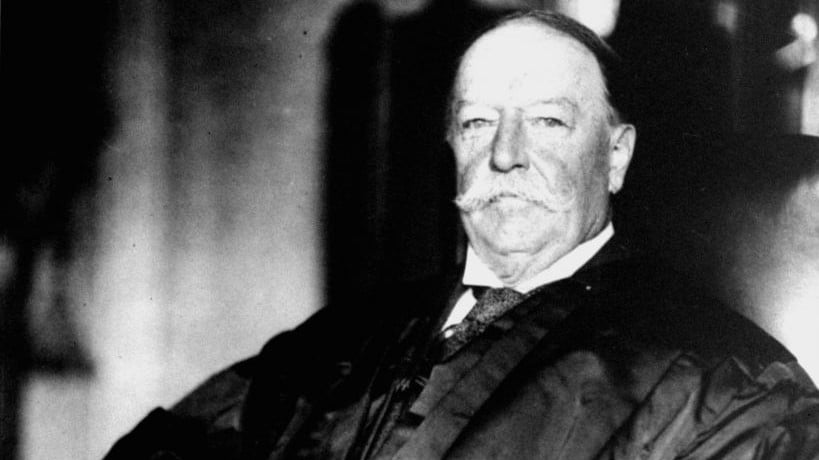
President William Howard Taft is probably the most high profile American of the early 20th century to get flack for his “corpulence,” but he was far from the only person of that era to be fat shamed. New research by Dr. Deborah Levine, a historian of medicine and science at Providence College, indicates that the massively obese president was in good company with lots of others — including Jewish immigrants.
Her report on Taft’s influence on the contemporary diet industry appears Monday in the journal Annals of Internal Medicine.
Levine, who is currently writing a book on the history of obesity in the United States from 1840 to 1940, has discovered that public concern about obesity is by no means a recent phenomenon. She found evidence that obesity and the American obsession over diet dates back to the mid 19th century, with some earlier evidence even going back as far as the 18th century.
A recent article in the New York Times focused on the discovery by Levine of extensive correspondence between Taft and his diet doctor, and how many of the weight loss methods Taft, the 27th US president (1909-13) was following are very similar to approaches used today.
However, in a conversation with The Times of Israel, Levine, 34, emphasized an interesting aspect of her historical research having to do with immigrants to the US early in the last century.

“By that time, obesity had been treated for several decades already as a medical issue,” Levine noted. “And interestingly, scientists were writing about their concern about the diet habits of immigrants, especially those from southern Europe and the Mediterranean, as well as about Jewish immigrants.”
It turns out that physicians and scientists who focused their attention on the influx of humanity arriving at New York’s settlement houses and the New York Diet Kitchen Association, were far from fond of immigrants’ body types (apparently rounder than Americans’).
“This was an era when eugenics were on the rise, and there was this notion that immigrants would pollute the American body.”
In reality, the majority of immigrants showed up at America’s shores practically starving, but still, the medical doctors and researchers managed to connect them to obesity. With the rise of the managerial class, middle-class Americans were becoming overweight.
“Basically, the doctors were worried that the middle class would become too obese for their jobs, and the immigrants would steal them away from them,” Levine explained.
She found plenty of examples of scientists writing about immigrants’ ways of eating and encouraging the new arrivals to adopt a more “modern” American diet. Efficiency of diet was what they were preaching. They counseled immigrants to spend less money on food, and tried to convince them that healthy fare equaled bland fare.
“They just couldn’t understand why a Jewish immigrant would want to spend her money on a kosher chicken, or on spices to make a traditional dish from the old country.”
Of course, it’s those Jewish immigrants who have had the last laugh. As we all know, bagels, lox, pastrami, matzo ball soup, challah, rugalach and many other Jewish delicacies have gone mainstream — and are now enjoyed by Americans of all backgrounds — not to mention all shapes and sizes.
Monday’s report offers a rare peek at the history of obesity, through the experiences of one of the first American public figures to struggle openly with weight — and how a doctor aided in an era when physician treatment of obesity was just emerging.
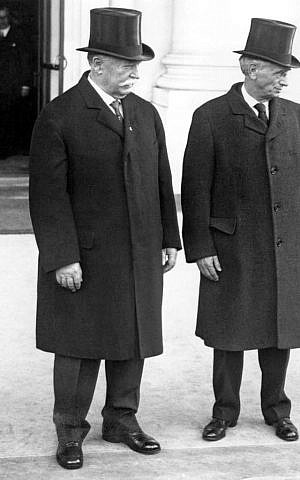
Taft’s “rise to political power coincided with this change in medical thinking, which led to the first celebrity weight loss patient,” said Levine.
History buffs know Taft is the only president-turned-Supreme Court chief justice. But he’s also remembered as the president whose weight, at times well over 300 pounds, made headlines.
Taft hired British dieting expert Nathaniel Yorke-Davies in 1905, four years before becoming president. Then 314 pounds, Taft was worried about heartburn and other health problems — he was famously fatigued, presumably from obesity-caused sleep apnea — and possibly also about his career, Levine wrote.
The candid exchanges between doctor and patient highlight the ups and down of weight loss.
“I feel in excellent condition. I used to suffer from acidity of stomach, and I suppose that was due to overloading it,” Taft wrote at one point.
Yes, obesity rates have surged to epidemic levels over the past few decades. But waistlines actually began to expand in the mid-19th century, as food became easier to cultivate and distribute. Diet books and pamphlets began flourishing. Where women’s corsets offered some tightening, Levine says obesity belts were developed for men.
Even then it was clear there was no quick fix. And if you think high-calorie restaurant food is only a recent problem, well, Taft wrote a relative that all the formal dinners required in politics sabotaged his efforts. In his first year with Yorke-Davies, Taft lost 59 pounds, Levine found, only to regain it. Only after leaving the White House did Taft shed significant weight and keep it off, with help from a different doctor, she noted.
Yorke-Davies had written a popular diet book, “Foods for the Fat: A Treatise on Corpulency and a Dietary for its Cure.” He and Taft had a long-distance relationship. The doctor mailed a three-page list of allowed and forbidden foods — heavy on lean meats and reducing sugar, almost a prelude to the Atkins diet. Taft was to weigh himself daily and mail a weekly report.
Levine compared the handwritten weigh-ins and the typed letters to the doctor. Sometimes Taft cheated.
And Yorke-Davies nagged, politely, but a lot. One month the doctor fussed that Taft’s weight loss was only 9 pounds, not the intended 14. When Taft slacked off, the doctor wrote that he’d heard “you are much stouter than you were a few months ago.”
Levine concludes that some core practices — close doctor-patient communication, tracking weight and food diaries — still are in use.









The Times of Israel Community.