German prosecutors call Thursday for the case of a 96-year-old former Nazi medical orderly at the Auschwitz death camp to be thrown out because he was deemed unfit for trial.
Hubert Zafke had faced charges of 3,681 counts of being an accessory to murder in the concentration camp in Nazi-occupied Poland.
But concerns over his mental and physical health had led to repeated postponements of the trial, which began in February 2016 in the northeastern lakeside town of Neubrandenburg.
Stefan Urbanek, a spokesman for the regional prosecutor’s office, says in a statement that medical evaluations in March and July this year had found the wheelchair-bound Zafke “unfit to stand trial.”
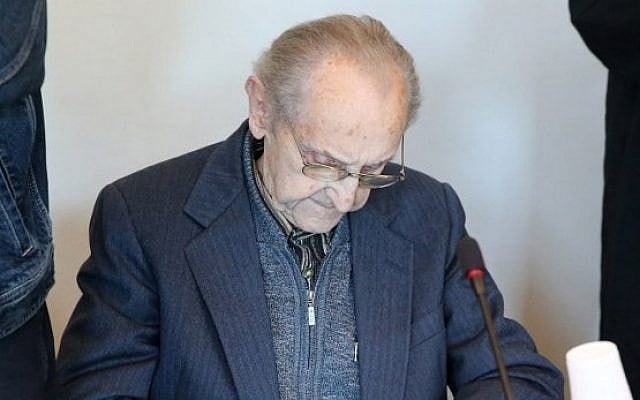
Former SS medic Hubert Zafke, 95, accused of aiding in 3,681 murders in Auschwitz in 1944, attends his trial on September 12, 2016 at the court in Neubrandenburg, Germany. (AFP/dpa/Bernd Wüstneck)
“The experts reached this conclusion after having diagnosed dementia in October 2015, leading to a determination that Zafke could only stand trial on a limited basis,” Urbanek says.
“Now the dementia has reached a severity that the defendant is no longer able inside and outside the courtroom to reasonably assess his interests or coherently follow or give testimony.”
Urbanek says prosecutors were required by law after receiving this independent medical evaluation to submit a motion to dismiss the case.
Proceedings against Zafke, a farmer’s son who joined the Nazi party’s elite police force the Waffen-SS at age 19, had already been halted last October following complaints that the judges were biased.
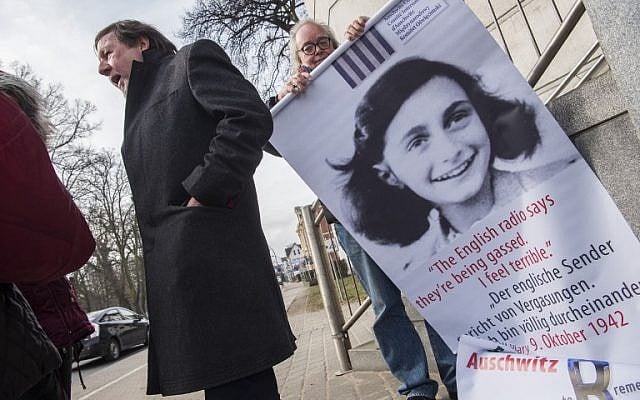
An activist with the International Auschwitz Committee rolls up a poster featuring Holocaust victim Anne Frank outside the regional court of Neubrandenburg during the first day of the trial against former SS medic Hubert Zafke, accused of aiding in 3,681 murders in Auschwitz in 1944, on February 29, 2016. (AFP/John MACDOUGALL)
The charges against Zafke focused on a one-month period in 1944 when 14 trains carrying prisoners — including the Jewish teenage diarist Anne Frank — arrived at Auschwitz-Birkenau. Frank, who arrived in Auschwitz with her parents and sister, was later transferred to another camp, Bergen-Belsen, where she died in March 1945, just two months before the Nazis were defeated.
— AFP
Help us report truthfully on social media
As a multimedia journalist, my job is to take the quality, fact-based journalism produced by The Times of Israel newsroom and make it accessible across every platform — from Instagram posts to podcasts to short-form videos.
This is how many, especially young people, consume news these days. But misinformation is rampant on social media. Our team at ToI produces accurate, responsible short-form reporting on Israel and the Jewish world.
If you believe in the importance of factual social media journalism, please consider joining our reader support group, The Times of Israel Community. Your financial support is essential to sustain responsible multimedia reporting.
We’re really pleased that you’ve read X Times of Israel articles in the past month.
That’s why we started the Times of Israel - to provide discerning readers like you with must-read coverage of Israel and the Jewish world.
So now we have a request. Unlike other news outlets, we haven’t put up a paywall. But as the journalism we do is costly, we invite readers for whom The Times of Israel has become important to help support our work by joining The Times of Israel Community.
For as little as $6 a month you can help support our quality journalism while enjoying The Times of Israel AD-FREE, as well as accessing exclusive content available only to Times of Israel Community members.
Thank you, David Horovitz, Founding Editor of The Times of Israel


 From the Liveblog of
Thursday, August 31, 2017
From the Liveblog of
Thursday, August 31, 2017
 Add ToI as a Preferred Source on Google