

Man or woman? New Israeli tech uses smartphones to find out
A new algorithm developed at Ben Gurion University can give marketers gender data they need, while being less invasive
 Add ToI as a Preferred Source on Google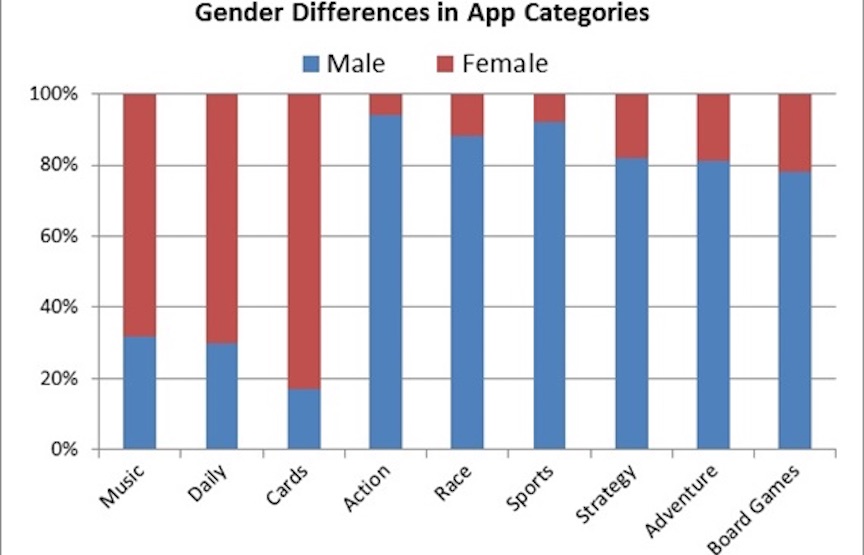
Are men and women really different? Most certainly, at least when it comes to how they carry and use their cellphones. A new technology developed by Ben Gurion University Department of Information Systems Engineering’s Dr. Asaf Shabtai and student Itay Hazan uses sensors already built into most smartphones to figure out whether its owner is a man or a woman.
In addition, information on gender can be garnered from how many apps users have on their devices, how “heavy” (in megabytes) those apps are, and what type of apps they’ve downloaded.
It sounds creepy, but it’s a far less invasive way for marketers to figure out who they are selling to than the current methods.
“Rather than have users reveal their preferences, inferring gender through the mobile device automatically helps replace older methods, such as text analysis,” the system’s authors said. “The average user would not be inconvenienced if an app were to measure the device’s position every so often in order to predict the user’s gender.”
The full method and results were presented last week at the annual MobileSoft2015 conference for mobile research and development held in Italy last week.
To the chagrin of many, privacy is almost a thing of the past. Marketers are going to market, as sure as the sun is going to come up tomorrow. The question for their “targets” – those of us who are not marketers – is how aggressive will they be?
For most marketers, the answer to that question is “as aggressive as we need to be.” There’s a lot of competition for business, and every customer counts – and if it takes invasive tactics to determine the identity, location, physical characteristics, and other features of customers, then that’s what they’ll do.
To get that information, marketers install cookies, trackers, beacons, and all sorts of other “innocuous” software that can inform them of everything they need to know in order to enable them to sell – who’s buying, what they’ve bought, where they’ve surfed, what interests them, etc.
With that information, marketers can build a remarkably accurate profile – to the extent that companies like Google are able to build a dossier that allows them to target ads specifically to each user, making them more “relevant” for the advertiser and recipient.
But with Shabtai and Hazan’s system, marketers will be able to dispense with at least some of the invasive activity and use the physical movements of a device to determine who owns it. The new algorithm – which the team plans to release for use by developers – uses information collected by existing sensors (such as motion sensors that detect user movements) which are accessible by any application to predict the phone owner’s gender (assuming the owner is the one using it most of the time).
In addition, the system examines the types of applications installed on the device which do not require any permissions on the part of the user. Android OS divides applications into 40 categories by type, such as sports, games, navigation, music, etc.
The prediction is about 80% accurate initially but improves over time and usage to 92%, and is completely transparent to the app user and the application programmer alike, enabling any application to obtain the most important demographic feature of the user without invading their privacy.
After testing their methods on actual devices, the pair discovered changes in patterns of use among men and women that were previously unknown. For example, men tend to download more apps overall, relatively heavier apps (50Mb+), and more paid apps as well. By combining these algorithms and more, any app builder could infer the user’s gender in a way that is fast and highly accurate without demanding permission to access the user’s private data, they said.
Once the information is processed and summarized correctly, machine learning algorithms are able to draw an imaginary circle and separate different groups, in this case men from women; movement can be used to infer other information, but that’s for future development, the team said.










The Times of Israel Community.