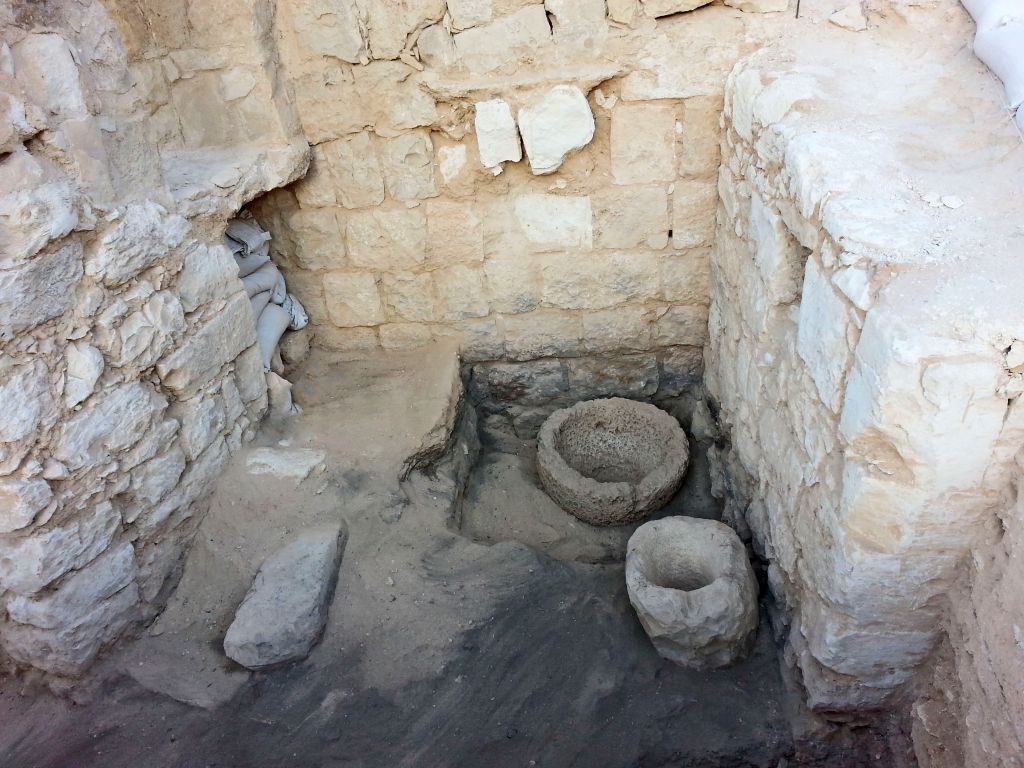
The stable’s interior. The round stone basins were apparently used for storing food and water for the animals (Israel Antiquities Authority/Courtesy)
A 1,500-year-old stable believed to have been demolished in an earthquake was unearthed by an archaeological team in the Negev desert and identified by a meter-thick layer of animal manure at the site, the Israel Antiquities Authority said on Thursday.
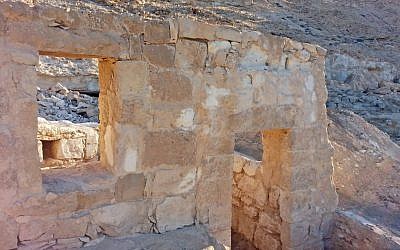
According to a statement from the IAA, the Byzantine-era stable in the Avdat national park was discovered within a cave, which was split into several rooms. Paintings of crosses were found on the walls of the cave, apparently used by monks.
The team also found stone basins thought to be used to feed the animals in the stable. The researchers were able to confirm the site was a stable due to the large quantities of donkey, sheep, and goat manure in the area.
“The identification as a stable was corroborated by an almost 1 m thick layer of organic matter (donkey, sheep and goat manure) on the floor of the building. It seems that the place was destroyed by an earthquake that decimated the city of Avdat in the early seventh century CE,” the statement said.
A 1,500-year-old stable is unearthed in the Avdat national park (Israel Antiquities Authority/Courtesy)
The excavation was led by Professor Scott Bucking of DePaul University and Dr. Tali Erickson-Gini of the Israel Antiquities Authority.
Get The Times of Israel's Daily Editionby email and never miss our top stories
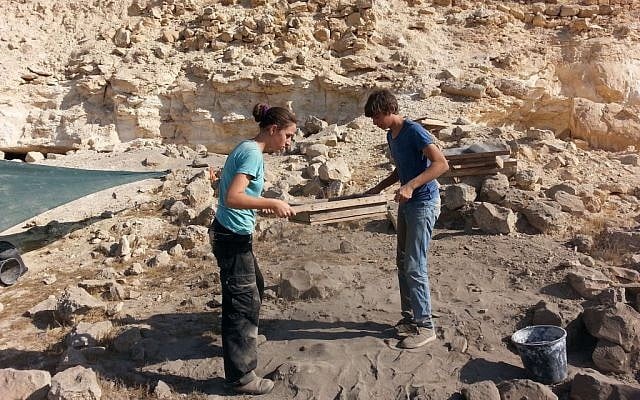
Students from the Har Hanegev Field School sifted through the materials and found grape seeds, which are expected to shed light on the eating habits and agriculture of the locals.
Students of the Har Ha-Negev Field School at work and sifting organic matter at the Avdat national park (Israel Antiquities Authority/Courtesy)
“The researchers hope that the grape seeds they found, which were well-preserved because of the dry conditions that prevail in the region, will allow them to extract the DNA of the ancient plant and identify the different species that were grown in the area,” the statement said.
Advertisement
Help us report truthfully on social media
As a multimedia journalist, my job is to take the quality, fact-based journalism produced by The Times of Israel newsroom and make it accessible across every platform — from Instagram posts to podcasts to short-form videos.
This is how many, especially young people, consume news these days. But misinformation is rampant on social media. Our team at ToI produces accurate, responsible short-form reporting on Israel and the Jewish world.
If you believe in the importance of factual social media journalism, please consider joining our reader support group, The Times of Israel Community. Your financial support is essential to sustain responsible multimedia reporting.
We’re really pleased that you’ve read X Times of Israel articles in the past month.
That’s why we started the Times of Israel - to provide discerning readers like you with must-read coverage of Israel and the Jewish world.
So now we have a request. Unlike other news outlets, we haven’t put up a paywall. But as the journalism we do is costly, we invite readers for whom The Times of Israel has become important to help support our work by joining The Times of Israel Community.
For as little as $6 a month you can help support our quality journalism while enjoying The Times of Israel AD-FREE, as well as accessing exclusive content available only to Times of Israel Community members.
Thank you, David Horovitz, Founding Editor of The Times of Israel


 Add ToI as a Preferred Source on Google