

NJ Jews and refugees break bread and barriers at Syria Supper Club
After a year of volunteering with asylum seekers, a pair of Jewish friends leverage their ‘baklava bellies’ into a grassroots social initiative
 Add ToI as a Preferred Source on Google
Renee Ghert-Zand is the health reporter and a feature writer for The Times of Israel.
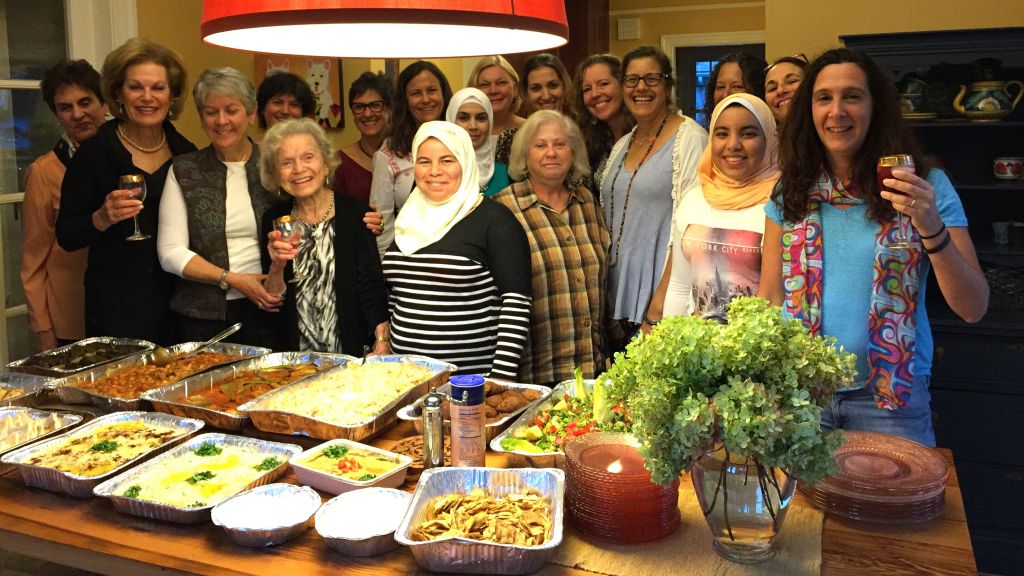
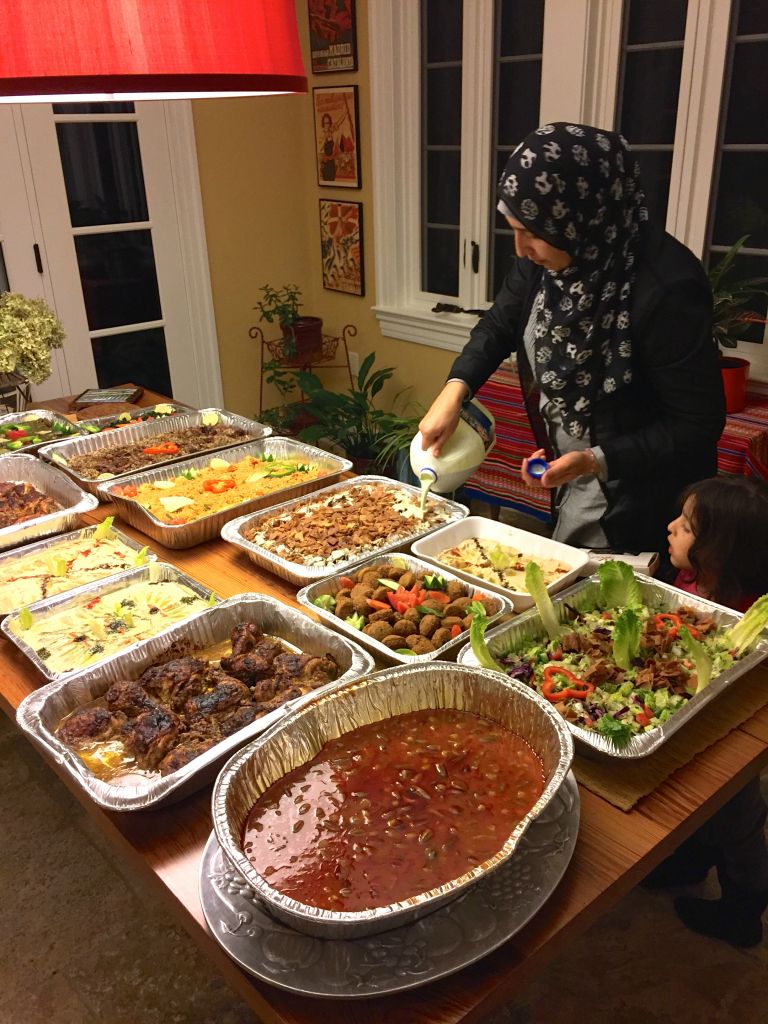
Pop-up supper clubs are trending on the contemporary culinary scene. In New Jersey, the Syria Supper Club is proving a hit for reasons well beyond the food. Hosted by members of the Jewish community and catered by recently arrived Syrian refugees, the ongoing series of meals allows new neighbors to break bread — and social barriers.
Friends Kate McCaffrey and Melina Macall, both members of the Reconstructionist-affiliated Bnai Keshet synagogue in Montclair, New Jersey, conceived of the supper club last fall. What started in September as a few Middle Eastern-flavored dinners in the women’s homes has now snowballed into a larger grassroots welcome wagon.
“We started the project in response to Islamophobia and hate language, and we used the tools we had to do it,” said Macall, who lives with her husband and four children in Montclair.
Macall is a food justice activist who runs an organic food coop. McCaffrey, a married mother of two from Maplewood, New Jersey, is a Montclair State University anthropology professor who researches new immigrants. The pair finds their perspectives complimentary.
After New Jersey Governor Chris Christie informed then-president Obama in November 2015 that he was no longer willing to have his state participate in the US refugee resettlement program, the friends decided to help newly arrived Syrian asylum seekers.
“When the governor said that no Syrian refugee should be allowed in because even a five-year-old was a terrorist risk, he didn’t speak for me — or for many of us,” Macall told The Times of Israel.
A year prior to forming their supper club, McCaffrey and Macall had already begun assisting Syrian refugees in nearby Elizabeth: After seeking the advice and support from Rabbi Elliott Tepperman at Bnai Keshet, Jewish refugee organization HIAS and local Muslim organizations, McCaffrey organized a couple dozen volunteers to provide tutoring to refugee children. Independently, Macall spearheaded a Muslim-Jewish Chinese food dinner on Christmas 2015 at Bnai Keshet for 180, including 50 refugees.
‘Every time we visited a refugee family, we were hauled to the table to eat’
After the Christmas dinner, the two women combined efforts to raise funds for a Syrian family from Daraa “adopted” by their synagogue. McCaffrey and Macall felt strongly that the best way to help Maryam and Fadel Al Radi and their children was to help them repay the $7,000 relocation and transportation loan they owed the US government.
“We weren’t going to do a sock drive or something patronizing like that. That’s insulting to the family. By removing the travel loan, we would be putting money back into the family’s budget,” Macall said.
“We didn’t want to do a social service thing. We wanted to do something that made a political statement, and that was replicable. It’s unbelievable that a shellshocked refugee family struggling to adjust to a new life is expected to pay back $7,000,” McCaffrey said.
The women launched the fundraising drive for Passover 2016, with the goal of raising $1,000 for each day of the holiday. They ended up raising the entire amount in 72 hours.
Next was a collaborative project with Carole Schwartz from Temple B’nai Abraham in Livingston, New Jersey, to subsidize day camp tuition for 20 refugee children at the Elizabeth YMCA.
But as summer came to a close, the women’s jokes about their “baklava bellies” and the “kibbeh kilos” they had gained from Maryam and other refugee women’s delicious food sparked the idea for the supper club.
“Every time we visited a refugee family, we were hauled to the table to eat. The value and pride in hospitality was already there, and it was something that was instantly transferrable,” Macall said.
The offer of a paid cooking gig was warmly welcomed by the refugee women, who have struggled to learn English and find work.
‘I’ve made lots of Jewish and Christian friends. The most important thing is to treat people with respect’
A few months later and today you’ve got to move fast if you want a place at one of the Syria Supper Club’s tables.There were 15 events (some co-ed, some women-only) in January alone, and an online schedule and sign-up form indicates the pace will not let up in the months ahead.Through May, the dinners of beautifully presented dishes like tabouleh, hummus and stuffed grape leaves are no longer available.
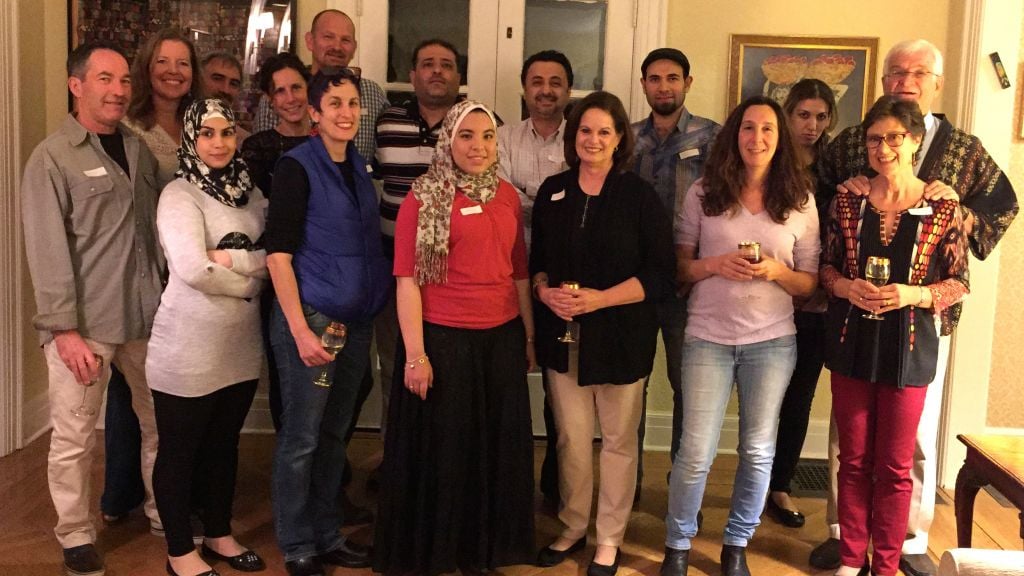
Each dinner is attended by a host who must have been a guest at a previous dinner. There are 10-12 guests, an interpreter or two, and the Syrian cook, her spouse, and a couple of her Syrian friends. The guests pay $50 a head, which goes to the cook to reimburse her for food costs and in recognition of her time and talents.
Social isolation is a major issue facing refugees. While the dinners are a way for the Syrian women to make a little income, they are perhaps even more importantly a way for them to meet Americans, as well as one another.
“It’s a good initiative. There are women who can’t leave the house because they don’t speak the language, so this helps them with the language,” said Khlood Alnablise, a 37-year-old refugee from Daraa who arrived two years ago with her husband and child.
“The people I’ve met at the dinners are good, kind people who support us and are sympathetic towards us,” added Alnablise, who cooked for a recent dinner.
‘It’s better to struggle to communicate in a warm, welcoming environment like this one than in some cold bureaucratic office’
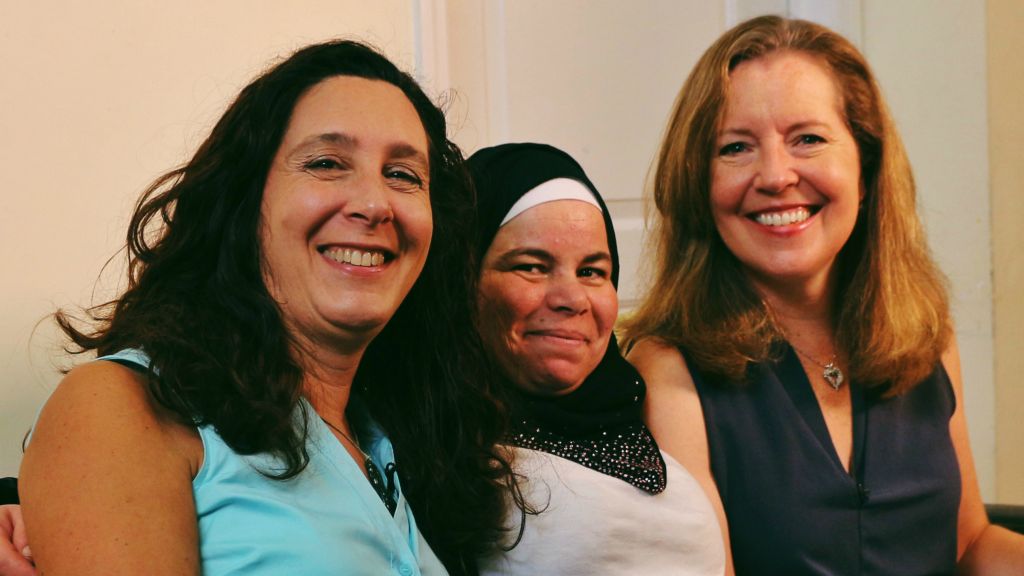
Maryam Al Radi, 40, has become close with McCaffrey and Macall. She said she has enjoyed getting to know Americans of different faiths.
“I’ve made lots of Jewish and Christian friends. The most important thing is to treat people with respect,” said Al Radi.
A couple of young adult refugees from Iraq, a brother and sister, met a group their age from New York City who came to one of the recent dinners.
“It was anything but a pity fest. They all got along great and now this brother and sister have some new friends to hang out with,” Macall said.
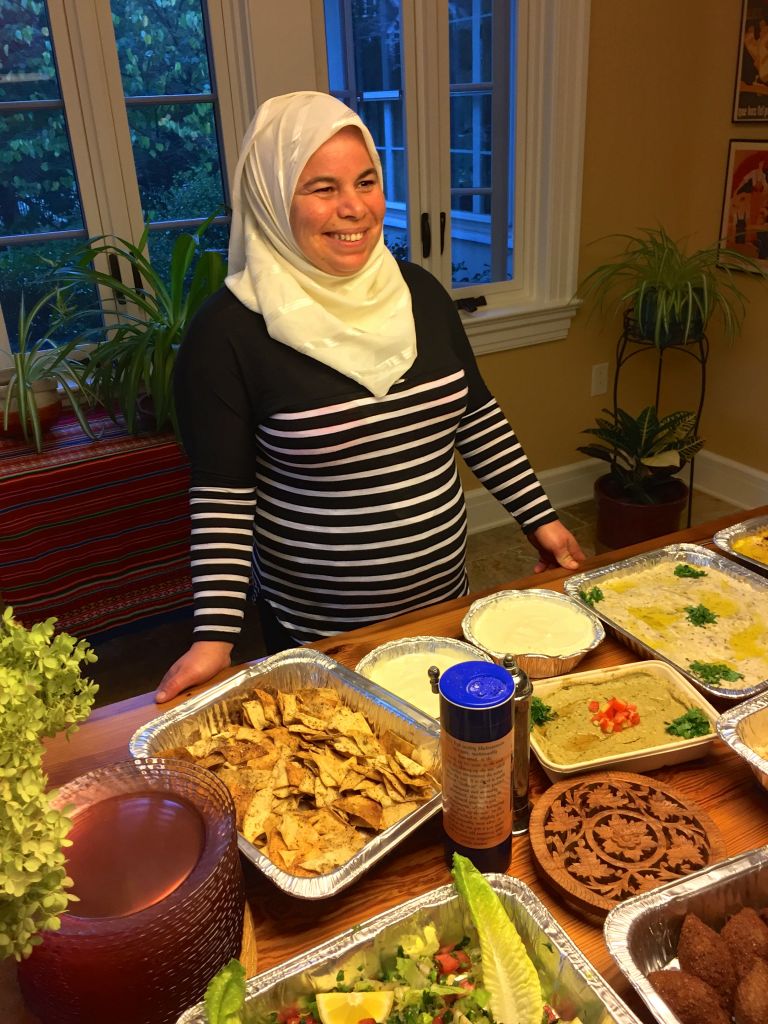
Even when not every word is understood, the Americans and Syrians manage to communicate well enough. The interpreters help, and thankfully Google Translate is only a fingertip away.
“In any case, it’s better to struggle to communicate in a warm, welcoming environment like this one than in some cold bureaucratic office,” Macall said.
In fact, groups of supper club guests have stayed in touch and formed action groups to help refugee families deal with bureaucratic red tape. In one case, they are helping a family negotiate a payment plan for an electric bill. Another group is helping a family sort out car insurance issues.
“The social safety net is so weak, especially when it comes to translation services,” McCaffrey said.
The Syria Supper Club started out as a way for Macall, McCaffrey and their friends to fulfill the Jewish commandment to welcome the stranger. In recent weeks it has taken on a political imperative, as well.
Macall hosted a dinner at her home on January 28, the day after President Donald Trump signed an executive order barring travelers from Iran, Iraq, Libya, Somalia, Sudan, Syria and Yemen from entering the US for 90 days. The order, which has been temporarily blocked by federal court orders, bars refugees for 120 days and bans refugees from Syrian indefinitely.
The group gathered that evening acknowledged the travel ban, but did not let it interfere with their goals: to “make contact, communicate, share hospitality and affirm basic humanity,” Macall said.
Translator Talia Ne’eman contributed to this article.







The Times of Israel Community.