

No gas, no problem at Israel alternative fuel expo
From fuel-efficient cars to electric planes, hundreds of companies unveil their energy-saving vehicles at Fuel Choices Summit
 Add ToI as a Preferred Source on Google
Melanie Lidman is an AP reporter and former Times of Israel reporter

What would a world look like without fuel? Tel Aviv caught a glimpse of a fuel-less utopia filled with silent electrical bicycles, cars, buses and even airplanes on display at Tel Aviv’s Habima Theater this week for the annual Israel Fuel Choices Initiative Summit.
The initiative, sponsored by the Prime Minister’s Office, aims to connect government ministries to startups and corporations involved in finding alternative fuels.
“We want to reduce 60% of fuel use by 2025, turn Israel into a center of technology, and build global cooperation for the same goal of reducing fuel use,” said Eyal Rosen, head of the Fuel Choices Administration, a division of the Prime Minister’s Office. With its NIS 1.5 billion ($400 million) budget, the six-year-old department supports more than 200 research groups and has overseen an increase in the number of fuel-related startups from a few dozen to more than 500.
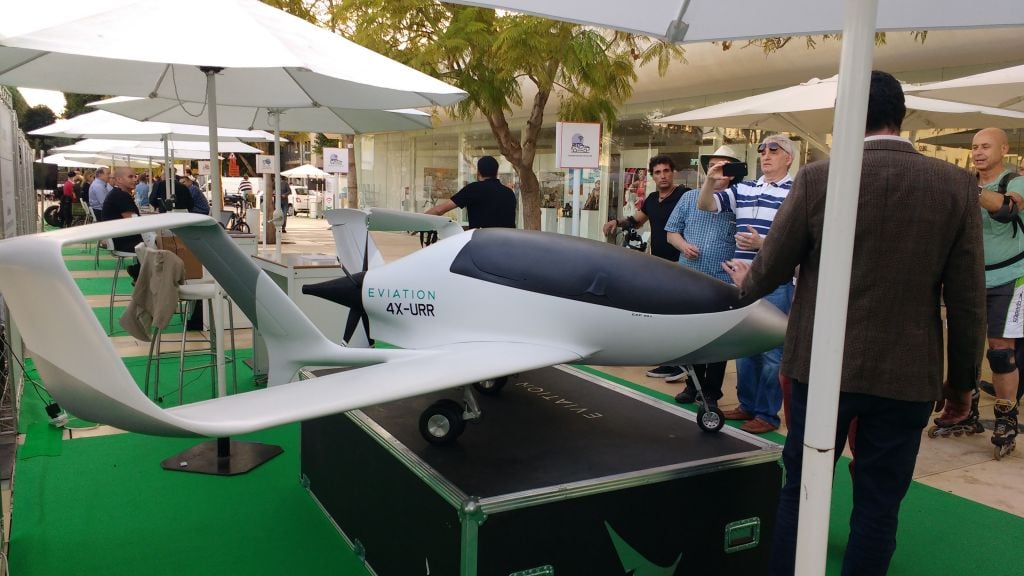
At the summit the Habima courtyard was filled with a smorgasboard of electric scooters and bicycles, a prototype of a car that is as thin as a motorcycle, and even a completely electric airplane, which is expected to start production in the coming year.
“We stand at the cusp of an energy revolution,” Prime Minister Benjamin Netanyahu said in a video address to the summit. “The monopoly of crude oil will end, and as a result, we’ll have a safer, cleaner, more sustainable world.”
One of the biggest announcements at the event was the unveiling of a market-ready Fiat 500 that will use a combination of gasoline and 15% methanol, known as M-15. In the US, there has been more emphasis on making ethanol-gasoline blends, although ethanol is more expensive than gas and requires food resources such as corn that could otherwise go towards feeding people.
While the new Fiat 500 that was specially developed to run on M-15 gas, the fuel blend will also be suitable for most cars, according to Ganit Shter Bar Joshua of Dor Chemicals, which developed the fuel blend. Bar Joshua recommends that drivers check with their car manufacturer before using the M-15 fuel, which will be available at gas stations across Israel starting in 2017.
The M-15 gas will be approximately 30 agorot less per liter than standard gasoline. As technology improves, cars in the future will be able to run on much higher ratios of methanol, which will further lower the cost per liter and a car’s carbon emissions.
China has already developed M-85 and even M-100 fuelled cars, which run on 85% and 100% methanol, respectively, though the cars do not meet European emission standards.

Virgilio Cerutti, vice president of business development for Fiat Chrysler Automobiles, said the company strategically chose to target Israel for the new Fiat 500 M-15, which is expected to cost about NIS 90,000 ($23,600) and will be available next year.
“Israel specifically can be a lab before being a market,” said Cerutti, citing its size and commitment, both governmental and private, towards finding fuel alternatives.
For anyone with a bit more cash in need of something flashier than a Fiat, the EViation company is offering a fully electric aircraft at a cost of $1 million. The plane will be able to carry six passengers up to 1,000 km (620 miles), and is being developed from the beginning with an automation feature that will allow the aircraft to fly without a pilot. Full-scale construction will begin in 2017 and the company expects the maiden flight to be in the second half of 2018.
Rosen knows most of the 400 companies at the summit will probably fail before they bring about world-changing advances that will break the world’s dependence on fuel, but he is optimistic that the answer is out there.
“The transportation market globally is $9 trillion, and the energy market is $6 trillion,” he said. “The geopolitical implications you see around us [from oil] are not esoteric. If the world stops using oil, the implications in Israel will be huge, a hundred fold over our investment.”







The Times of Israel Community.