

Nothing new under the gun
Pundits don’t predict much will change after Russia’s ambassador was assassinated in Turkey, and papers show they are still willing to jump to assumptions about what is terror
 Add ToI as a Preferred Source on Google
Joshua Davidovich is The Times of Israel's Deputy Editor
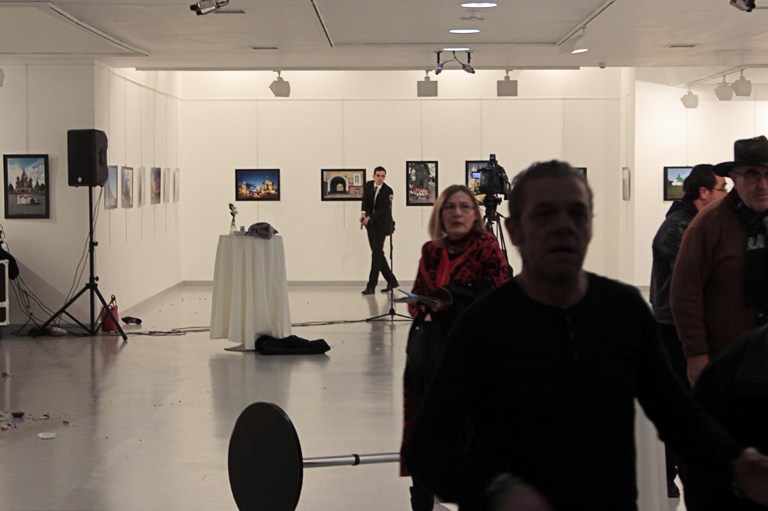
It would be convenient to say that it’s fitting that two high-profile attacks to occur within hours of each other Monday night came on the same day the Merriam-Webster dictionary anointed “surreal” as the word of 2016.
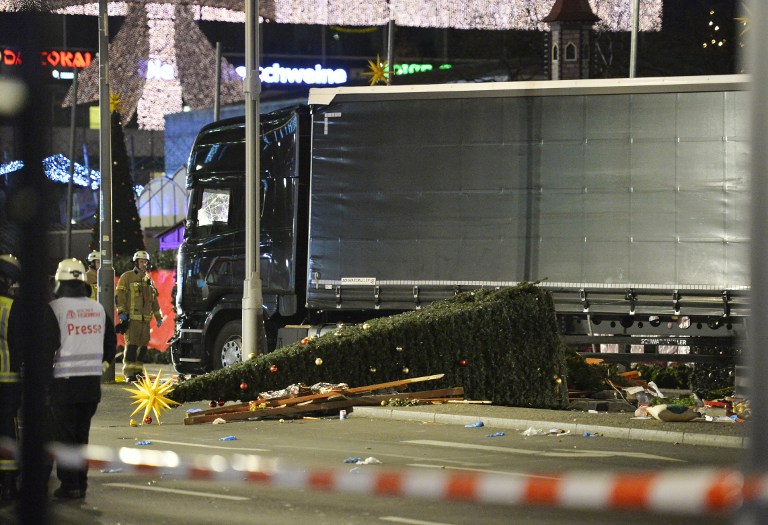
The fact is, though, that while the circumstances of the assassination of a Russian ambassador in Ankara and a truck-ramming attack in Berlin were uniquely of this year, their surrealism – the Dali-like quality of seeing the mod-looking assassin yelling above his victim as cameras clicked away and the tractor trailer stopped amid crushed Christmas trees and other carnage – were unfortunately nothing new.
New, no, but they were news, even as papers in Israel went to bed Monday night without sure-fire confirmation the truck crash in Berlin was a terror attack.
There was less uncertainty about the assassination of Russian Ambassador Andrey Karlov at an art gallery opening attended by several media outlets.
An astounding picture of killer Mevlut Mert Altintas, pointing his finger in the air while yelling and holding a pistol in the other hand, captured by AP photographer Burhan Ozbilici moments after the shooting, graces all three of Israel’s top dailies Tuesday morning, as it will likely grace most front pages around the world and history books for years to come.
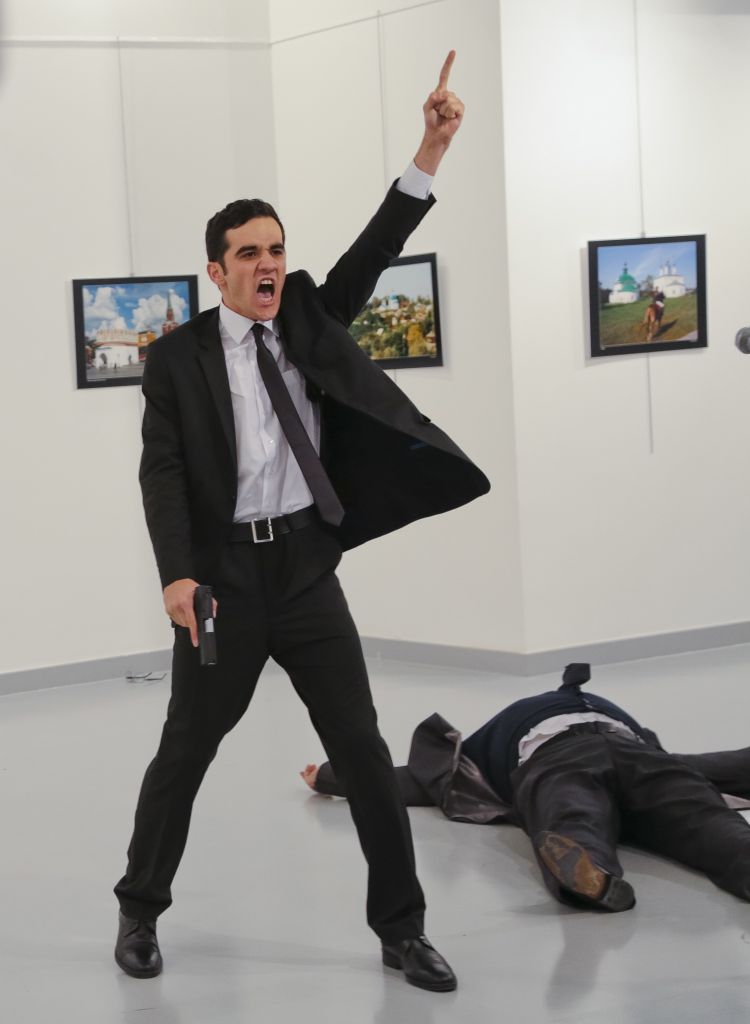
With Altintas yelling about revenge for Aleppo, there is also little left to wonder in the papers about the motivation behind his murderous act, and in Yedioth Ahronoth, analyst Ronen Bergman notes that the message should reverberate from Kaliningrad to Kamchatka.
“In the old days of the KGB that [Russian president Vladimir] Putin came from, it would have been possible to hide an incident like this, harming Russian pride, from citizens back home. Today that’s impossible. The proud Russians understand that Putin’s actions in Syria caused someone to stand up and do something. Putin can maybe cow [Turkish President Recep Tayyip] Erdogan, and win a president in the White House who owes him thanks, but he can’t control the whole population of the Middle East,” he writes. “The more Putin continues to meddle in the region he will learn, as other leaders have, that the painful price to pay for getting involved will only grow.”
Yet even if Boris Q. Public gets the message about Syria, analysts in Haaretz and Israel Hayom are united behind the idea that the assassination won’t affect ties between Ankara and Moscow, which seeks Turkish support if it hopes to keep Assad in power, at least for a transitional period.
“Despite their tepid diplomatic relations, the two countries have succeeded in building a reasonable basis for cooperation over the Syrian crisis in general, and Aleppo in particular. It was this cooperation that produced the ceasefire in Aleppo last week … The foreign and defense ministers of Russia, Turkey and Iran are scheduled to meet on Tuesday to discuss more effective ways to enforce the ceasefire agreement, and especially to broaden the options for besieged residents to leave and for humanitarian aid convoys to enter,” Haaretz’s Zvi Bar’el writes. “Russia seeks to bring … a few agreed-upon diplomatic facts to the table. The most important one is a Turkish-Iranian-Russian axis that speaks with one voice and adopts one slogan: The Syrian people will determine their future. Assad is still an option, in other words.”
In Israel Hayom, Boaz Bismuth commentates that more than not damage ties, the assassination will give Russia greater leeway to fight terror (i.e., Syrian rebels) in the region, and could even win it some brownie points too.
‘Now the Russians not only won’t be condemned but will win sympathy’
“Even before the assassination of the Russian ambassador, Moscow was the big winner in the Syrian war, after it didn’t hesitate to use force, sometimes exaggeratedly so. Now, after the assassination, the Russians not only won’t be condemned but will win sympathy,” he writes.
Bismuth also connects the assassination to the truck attack in Berlin, concluding that the world is a dangerous place. Indeed, while Haaretz displays typical German patience and states simply that “it’s not clear if it was an accident or a terror attack,” both Israel Hayom and Yedioth run with the assumption that it was terror, even though the incident was not a confirmed attack by the time editors sent their newspapers to the printing press.
Israel Hayom even goes so far as to cite false reports circulating late Monday night that the attack was claimed by the Islamic State.
Yedioth tries to straddle both sides of the fence, calling it “suspected terror” on the front page and a “Christmas attack” on page 2, riddling part of its reporting with question marks that ostensibly give it leeway to write whatever without knowing all the facts, but also writing sentences like, “The truck-rammer knew exactly where to carry out the terror attack.”
Given Israelis’ love for Berlin, the paper doesn’t have a hard time finding people in the city with what to say, and runs a column by Shir-Li Golan, whom the paper says was at the Christmas market.
Which is true, except she was there last week. No matter, Golan still describes the sinking feeling when reading the reports of the incident and puts herself in the shoes of those who were there and the dissonance created by the location of the attack.
“The gap between the lightness and beauty and the fear was surely experienced by those there last night,” she writes. “The understanding that there’s no place safe in this monstrous world we have here, not even in a city that does its best to commemorate the horrors of the past, to be a welcoming face for strangers, to give all who enter its gates freedom, and fun and much joy,” she writes.





The Times of Israel Community.