

Officials seek to calm public after algicides dumped at sea in bid to reopen desalination plants
Fishing temporarily banned ‘as a precaution’ but water supplies back to normal, says Energy Ministry, after initially unannounced push to get rid of rogue algae crippling stations
 Add ToI as a Preferred Source on Google
Sue Surkes is The Times of Israel's environment reporter
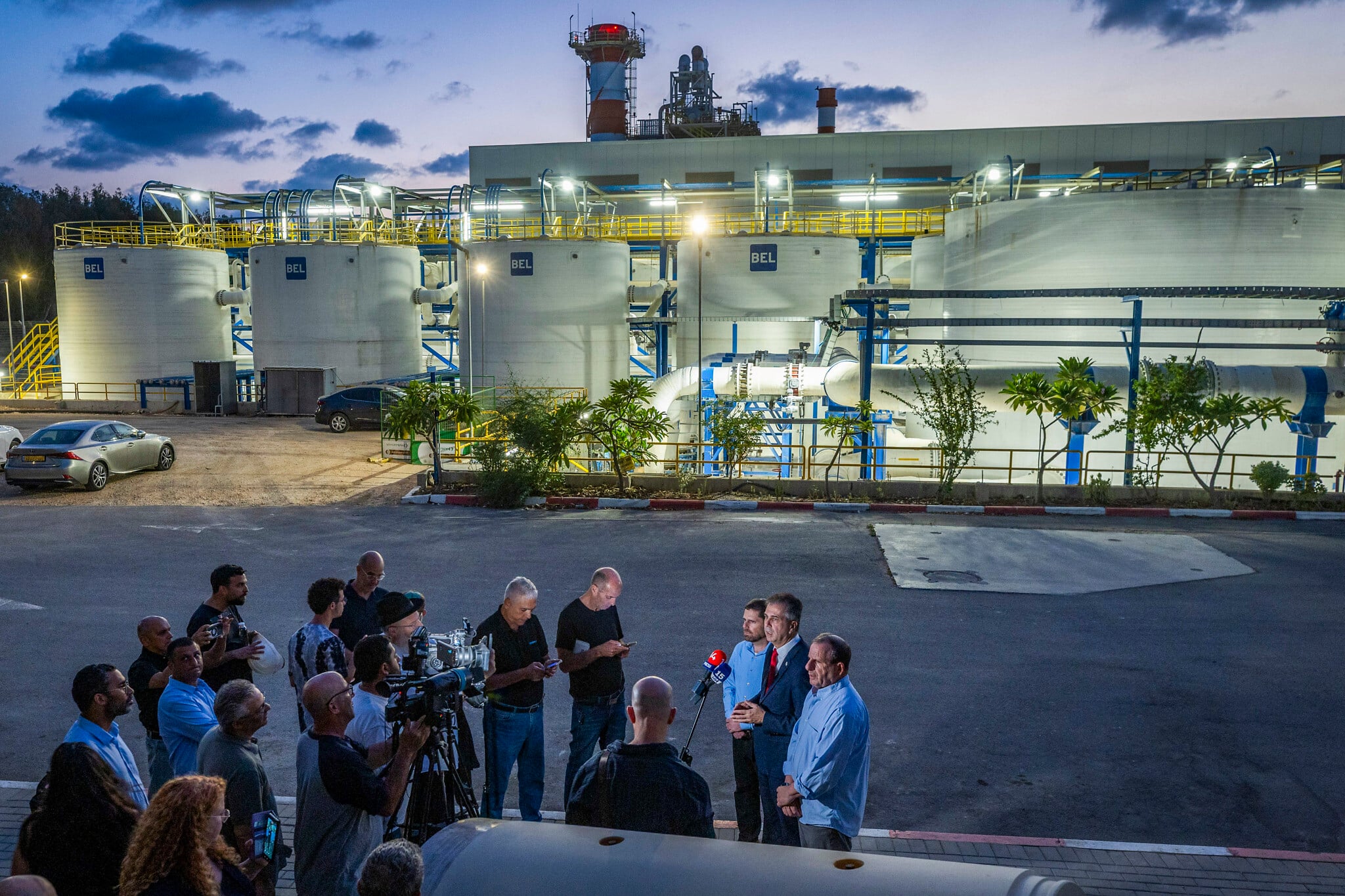
Authorities on Thursday and Friday sought to calm public concern over the risks of materials dumped about a kilometer (0.6 miles) off the southern Mediterranean coast to tackle algae that had days earlier forced five of Israel’s six desalination stations to shut down.
Channel 13 reported Thursday that, without initially informing the public, the Water Authority had dumped a cocktail of materials including large quantities of copper sulfate from the air along a nine-kilometer (5.6 miles) stretch of marine coastline.
The Health Ministry subsequently called for a temporary ban on fishing in the area, but emphasized that there was no proven risk, and that the ban was intended as a precautionary measure until further data was available. There is no ban on fish consumption.
The Energy and Water Ministry said in a statement that “the targeted dispersion of authorized substances in the sea was carried out with the approval of the interministerial Committee [for granting permits to dump substances] led by the Environmental Protection Ministry and the Health Ministry. The substances do not endanger bathers; environmental monitoring is currently underway in the area, and results are expected soon.” It added that potable water was “completely safe for drinking and household use without any concern.”
The Environmental Protection Ministry said the Health Ministry had reviewed the substances before and during the interministerial committee discussions, and that the committee had approved the request for “targeted activity, within a defined time and space, and subject to special and stringent conditions.”
It added: “The approval included restrictions on the location and method of substance dispersion, environmental monitoring and documentation, continuous tracking of current directions, and immediate cessation in the event of flow toward the shore or a risk of harm to wildlife.”
It added that the substances were applied in controlled quantities and designed to disperse and degrade rapidly in the water. Any future activity would be “professionally evaluated based on findings” and would require a new permit, it said.
However, Prof. Nadav Davidovitch, head of the School of Public Health at Ben-Gurion University, said that “the revelation regarding the dispersion of toxic substances near Israel’s coasts as a response to the algae crisis is further testimony to ongoing helplessness and crisis management in a firefighting mode, rather than a broad, in-depth vision that must focus on prevention and preparedness. Our growing reliance on desalinated drinking water brings numerous challenges, both in routine times and emergencies, certainly in light of climate change and the need to account for various environmental impacts.”
He continued that “neglect of the marine environment and the failure to address the root causes of pollution come back to bite us like a boomerang.”

Israelis depend on desalination for 80 percent of their potable water.
Five stations had been closed in an unprecedented move because of algae carried northwards on the waves from the Nile Delta.
The stations only returned to full operation on Thursday.
That came after local authorities suspended irrigation and other uses in public spaces countrywide, and temporarily halted water for southern farmers.










The Times of Israel Community.