

Palestinians protest PA prisoner payment reform, in apparent sign of implementation
Rallies staged in several West Bank cities over shift to stipends based on financial need instead of time served; Israel presents EU with dossier alleging reform not in place


 Add ToI as a Preferred Source on Google
Hundreds of Palestinians attended protests across the West Bank on Sunday against the Palestinian Authority’s new prisoner payment system. The public anger indicates that Ramallah is moving ahead with the Western-pushed welfare reform, after a series of illicit payments made under the old mechanism led to the firing of the PA finance minister last month.
Demonstrations were held in the cities of Ramallah, Tulkarem, and Nablus, with attendees including the families of prisoners, as well as relatives of individuals killed or wounded in attacks or clashes with Israeli forces.
Speakers at the rallies accused the PA of “criminalizing the Palestinian national struggle” and of trying to frame the stipends as welfare. The protests follow the reform signed by PA President Mahmoud Abbas in February, which requires that future payments be conditioned on financial need, rather than the length of a prisoner’s sentence.
The wife of one prisoner speaking at the Ramallah protest said her family, along with those of at least 1,612 inmates, had not received their monthly stipends in over eight months.
Israel has denied that the PA reform is in place, and its National Security Council dispatched a three-person delegation to Brussels in late November to make the case that payments have continued under the old system, which Jerusalem dubs “pay-to-slay,” accusing the PA of incentivizing attacks on Israelis.
The delegation handed over a “big dossier” of evidence, a European official told The Times of Israel, saying it was not a hard case to make, given Abbas’s firing of then-PA finance minister Omar Bitar for signing off on illicit payments made under the old mechanism.

The European Union is the largest foreign donor to the PA, but continued funds are linked to reforms by Ramallah, including of its prisoner payment system. “We are extremely unhappy after what happened last month. We are serious about the link of the EU money to their reform benchmarks,” the European official said.
A Western diplomat familiar with the matter told The Times of Israel that the evidence Israel presented falls short of a “smoking gun.”
Western countries are aware of the batch of stipends made last month that led to Bitar’s firing, but Israeli claims of a more widespread PA cover-up have yet to be proven, and a US-backed audit of the reform is expected to move ahead next year at Ramallah’s request, the diplomat said.
Recent weeks have seen an uptick in applications for welfare stipends through the revived National Economic Empowerment Institution known as “Tamkeen,” after initial months saw very little Palestinian buy-in to the unpopular reform, a PA official said.
‘A false impression of reforms’
The Foreign Ministry insisted on Tuesday that Israel’s intelligence makes clear that the PA’s “policy of payments to terrorists is still in effect.”
The ministry told The Times of Israel in a statement that the payments “are carried out through various channels designed to conceal their continuation, while creating a false impression of reforms for the international community.”
It claimed that the PA paid $144 million to the families of slain attackers last year and that Ramallah has earmarked roughly $214 million for such payments in 2025.
The Israeli statement referenced footage from October that purportedly shows individuals waiting in line for stipends at a branch of the Palestinian post office — the method of receipt for stipends under the previous pay-for-slay system.
The Foreign Ministry also referred to statements by Palestinian leaders in February 2025 in which they expressed their commitment to supporting prisoners just days after the new reform was announced that only allows for their continued payment if they are poor enough to be on welfare.
The Fatah Revolutionary Council pledged in a February statement to “redouble efforts to support and assist the prisoners… [and] renewed its firm commitment to provide sponsorship for the families of the martyrs, prisoners and wounded, as they are heroes of freedom and a top priority in protection and care.”
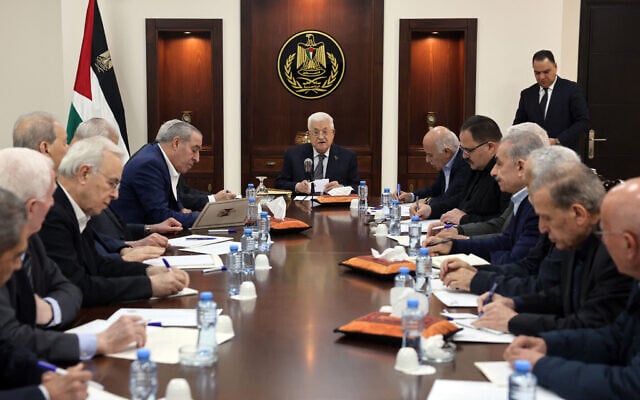
Three days later, Abbas himself said, “If we are left with only one penny, it will be given to the prisoners and the martyrs. I will not allow anyone — nor should you — strip any commitment, interest, or penny given to them. They must receive everything they received in the past, and they are more honorable than all of us.”
In September, though, Abbas told a UN conference that the PA is “establishing a unified social welfare system after the abolition of all previous payments to the families of prisoners and martyrs.”
Particularly unpopular time for reform
Those protesting on Sunday took particular issue with the PA advancing the new policy during a time of mounting allegations of mistreatment of Palestinian prisoners by Israeli authorities.
Israel’s own Public Defender’s Office said in a report earlier this month that Palestinian security prisoners have been held in increasingly dire conditions since the Hamas-sparked Gaza war, with many suffering from severe hunger.

On Sunday, the PA’s prisoner affairs office said that another Palestinian had died in the West Bank’s Ofer Prison, bringing to 86 the number of prisoners to die in Israeli custody since October 7, 2023.
The PA identified the prisoner as Sakher Zaghoul and said he had been under administrative detention since June. The practice is controversial, enabling the holding of suspects indefinitely without charge or due process, and Defense Minister Israel Katz halted its use against Jews. It has remained in place for thousands of Palestinians, however, in what opponents of the PA welfare reform argue further justifies robust support for prisoners.
Organizers of the Sunday protests said similar demonstrations would continue and expand in the coming weeks.
The West Bank is already on edge amid widespread IDF counterterrorism operations that have displaced tens of thousands living in refugee camps across the territory.
Meanwhile, the olive harvest season, which is seen as essential for the struggling Palestinian economy, has again been marred by unchecked Israeli settler violence.
IDF checkpoints, which Israel justifies as necessary security measures, have also mushroomed throughout the West Bank. These have placed significant curbs on Palestinian movement, with many preferring not to travel between cities, as commutes that once took 15 to 30 minutes now extend to several hours in bumper-to-bumper traffic.

Unemployment in the West Bank has also skyrocketed since October 7, with the IDF revoking work permits to an estimated 200,000 Palestinians, who had been employed in Israel, due to security concerns.
Additionally, Israeli limits on the banking sector have plunged the West Bank into a liquidity crisis, with Palestinian banks unable to offload excess shekels.
Smotrich approves 2-month extension to banking ties
Further complicating matters has been Finance Minister Bezalel Smotrich’s pushback against granting Israeli banks indemnity to conduct transactions with Palestinian ones.
Western countries have been pushing Smotrich to sign a waiver permitting such cooperation to continue for an extended period of time, concerned that allowing the old waiver to expire would risk collapsing the Palestinian economy, given that the Oslo Accords, signed in the 1990s, require it to run on the Israeli shekel.
But the far-right finance minister, who has spoken in favor of dissolving the PA and of Israel annexing the West Bank, has bucked international pressure and has only agreed to offer limited extensions, while insisting on measures to boost Israeli settlements in exchange.
As another indemnity waiver deadline was about to expire at the end of November, Prime Minister Benjamin Netanyahu sought to pass a cabinet decision that would strip Smotrich of his authority on the matter, an Israeli official told The Times of Israel, indicating that even the premier does not back the approach of his finance minister. However, Smotrich threatened to collapse the government, and Netanyahu backed off, the Israeli official said.

Smotrich did agree to sign a two-week extension, and, before that one expired on Sunday, a two-month extension to indemnity for Israeli-Palestinian banking transactions was signed, three officials from separate governments said. The Finance Ministry declined to comment.
The latest extension came as the Israeli cabinet voted on Thursday to grant official status to 19 illegal outposts in the West Bank, including two that were vacated 20 years ago under the so-called disengagement plan. The proposal approved by the government was crafted by Smotrich.
While the PA blasted the move along with Arab and European countries, which took issue with Israel further limiting West Bank land available for a potential Palestinian state, US Ambassador to Israel Mike Huckabee defended the outpost legalizations, arguing that Jerusalem was acting within its rights.








The Times of Israel Community.