

Politicians unite to fight graft. Just don’t ask them what that means
Parties from left to right vow to oppose corruption at good government confab. But each views the scourge through its own political lenses, destroying any harmony on the issue

 Add ToI as a Preferred Source on Google
Raoul Wootliff is a former Times of Israel political correspondent and Daily Briefing podcast producer.

Speaking one after the other at Monday’s Movement for Quality Government conference held in the central Israeli town of Modiin, the heads of seven political parties from across the full spectrum all appeared to be in rare agreement with one another.
Praising the NGO dedicated to clean government, leaders from Meretz on the left to National Union on the right said that corruption was indeed one of the biggest threats to the future of Israel, if not the biggest, and must be eliminated entirely.
That precious agreement crumbled, though, when it came to defining what corruption is.
Speaker after speaker offered dramatically different takes on the scourge, with all the political leaders projecting their own agendas onto their understanding of the graft they all said needs to be stopped.
With Prime Minister Benjamin Netanyahu facing possible bribery indictments in three separate corruption cases, the issue of public graft has become among the biggest campaign issues ahead of April’s elections, joining the security and cost of living conversations that normally dominate elections. As Attorney General Avichai Mandeblit nears his decision on whether to indict the premier, the public cacophony over the issue is only expected to grow louder.
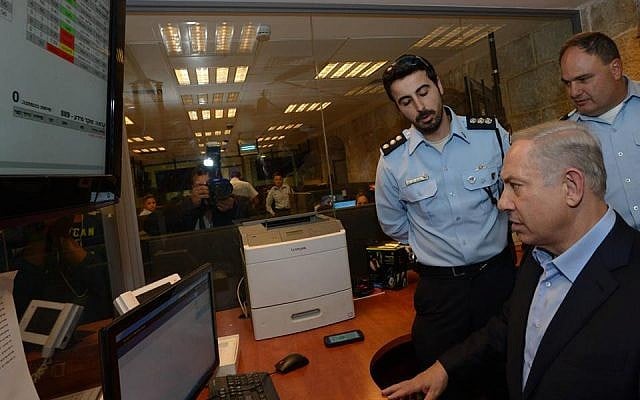
Some of the candidates, as expected, used their speeches to attack the prime minister over the accusations, saying that the corruption that needed to be fought against was Netanyahu himself.
More worrying than Iran
Moshe Ya’alon, who served as defense minister under Netanyahu, said that Netanyahu’s conduct keeps him up at night more than the threat posed by Iran.
Ya’alon, who quit the government and Likud in 2016 not over graft concerns but after his post was sold to Yisrael Beytenu’s Avigdor Liberman to shore up the coalition, has since founded the Telem party and merged with fellow former general Benny Gantz’s Israel Resilience list.
“When we talk about a leadership that must also be able to face extremely trying situations, including war, the question of the public’s trust in the government becomes critical,” Ya’alon explained with his typical taciturn delivery. “The question of eroding trust in the leader becomes a blow to national strength and national security.”
To counter the threat, Ya’alon said he plans to advance legislation to impose a two-term (or maximum of eight-year) term limit on the prime minister and to block anyone convicted of a crime with moral turpitude, such as bribery or breach of trust, from serving in public office.
Current legislation only bans them from office for seven years, which is how former convict Aryeh Deri is back as interior minister less than two decades after serving time for crimes committed when he served in the same position. Deri’s ultra-Orthodox Shas party was one of a handful of top factions to not send anyone to the conference.
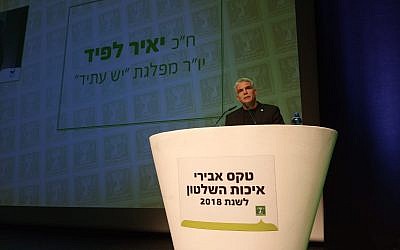
Yair Lapid, whose Yesh Atid party proposed a similar bill in the past year only to have it rejected by the coalition, told the audience that Netanyahu specifically wants the elections to focus on the criminal investigations against him, so that he can shut them down after the national ballot and save himself from prison. The prime minister’s campaign has so far largely focused on refuting the allegations and attacking his detractors.
“He wants elections on investigations because if he wins, he believes he’ll have a mandate to shut down the investigations,” said Lapid, who swept into the Knesset, and a ministerial position, on an anti-corruption platform in 2013.
He did not seem to notice the irony that with this oft-voiced criticism of the premier, he himself was making the corruption allegations a key focus of his campaign too, even while saying the campaign should focus on welfare and economic issues. Nonetheless, the anti-corruption conference crowd rewarded him with cheers and even a modest standing ovation.
Corrupting morality
Meretz leader Tamar Zandberg agreed Netanyahu’s alleged graft was a concern, but she contended that it only represented a symptom of a deeper malaise: “the corrupt and corrupting occupation.”
Zandberg argued that Israel’s continued control over the 2.5 million Palestinians living in the West Bank was “the ultimate source of a willingness to accept corruption” and of the efforts to stop those fighting against it.
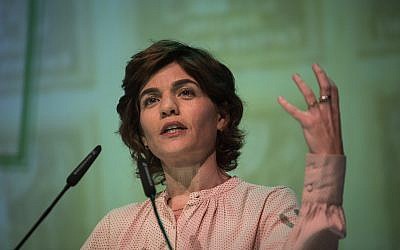
“If you can lie for the sake of Israel, they why can’t you steal?” she explained, referring to a Talmudic ruling that Jewish settlement of the Land of Israel takes precedence over some other Biblical commandments. “And if you can steal for the sake of the land of Israel, then why can’t you steal whenever you want?”
“What sort of Israel do we want,” she asked. “A corrupt and occupying one? Or a clean and moral one?”
Hatnuah chair Tzipi Livni also framed corruption as a moral issue, but zeroed in on criticism of the judicial system that has recently become a mainstay of Netanyahu and Likud talking points, warning that “the basis of Israel as a democratic state” was under attack.
Livni, who has championed herself as a defender of Israel’s democracy, said that the primary concern of anti-corruption activists must be the way in which the prime minister has “eroded public trust in law enforcement and the judicial institutions in Israel.”
Denying any wrongdoing, Netanyahu has claimed the investigations are part of a political vendetta and witch hunt aimed at ousting him, involving the political left, the media and the law enforcement community.
Judging corruption
Bezalel Smotrich, head of the far-right National Union faction, by contrast, argued that the attacks on the judiciary were exactly what was needed to keep activist judges and prosecutors in check lest they subvert the will of the voters.
“Israeli democracy is stronger than ever … after many years of being in a kind of coma,” he posited.
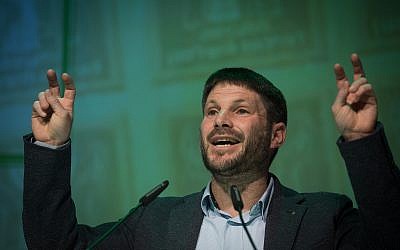
“The power struggles we have witnessed in recent years between the elected representatives and the judiciary, rather than representing a threat to democracy, are welcome and should be praised as the revival of Israeli democracy,” Smotrich declared, before launching into a list of examples of what he called “judicial corruption” that included a lack of transparency on Supreme Court justices and vast conflicts of interest in which cases judges are allowed to take on.
“Critics of the judicial system, including myself, do not ask, God forbid, to harm it,” said the leader of the faction within the Jewish Home party. As he was speaking, activists from the other faction within Jewish Home were voting to move MK Moti Yogev, who once called for the Supreme Court to be razed, up the party’s slate.
Smotrich’s comments reflected a feeling by many on the right that the Supreme Court has become a bastion of leftist ideals that has repeatedly ruled in favor of outpost evacuations and against settlers.
Ayelet Shaked, who was until recently in Jewish Home, has worked as justice minister to move the court to the right. Her New Right party did not send a representative to the conference.
“All we are asking,” said Smotrich, “is to prevent tyranny of government from the judicial system and the disgust and corruption that usually accompany governmental tyranny.”
Finance Minister Moshe Kahlon said that the approach of Smotrich and others in the coalition to attack the judiciary rather than the suspects had forced his primarily economically minded Kulanu party to become “the sole voice within the government fighting against legislation that would encourage corruption.”
He listed over half a dozen proposals that Likud lawmakers have attempted to pass in the last year that could have either saved Netanyahu from prosecution or, as Smotrich called to do, drastically limited the scope of the judicial system.
“Politically — you pay a price for it, and we paid a price for it,” Kahlon said, referring to his recent poor showing in public opinion polls. “But there is nothing you can do. If you believe it’s the right thing to do, then you pay the price you need to.”
Something to agree on?
With the key causes of corruption presented numbering almost as many as the speakers, Gesher leader Orly Levy-Abekasis, herself somewhat of a surprise in these elections — having left Yisrael Beytenu two years ago and since emerging as a political force in her own right — proposed what she called a “surprising” solution to all of them.
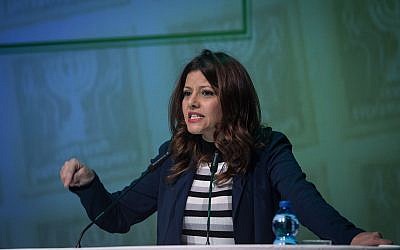
“My proposal might sound creative, but repeated research around the world has proved it to be universally effecting in reducing corruption,” she said, to the growing interest of the somewhat worn-out audience.
“Very simply: We need more women in the Knesset,” she declared, quoting academic papers showing a direct converse correlation between female representation in worldwide parliaments and the amount of reported corruption.
And acknowledging that the various party leaders present at the conference — Likud, Labor, United Torah Judaism and Joint (Arab) List also did not send anyone — had vastly divergent views on what corruption they felt needed to be rid of, Levy-Abekasis concluded hopefully, “Surely people can’t argue with that, can they?”
Next week’s Van Leer Institute conference on “Women in Politics” will likely prove her wrong.










The Times of Israel Community.