

President Clinton’s aide Sandy Berger dies at 70
Former national security advisor also offered then-secretary of state Hillary Clinton tips on how to deal with Netanyahu
 Add ToI as a Preferred Source on Google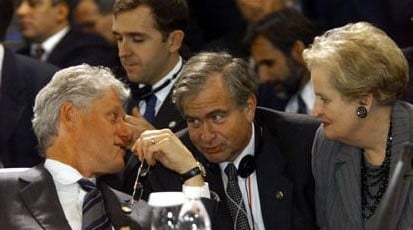
WASHINGTON (AP) — Former national security adviser Sandy Berger, who helped craft President Bill Clinton’s foreign policy and got in trouble over destroying classified documents, died Wednesday.
He was 70. The cause of death was cancer, said a statement by his consulting firm, the Albright Stonebridge Group.
Berger was White House national security adviser from 1997 to 2001, when the Clinton administration carried out airstrikes in Kosovo and against Saddam Hussein’s forces in Iraq. Berger, a lawyer, also was deeply involved in the administration’s push for free trade, and in the response to al-Qaida’s bombing of American embassies in East Africa.
He was deputy national security adviser during Clinton’s first term, and had previously worked in the State Department in President Jimmy Carter’s administration.
“Today, his legacy can be seen in a peaceful Balkans, our strong alliance with Japan, our deeper relationships with India and China,” President Barack Obama said in a statement.
In 2005, Berger pleaded guilty to illegally removing classified documents from the National Archives by stuffing some papers in his pants leg. He cut up some of the documents with scissors, for reasons that remain unclear. He was sentenced to probation and a $50,000 fine. He expressed regret for his actions.
Out of government, he helped found an international consulting firm that in 2009 merged with one run by former Secretary of State Madeleine Albright.
“He cared deeply about where this country was going and what we could do to solve problems,” Albright said in a telephone interview. “That was the basis of his life, was to make a difference.”
https://twitter.com/AmbShapiro/status/672116609717305344
Berger presided over foreign policy during what was a relatively serene period between the fall of the Soviet Union and the September 2001 terrorist attacks.
The biggest trouble spot was the Balkans, where the breakup of the former Yugoslavia spawned a series of civil wars. The U.S. and its NATO allies took militarily action against what they viewed as Serbian aggression, first in the conflict over Bosnia, and then in Kosovo.
Berger led White House meetings during NATO’s 11-week bombing of Kosovo in 1999.
He also played a key role in Operation Desert Fox, the four-day bombing of Iraq in 1998 over Saddam’s failure to comply with UN Security Council resolutions about weapons inspections.
Also in 1998, al-Qaida attacked US embassies in Kenya and Tanzania. The Clinton administration responded with a cruise missile barrage against training camps in Afghanistan and a pharmaceutical plant in Sudan. The strikes did little to disrupt al-Qaida and became a thread in a long running criticism that Clinton and his team failed to properly respond to a burgeoning terrorist threat.
After the attacks of Sept. 11, 2001, Berger was vocal in defending the administration’s counter terrorism record, and it was his passion that may have led to his prosecution.
In court, Berger admitted to taking and destroying three copies of a classified report about the government’s response to the millennium plot in 2000 by Islamic extremists to attack in Los Angeles and other locations. But a report by House Republicans claimed he may have secretly removed many more documents from the Archives.
Albright said she and Berger never spoke about the matter, through years of working together.
“Even the finest people make mistakes,” she said.
Berger grew up in Millerton, New York, where his father died in 1953 when Berger was 8. His mother ran the family Army-Navy store while raising Berger and his sister.
He went to Cornell, and then Harvard law school. He met Bill Clinton while the two worked on George McGovern’s 1972 presidential campaign.
“There is no one I have relied on more these past eight years,” Clinton wrote Berger in a letter as the pair left office in January 2001. “You never flinched when American’s interests and values demanded that we make unpopular choices.”
Berger remained an important political and foreign policy figure in Washington. In August, he wrote an opinion piece for Politico in support of the Iran nuclear agreement.
“It is not without risks, and it does not solve the Iran threat in the region. But it will prevent Iran from developing a nuclear weapon for at least 15 years,” he wrote.
Berger’s name recently came back to the headlines as a person who advised Democratic candidate Hillary Clinton on how to deal with Prime Minister Benjamin Netanyahu on the stagnant peace process.
His advice to Clinton on Netanyahu was revealed earlier this year among emails exposed that in correspondence released as part of the trove related to the controversy over Clinton’s use of a personal email address while serving as secretary of state.
In emails to Clinton, Berger described the difficulties of Netanyahu’s personality and the need to coddle him in a memo dated Aug. 24, 2010, when direct talks between Israelis and Palestinians resumed for a short period.
Arab interlocutors are difficult, Berger wrote to Clinton, but at least make clear what they will and will not accept. Netanyahu, he says, “either does not know himself or is not prepared to share.”
Berger told Clinton that at times she would have to be “tough” and push back against Netanyahu’s “most extreme demands,” but advised her to cultivate the Israel prime minister as a friend and confidant.
“You are ideally suited to begin a series of in-depth conversations aimed at understanding his key concerns, how they can be met, what he would need from us and others,” Berger wrote.
Berger is survived by his wife, Susan, in addition to three children and five grandchildren, Albright said.
— Times of Israel staff contributed to this report.








The Times of Israel Community.