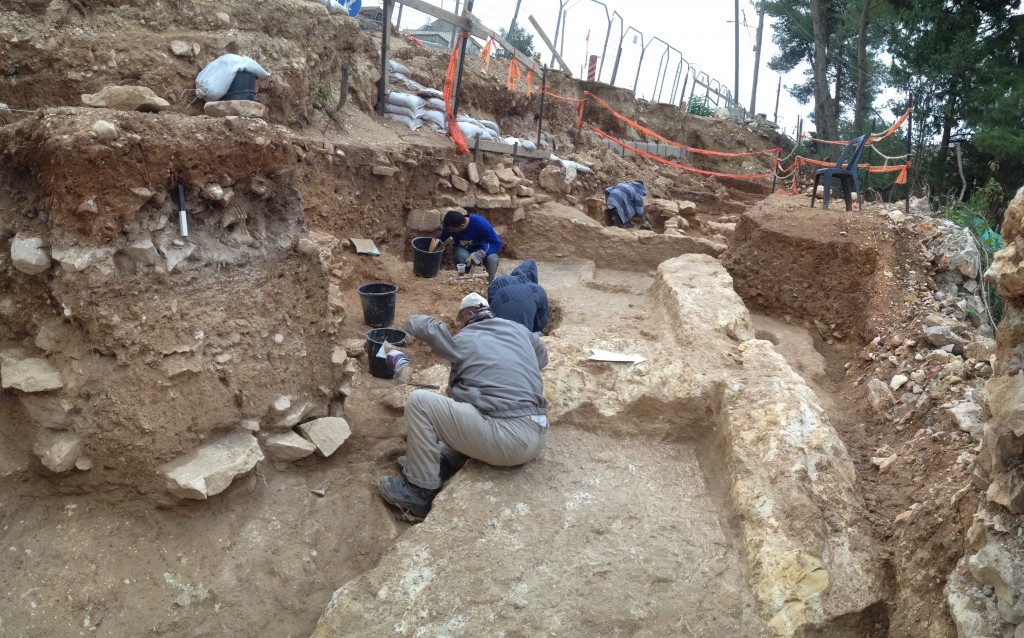
Workers uncover the foundations of ancient buildings under a road in the Jerusalem neighborhood of Kiryat Hayovel (Courtesy of the Israel Antiquities Authority)
Israeli archaeologists digging under a road in Jerusalem have uncovered the remains of an agricultural community that could yield new information on the lives of residents before and after the rise of the Hasmonean dynasty around 2,200 years ago, the Israel Antiquities Authority said Monday.
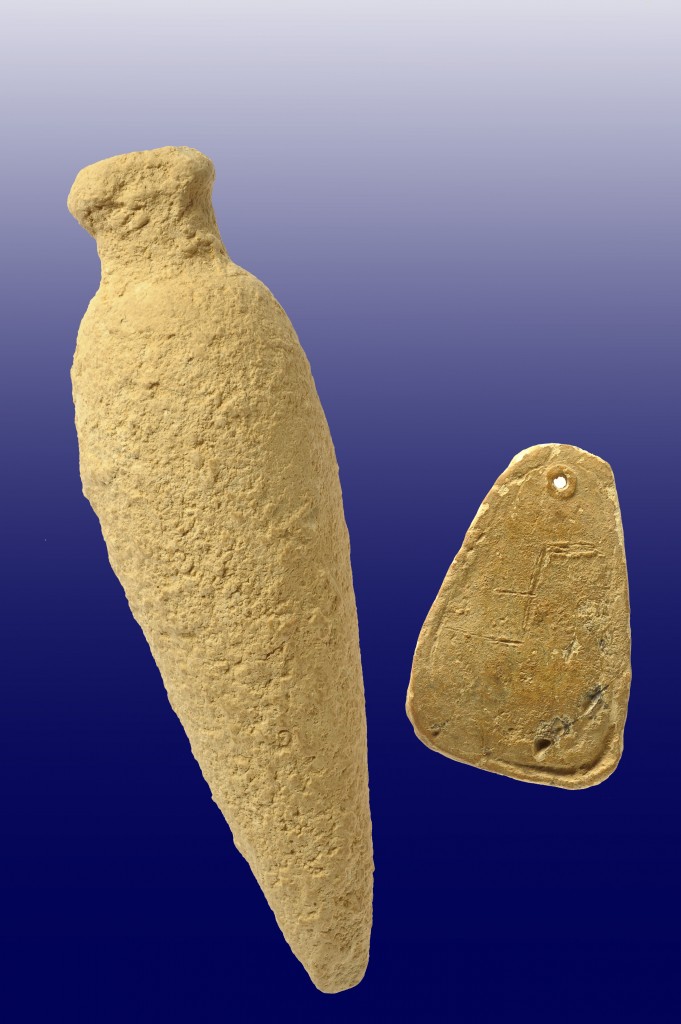
The excavation in the city’s modern-day Kiryat Hayovel neighborhood has yielded a perfume bottle, wine press, bread oven and the remains of houses and agricultural buildings, according to an IAA statement.
Archaeologists also found a hand-made lead weight with a letter carved on it — seemingly the letter “yod,” the tenth letter of the Hebrew alphabet and the equivalent of the English letter “y.”
A perfume bottle and a lead weight bearing a carved letter were found at the Kiryat Hayovel dig (Courtesy of the Israel Antiquities Authority)
The community seems to have been active both before and after the Maccabees took Jerusalem and re-dedicated the Temple in 164 BCE, marking the beginning of Hasmonean rule, according to the IAA.
That victory is commemorated this week by the festival of Hanukkah.
Get The Times of Israel's Daily Editionby email and never miss our top stories
“Very little is known about the material culture and history of the residents of Jerusalem and the rural area around it in the fourth and third centuries before the common era, and the newly revealed site will help us construct a theoretical model of a settlement in this area,” Daniel Ein-Mor, the dig director, said in a statement released by the IAA on Monday.
The excavation, a salvage dig, is being carried out ahead of an expansion of the Jerusalem light rail system.
Advertisement
Help us report truthfully on social media
As a multimedia journalist, my job is to take the quality, fact-based journalism produced by The Times of Israel newsroom and make it accessible across every platform — from Instagram posts to podcasts to short-form videos.
This is how many, especially young people, consume news these days. But misinformation is rampant on social media. Our team at ToI produces accurate, responsible short-form reporting on Israel and the Jewish world.
If you believe in the importance of factual social media journalism, please consider joining our reader support group, The Times of Israel Community. Your financial support is essential to sustain responsible multimedia reporting.
We’re really pleased that you’ve read X Times of Israel articles in the past month.
That’s why we started the Times of Israel - to provide discerning readers like you with must-read coverage of Israel and the Jewish world.
So now we have a request. Unlike other news outlets, we haven’t put up a paywall. But as the journalism we do is costly, we invite readers for whom The Times of Israel has become important to help support our work by joining The Times of Israel Community.
For as little as $6 a month you can help support our quality journalism while enjoying The Times of Israel AD-FREE, as well as accessing exclusive content available only to Times of Israel Community members.
Thank you, David Horovitz, Founding Editor of The Times of Israel


 Add ToI as a Preferred Source on Google