

Sides stay mum as ‘serious’ talks get underway
Israeli and Palestinian negotiators meet in the capital for nearly five hours, one day after prisoner release
 Add ToI as a Preferred Source on Google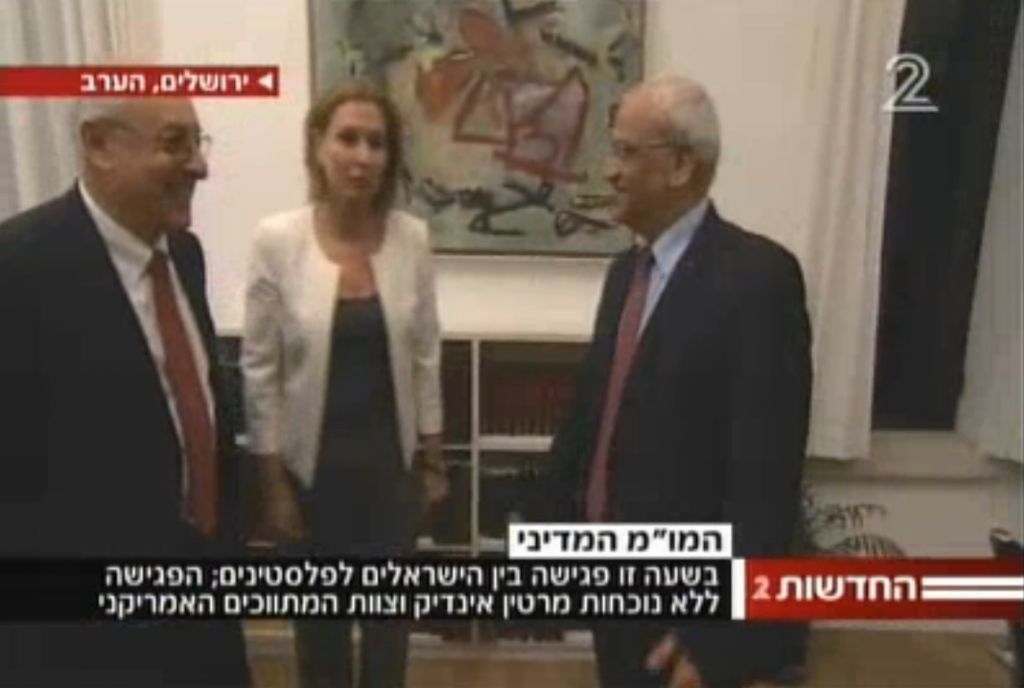
Israeli and Palestinian negotiation teams began hashing out a peace deal Wednesday, while maintaining an impressive level of silence that concealed even when and where they were meeting.
Justice Minister Tzipi Livni and Prime Minister Benjamin Netanyahu’s aide Yitzhak Molcho sat down with Palestinian Authority President Mahmoud Abbas’s advisers Saeb Erekat and Mohammed Shtayyeh somewhere in the capital on Wednesday.
The sides met for nearly five hours, reported Israel Radio, and the meeting was described as “serious” by sources close to the talks. The participants agreed to meet again soon, in the West Bank city of Jericho.
It was the second encounter since talks kicked off last month, and it went ahead after Israel released 26 Palestinian prisoners the night before, a key precondition for talks, and several days after Jerusalem announced it would approve some 2,000 new units in East Jerusalem and major West Bank settlement blocs. Both moves created an atmosphere of mutual recrimination in the negotiations.
The sides and the US, which is shepherding the negotiations, have vowed to maintain radio silence in the hopes of silencing critics that could scuttle the negotiations.
“The talks resumed. no photo opp. no statements. Why? to allow the teams to work together, and not think about the media waiting outside,” Livni spokesperson Mia Bengel tweeted Wednesday evening in a rare statement.
At the Palestinians’ request, Army Radio reported, no photo opportunities were scheduled either, though the Government Press Office issued brief footage of Livni, Molcho and Erekat speaking.
There were differing reports as to whether US envoy Martin Indyk was present in the room during the talks.
Speaking at a swearing-in ceremony for the chief rabbi Wednesday morning, Livni told reporters: “We are committed to making the effort, for the sake of the people the State of Israel and its values. It’s going to be complex and complicated, but I’m not ready to give up.”
Also Wednesday, Science Minister Yaakov Peri, who formerly headed the Shin Bet internal security service, told Army Radio of the mixed feelings he has over the prisoner release that will see a total of over a hundred convicted Palestinians set free in four phases as the talks progress.
“Out of the 104 prisoners that are to be released, I was personally involved in, or directed, the capture of 92 of them, so these are not easy times for me and for the families [of the victims],” he said. “But that is part of the price in the quest for peace.”
Deputy Defense Minister Danny Danon from the Likud party argued that Israelis today would not accept a peace proposal made by Netanyahu predecessor Ehud Olmert.
Such an agreement “will not win support, not just from me, but also from the Likud and, I think, most of the nation,” Danon told Israel Radio.
The talks are so far keeping to a schedule hammered out two weeks ago in Washington during a first round of talks that laid down a nine-month timetable to reach an agreement. However, there is pessimism on both sides as to what they will achieve.
“We set ourselves nine months and we will try and reach something with the Palestinians,” an Army Radio report quoted Defense Minister Moshe Ya’alon on Wednesday. “In the meantime we’ve been trying for 20 years since Oslo, 20 years of conflict, and you can hear in my tone the skepticism, but we decided to give this a chance.”
Meanwhile, Shtayyeh criticized Housing and Construction Minister Uri Ariel’s announcement on Sunday of the construction of 1,187 new housing units in East Jerusalem and the West Bank.
Israel’s move proved “it wasn’t serious about negotiations” and was instead trying “to topple the foundations of the solution, which is establishing a Palestinian state in the ’67 borders,” he said, according to a report from Israel Radio.
Even before the announcement of the construction plans, Erekat had already said in an interview with Reuters this week that the settlements could force him and his team “to leave the negotiating table.”
“If the Israeli government believes that every week they’re going to cross a red line by settlement activity, if they go with this behavior, what they’re advertising is the unsustainability of the negotiations,” Erekat said.
On Tuesday, the Housing Ministry confirmed that it had secretly approved a further 900 housing units in East Jerusalem, scrambling the US secretary of state to play down the significance of the construction plans that, he said, the Palestinians were well aware of in advance.
Trying to salvage the US-brokered peace talks, Kerry spoke Tuesday to reporters while on a trip to Brazil and said that although it would be better if Israel didn’t make such announcements during the peace talks, he did not think they would threaten the second round of talks. Kerry revealed Tuesday night that Netanyahu told him and Abbas in advance of Israel’s intention to announce additional building “in places that would not affect the peace map.”
AP contributed to this report.






The Times of Israel Community.