

The tears and laughter of Yasmina Reza’s lost Babylon
Latest novel from French Jewish playwright about dispute over free-range chicken in running for top literary prize
 Add ToI as a Preferred Source on Google
PARIS (AFP) — Yasmina Reza insists she doesn’t like to make her characters suffer. But suffer they do in her deliciously droll dissections of middle-class mores such as “Art” and “God of Carnage,” which have been worldwide hits for France’s most famous playwright.
Her new book, “Babylon,” is no exception, a novel in which a dinner party dispute over free-range chicken has fatal consequences.
You can see the same scalpel at work in her latest play “Bella Figura,” which begins its French run in January. It has a man and his mistress going to a restaurant his wife has recommended only to bump into one of her friends in the car park.
Reza’s parents are both Jewish. Her violinist mother fled Hungary after the Iron Curtain fell, and her father came from an Iranian Jewish family from Samarkand, Uzbekistan.
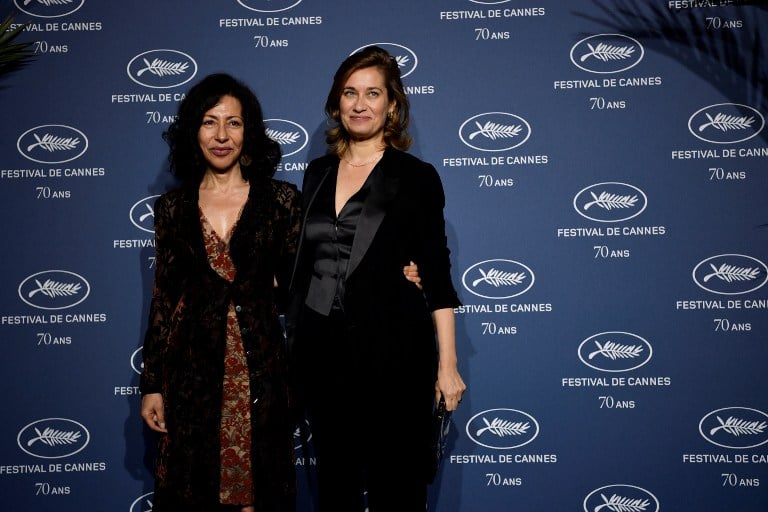
For Reza truth is often to be found in the dark dance of the tragic and the absurd which fires her writing.
It all goes back to her pianist father’s love of Mozart’s opera “Don Giovanni,” she told AFP, and in particular the dramatic finale when the old rake is carried off to Hell.
“We laugh and are chilled to the core at the same time,” she said. “I was very young but I said to myself that is pure genius — there is nothing higher than that.”
Farce and tragedy
“That mix of farce, of the ridiculous, the grotesque, of the tragic and the dramatic is the essence of life,” she said.
Babylon — which is in the running for France’s top literary prize, the Goncourt — ticks all those boxes, the story of how the comfortable ordered lives of two middle-aged couples in the suburbs of Paris unravel over the course of an evening.
But it is also a touching study — as the title drawn from the biblical psalm “By the rivers of Babylon we sat and wept…” suggests — of people living in exile from themselves.
Everyone, including an irascible cat called Eduardo who only understands Italian, has been cut adrift from their youth and their dreams.
“For me Babylon represents… that lost world, all that we could have lived, all that humanity that is behind us,” said Reza. Our only real home is inside ourselves, she said.
‘Decorative’ identities
“I feel this very strongly… because of my origins and my own personal history there never been a place I called home,” Reza added.
Which is why she finds the rise of identity politics across Europe hard to swallow.
“To reduce ourselves to desperately attaching ourselves to an identity that is always outside oneself” is incomprehensible, she said, “be it our origins, religion our homeland — which is the craziest of all in my opinion.
“These are decorative entities,” she insisted. “They have nothing to do with the one’s deep identity. And one sees clearly the disaster that it leads to.”
Even so Reza will not be drawn on the former French president Nicolas Sarkozy’s much-criticized shift into populist politics, playing hard on French identity as he bids to win back power.
In a scoop that left the world’s press agog at the time, Sarkozy granted the writer privileged access to follow him in the months before he was first elected in 2007.

Her resulting bestseller “The Dusk, the Evening or the Night” gave a rare insight into a man whose mercurial personality still fascinates.
But Reza insisted her interest in him was purely an exercise in character study.
“It was an extremely interesting moment in his life… the loss of his wife [who had left him], his attempt to win power at the same time… you can say it was a kind of adolescence, because he became an adult when he entered the Elysee,” she said.
She has only seen him twice since, she said, the last time after he lost the 2012 election to the Socialist Francois Hollande.
“I don’t know him, or what he is now. I look at him with a completely neutral gaze,” she said.










The Times of Israel Community.