

Treasury, Yisrael Beytenu said close to deal on pensions
In late-night meeting, Finance Ministry officials and Liberman’s representatives make progress on main coalition hurdle
 Add ToI as a Preferred Source on Google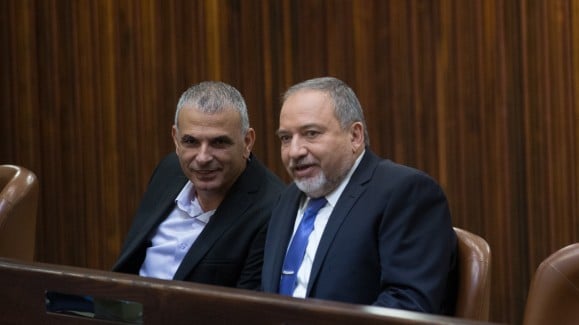
Representatives from the Yisrael Beytenu party and the Finance Ministry met until late Monday night to resolve a sticking point in the coalition talks, with progress reported in finalizing the agreement on pension reform for former Soviet Union immigrants.
The negotiations were set to resume on Tuesday.
The talks to include the right-wing five-seat Yisrael Beytenu party in the government have been stalled over Avigdor Liberman’s demand for billions of shekels in state funds to shore up the pensions of tens of thousands of former Soviet Union immigrants.
But according to Army Radio on Tuesday, the negotiating teams drafted alternative plans overnight Monday-Tuesday and were set to present the compromise to both Finance Minister Moshe Kahlon and Liberman for final approval.
The issue is critical for Yisrael Beytenu, for which elderly Russian-speaking Israelis are a core constituency. Most of the approximately 78,000 elderly immigrant poor in the country hail from the FSU, in part because many of those immigrants arrived in Israel without pensions and were too old to save up for new pensions in Israel.
Liberman on Monday afternoon said the talks were “deadlocked,” but Prime Minister Benjamin Netanyahu was unfazed, saying coalition negotiations have their ups and downs.
Liberman said the pension reform was intended to address inequalities affecting all Israelis, and complained that the Finance Ministry — headed by Kulanu party leader Moshe Kahlon — was making “unacceptable” proposals on the issue.
“We intended to finish the negotiations as quickly as possible,” Liberman said. “We were willing to compromise on many things, and we compromised: on (legislation concerning) religion and state and on (proposed amendments to legislation to enable) the death penalty for terrorists. But on two fundamental issues we are not willing to compromise: defense and pension reform.”
The current proposals, he said, were “unacceptable.” Nonetheless, Liberman made clear, his intention was still to join the coalition, he was not issuing ultimatums, and he was open to any reasonable offer. “We’re at a dead end. We’re waiting for other offers. If we get them, we’re open to negotiations,” he said.
Finance Ministry officials have balked at Yisrael Beytenu’s demand, noting the high price tag — some NIS 2.5 billion ($645 million), according to estimates — and the legal and ethical problems that arise when welfare benefits are applied based on place of birth.
“The finance minister is unwilling to accept Yisrael Beytenu’s demand that the benefits apply only to new immigrants, and we haven’t found a solution to this problem,” a Finance Ministry official was quoted by the Walla news site as saying.
Kahlon reportedly told Netanyahu that his 10-seat party would not remain in the coalition if the measure was forced through as is — a move that could topple the government.
Any attempt to expand the proposed benefits to the broader population of elderly poor could cost more than five times as much, say officials.
Opposition lawmakers threatened on Monday to work to torpedo the passage of any immigrants-only (or FSU-immigrants-only) pension benefit.
Zionist Union MK Itzik Shmuli, who chairs the Knesset Pensioners Caucus, said that if the final agreement offers benefits only to immigrants from the former Soviet Union, “we will challenge this discriminatory deal in court.”
Shmulik Mizrahi, head of the Pensioners Union, sent a letter Monday to Netanyahu demanding that any benefits agreed to in the negotiations be applied equally to all pensioners based on economic need, not geographic or cultural origins, Walla reported.
MK Tali Ploskov, a former Yisrael Beytenu mayor of Arad who now serves in the Knesset on the Kulanu list, also criticized her former party’s demand, saying that a pension reform plan is already under development in the Finance Ministry that would push all the elderly poor above the poverty line. The reform was a campaign promise of Kulanu.
If the talks fall through, Netanyahu will find himself with the same narrow 61-seat coalition he had before starting coalition talks with Zionist Union several weeks ago. Those fell apart last week after Liberman provisionally agreed to join the coalition, where he is set to take on the role of defense minister.
Netanyahu on Monday night continued to extend an invitation to the Zionist Union to join the coalition, even as party leader Isaac Herzog insisted that “door was closed.”









The Times of Israel Community.