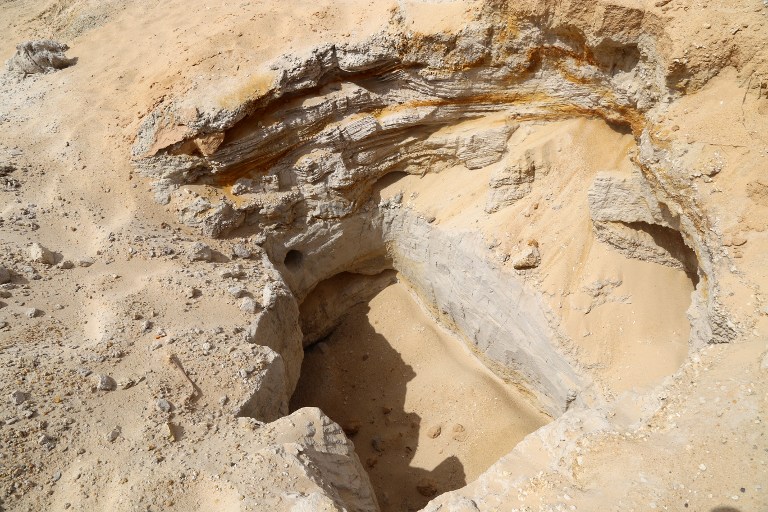
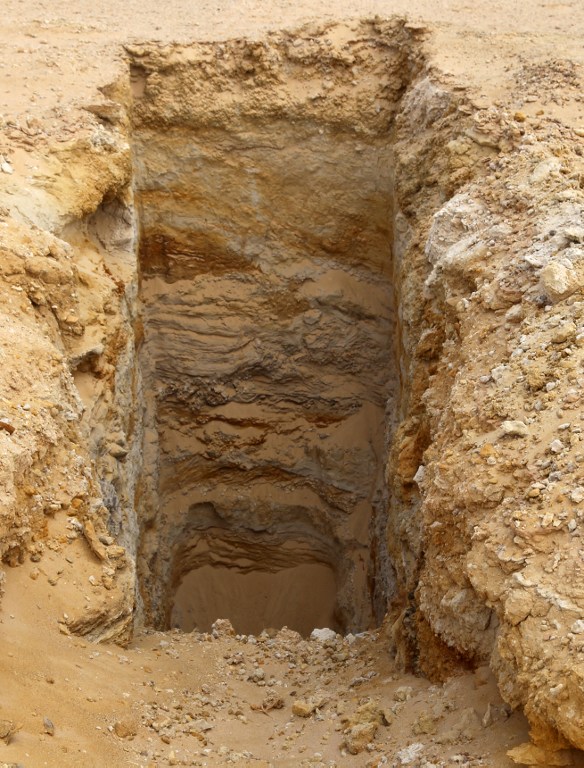
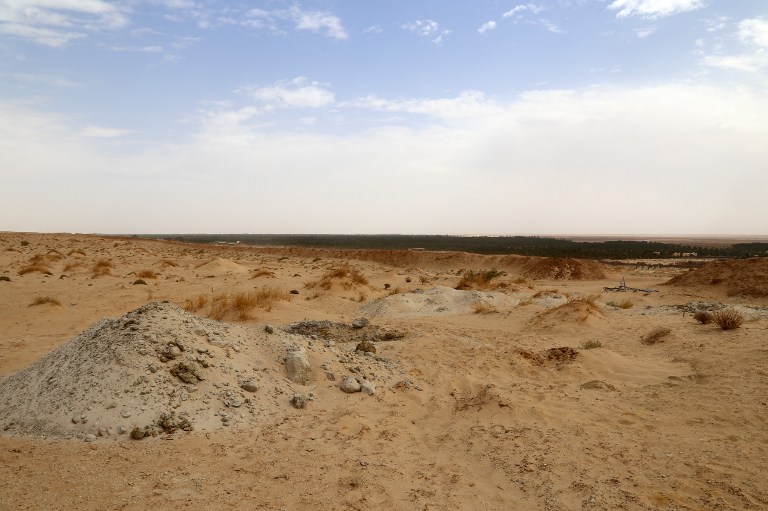
An image taken on September 15, 2016, shows the site of excavations near Tozeur, in southwestern Tunisia, where Tunisian and British researchers say they have unearthed Stone Age tools showing humans lived in the area nearly 100,000 years ago. (AFP PHOTO / AYMEN ZAOUALI)
TUNIS, Tunisia — Tunisian and British researchers have unearthed Stone Age tools showing humans lived in southern Tunisia nearly 100,000 years ago, they said Thursday.
The discovery could help explain the spread of Homo sapiens who appeared in eastern Africa 100,000 years earlier and emerged out of the continent around 65,000 years ago.
After a year and a half of digging near Tozeur, in southwestern Tunisia, researchers had identified a “promising” site of around 6,000 square meters (65,000 square feet), said researcher Nabil Guesmi.
The artifacts are the oldest evidence of human activity ever discovered in Tunisia, and include flint tools similar to those early humans in other areas used for hunting.
An image taken on September 15, 2016, shows the site of excavations near Tozeur, in southwestern Tunisia, where Tunisian and British researchers say they have unearthed Stone Age tools showing humans lived in the area nearly 100,000 years ago. (AFP/Aymen Zaouali)
The researchers, from Tunisia’s National Heritage Institute (INP) and the University of Oxford, also found tools from the Middle Stone Age that attest to the presence of Homo sapiens, said Guesmi.
Get The Times of Israel's Daily Editionby email and never miss our top stories
“We have found bones that indicate the presence of savannah animals — rhinoceros, zebras — and therefore fresh water,” he said.
Guesmi said a technique called thermoluminescence had shown that some of the tools were as much as 92,000 years old.
The oldest human remains in North Africa were uncovered in Temara, northwest Morocco, and are thought to date back some 160,000 years.
Advertisement
The INP says the new site could yield evidence of early human “passageways” through the region.
“We can imagine going further, because the site is relatively large,” said Guesmi.
An image taken on September 15, 2016, shows the site of excavations near Tozeur, in southwestern Tunisia, where Tunisian and British researchers say they have unearthed Stone Age tools showing humans lived in the area nearly 100,000 years ago. (AFP/Aymen Zaouali)
Help us report truthfully on social media
As a multimedia journalist, my job is to take the quality, fact-based journalism produced by The Times of Israel newsroom and make it accessible across every platform — from Instagram posts to podcasts to short-form videos.
This is how many, especially young people, consume news these days. But misinformation is rampant on social media. Our team at ToI produces accurate, responsible short-form reporting on Israel and the Jewish world.
If you believe in the importance of factual social media journalism, please consider joining our reader support group, The Times of Israel Community. Your financial support is essential to sustain responsible multimedia reporting.
We’re really pleased that you’ve read X Times of Israel articles in the past month.
That’s why we started the Times of Israel - to provide discerning readers like you with must-read coverage of Israel and the Jewish world.
So now we have a request. Unlike other news outlets, we haven’t put up a paywall. But as the journalism we do is costly, we invite readers for whom The Times of Israel has become important to help support our work by joining The Times of Israel Community.
For as little as $6 a month you can help support our quality journalism while enjoying The Times of Israel AD-FREE, as well as accessing exclusive content available only to Times of Israel Community members.
Thank you, David Horovitz, Founding Editor of The Times of Israel


 Add ToI as a Preferred Source on Google