

UK leaders pay tribute to murdered lawmaker Amess as MPs demand tougher security
British PM, opposition leader make joint visit to church where Conservative lawmaker was stabbed to death; MPs press for protection after murder of 2nd colleague in 5 years
 Add ToI as a Preferred Source on Google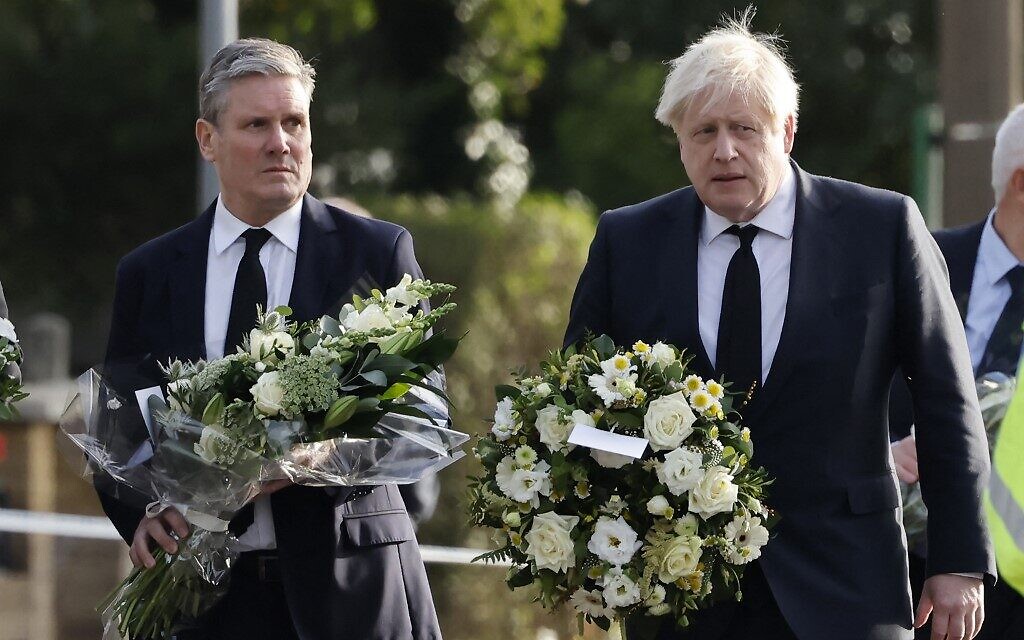
Leaders from across the political spectrum came together Saturday to pay tribute to a long-serving British lawmaker who was stabbed to death in what police have described as a terrorist incident, as politicians increased calls for tougher security.
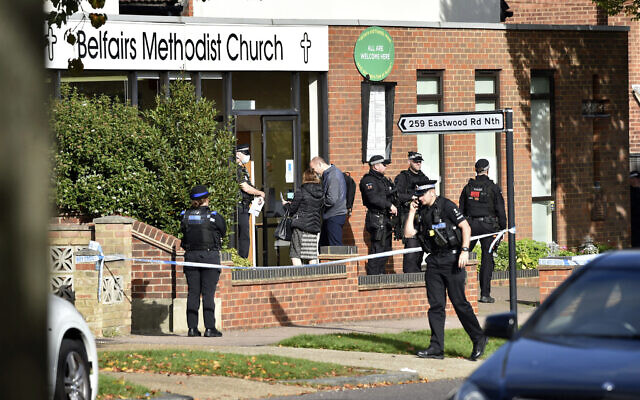
British Prime Minister Boris Johnson, the leader of the main opposition Labour Party, Keir Starmer, and the non-partisan speaker of the House of Commons, Lindsay Hoyle, arrived at the church where David Amess was stabbed multiple times while meeting with constituents on Friday.
A 25-year-old man is in custody for the attack. The Times and other UK reports said the suspected killer was a Muslim man aged 25, believed to be of Somali descent. Multiple United Kingdom media outlets reported that the man is believed to be a British national.
The politicians went up to the front of Belfairs Methodist Church individually to pay their respects to the Conservative lawmaker, who had been a member of the British Parliament since 1983. After laying flowers, they returned to their vehicles, escorted by a police convoy. They did not stop to talk to reporters.
In a statement early Saturday, the Metropolitan Police described the attack as terrorism and said the early investigation “has revealed a potential motivation linked to Islamist extremism.”
Amess, 69, was attacked around midday Friday at a Methodist church in Leigh-on-Sea, a town about 40 miles east of London. Paramedics tried without success to save him. Police arrested the suspect and recovered a knife.
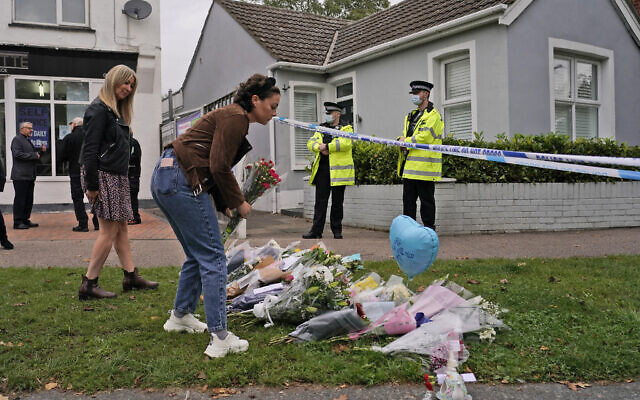
Police said they believed the suspect acted alone, and were not seeking anyone else in connection with the killing, though investigations continue.
As part of the investigation, officers were searching two locations in the London area. The senior national coordinator for counter-terrorism policing, Deputy Assistant Commissioner Dean Haydon, formally declared the incident as terrorism early Saturday.
The Metropolitan Police said an “early investigation has revealed a potential motivation linked to Islamist extremism,” but the department did not provide any details about the basis for that assessment.
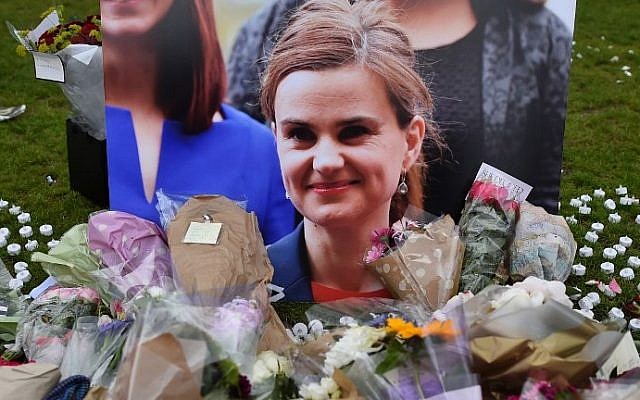
The slaying came five years after another MP, Jo Cox, was murdered by a far-right extremist in her small-town constituency, and Amess’ killing has renewed concern about the risks politicians run as they go about their work representing voters.
British politicians generally are not given police protection when they meet with their constituents.
Amess himself wrote about public harassment and online abuse in his book “Ayes & Ears: A Survivor’s Guide to Westminster,” published last year.
“These increasing attacks have rather spoilt the great British tradition of the people openly meeting their elected politicians,” he said.
MPs have had to install security cameras and only meet constituents by appointment, he added.
Labour MP Chris Bryant wrote in The Guardian that “sensible measures” were needed both in parliament, which is typically heavily guarded, and in constituencies, where MPs often hold meetings in locations such as church halls and high-street offices.
“We don’t want to live in fortresses. But I don’t want to lose another colleague to a violent death,” Bryant added.
Home Secretary Priti Patel on Friday ordered police across the country to review security arrangements for all 650 MPs, and veteran Labour lawmaker Harriet Harman said she planned to write to the prime minister to ask him to back what is known as a Speaker’s Conference to review the safety of parliamentarians.
“I think that, while we anguish about this dreadful loss, we can’t just assert that nothing should change,” Harman told BBC radio. “I don’t think anybody wants to go to a situation where the police are vetting individual constituents who come and see us, but I’m sure there is a safer way to go about our business.”
Under a Speaker’s Conference, the speaker brings together political parties and authorities to come up with non-partisan recommendations. They occur rarely, about once every 10 years.
“Since Jo Cox’s tragic killing, we’ve had changes in our home security, we’ve had changes in security in Parliament, but we haven’t looked at the issue of how we go about that important business in our constituency, but do it in a safe way — and I think we must do that now,” Harman said.
Cox’s sister Kim Leadbeater, who became an MP in the same constituency this year, said Amess’ death had left her “scared and frightened.”
“This is the risk we are all taking and so many MPs will be scared by this,” she added.
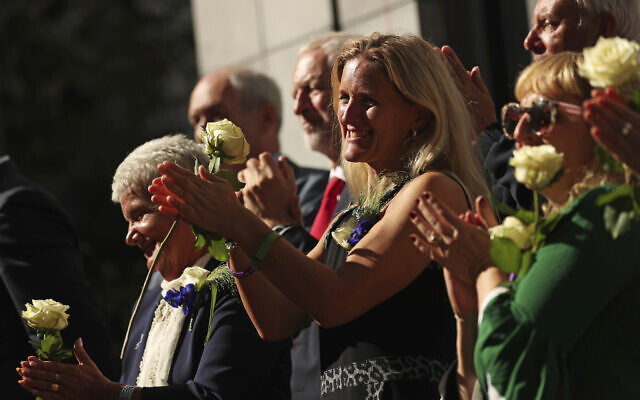
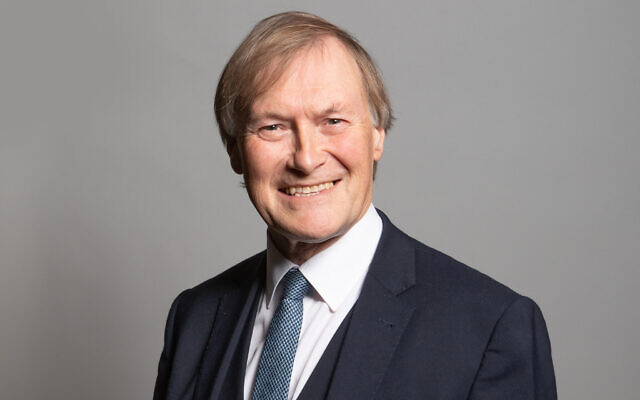
Amess had been a member of Parliament for Southend West, which includes Leigh-on-Sea, since 1997, and had been a lawmaker since 1983, making him one of the longest-serving politicians in the House of Commons.
A social conservative on the right of his party, he was a well-liked figure with a reputation for working hard for his constituents and campaigning ceaselessly to have Southend declared a city. He was the Honorary Secretary of the Conservative Friends of Israel from 1998, and was regarded as a longtime friend of the UK Jewish community.
He was knighted by Queen Elizabeth II in 2015 for his service.







The Times of Israel Community.