

The megilla as a relationship handbook
A new study guide uses Esther’s story to introduce the vocabulary of domestic abuse
 Add ToI as a Preferred Source on Google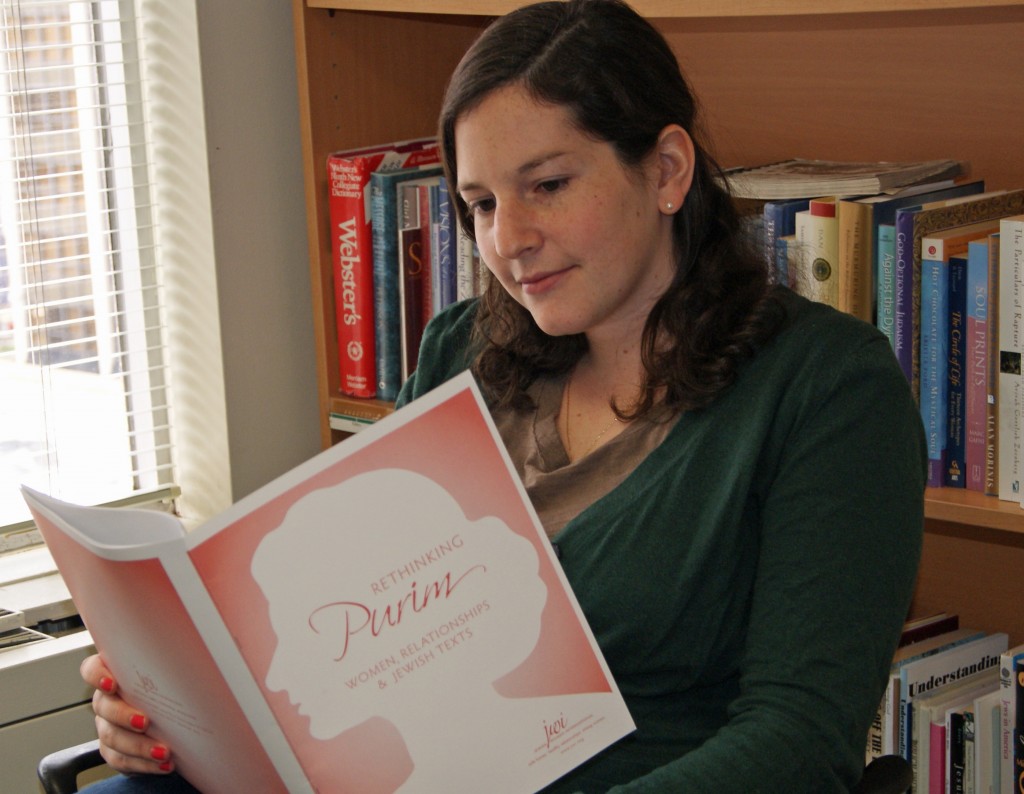
Rabbi Elisa Goldberg is planning a Purim text study at her Abington, Pennsylvania, congregation this weekend and she has found a new perspective on the megilla: Esther’s defense of the Jewish people parallels an abused women’s need to protect her children.
“Esther not only worried about herself; she worried about the Jewish community. It’s not exactly the same, but similar to the way a mother feels about her children,” Goldberg says.
That angle on the Purim story comes from a new study guide compiled by another rabbi, Donna Kirshbaum of Princeton, New Jersey, and published by Jewish Women International, an organization behind other projects combating domestic abuse.
Goldberg, who is also director of Jewish community services for the Jewish Family and Children’s Service in Philadelphia, introduced the new study guide at a meeting of chaplains associated with that organization. It led, she says, to a discussion of halting abuse and helping people extricate themselves from abusive relationships.
The guide, she says, “takes an innovative approach to the story of Purim,” one that notes “Esther’s power and not just her disempowerment.”
But some of the rabbis, particularly those whose congregants are primarily elderly, were hesitant about introducing the booklet for Purim because of fears it could ruin the festive mood. “This is the one time of year they really enjoy themselves,” she says.
The study guide, “Rethinking Purim: Women, Relationships and Jewish Text,” is meant to be more affirming than damning.
The megilla tells a story of “someone growing into a greater sense of self,” says Nina Beth Cardin, a Baltimore rabbi affiliated with Jewish Women International. Esther grows “into a personality who says, ‘Yes, I can be a master of my destiny,’ within some cultural boundaries,” she said.
“The fundamental message is that we all deserve to have that sense of confidence. You don’t have to be born with it. You can reach deep down into your soul,” Cardin says. “We want people to be able to identify the person they can imagine themselves becoming” and then identify the way to get there.
‘The fact is that the Jewish community is still just waking up to the realities of domestic violence abuse and family dysfunction, and we really need to make sure it is an acceptable public conversation’
“The fact is that the Jewish community is still just waking up to the realities of domestic violence abuse and family dysfunction, and we really need to make sure it is an acceptable public conversation,” Cardin says.
Introducing the Jewish community to the vocabulary of that conversation is part of what Kirshbaum had in mind when she was formulating the study guide, which is designed to be the first in a series using holidays and Jewish texts to discuss characteristics of healthy relationships.
The Purim guide encourages readers to imagine such relationships and determine how to achieve them, using the megilla to look in particular at three characteristics.
The first involves developing a strong voice as well as an identification with a something larger than oneself. In Esther’s case, this was the Jewish people. The second is to cultivate “the conscious use of self” — in the megilla, Esther dresses for success.
The third is striving for parity. In the story, Esther is ultimately able to tell the king of the plight of the Jewish people.
The includes a talmudic midrash about Purim in which the king refers to his wife as a “vessel.” In the commentary, Deborah Rosenbloom writes that he “considers his wife solely as a means of satisfying his sexual needs.”
In a healthy relationship, she writes, “each partner values and respects the other, in all their complexity as a human being.”
Kirshbaum says her mother, who died in May at 85, inspired the series. She stops short of identifying her mother as a victim of domestic abuse, saying only that she did not know how to turn her marriage into a healthy relationship.
“She loved my dad deeply and devotedly and was miserable for decades,” the rabbi says.
Elissa Schwartz, executive director of the Washington, DC-area Jewish Coalition Against Domestic Abuse, praises the new guide.
“Any time there is a program where someone speaks about domestic abuse,” she says in an email, “someone comes forward to seek help.”









The Times of Israel Community.