

Weapons of mass discussion: What the press is saying on August 20
A US push for Israel’s okay of F-35 sales to the UAE breaks the denial barrier, though the role of normalization and Israel’s QME stays in the clouds. Plus elections!? (again!)
 Add ToI as a Preferred Source on Google
Joshua Davidovich is The Times of Israel's Deputy Editor
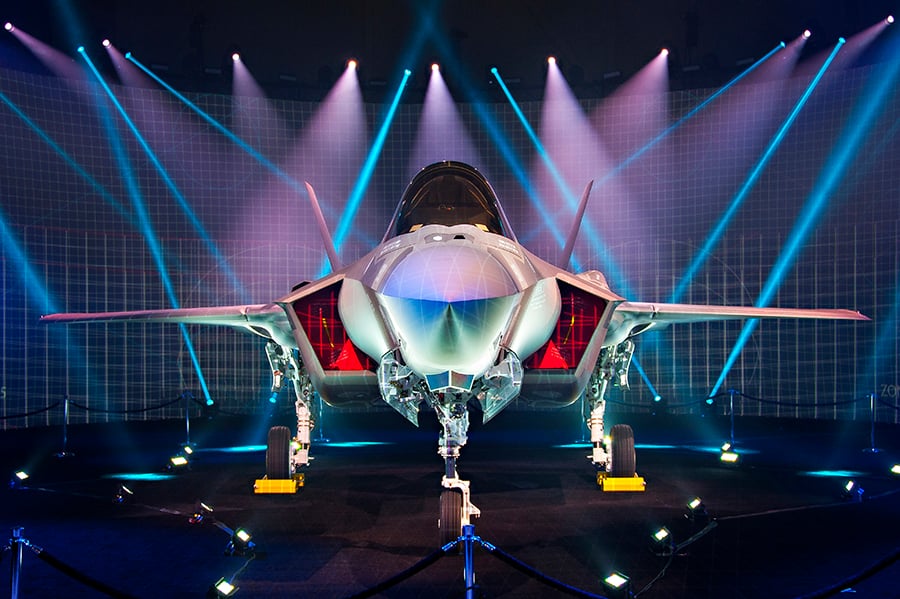
1. Leaning on a jet deal: To the surprise of absolutely nobody, drips and drabs of confirmation are leaking out about the US selling F-35 fighter jets to the UAE, or at least trying to, and seeking Israel’s thoughts on the matter, at the same time as a historic normalization deal involving all three parties is being hashed out.
- Chief among the sources is US President Donald Trump, who tells reporters Wednesday evening that “They would like to order quite a few F-35s. It’s the greatest fighter jet in the world… They’d like to buy F-35s, we’ll see what happens. It’s under review.”
- Or as a headline on Ynet puts it: “The Emiratis have money, we’re looking into it.”
- Trump’s comments come around the same time as a New York Times report that “The Trump administration has accelerated a push to sell the F-35 stealth fighter and advanced armed drones to the United Arab Emirates.”
- While the officials quoted in the New York Times report do not directly link the sale as a condition of open Israel-UAE ties, the “officials do not dispute that the new momentum on the arms sale — after years of stalled requests by the Emirates to buy the fighter jet — is linked to the broader diplomatic initiative,” in the paper’s telling.
- That comes only a short while after a Channel 13 report that National Security Council head Meir Ben-Shabbat in June asked Israeli Air Force chief Amikam Norkin about the Israeli position on sales of F-35s in the Middle East, which he vaguely tied to US exploration of potential sales.
- According to the channel, Ben-Shabbat broke protocol by not going to Defense Minister Benny Gantz, who has been kept in the dark about the deal.
- In response, the Prime Minister’s Office puts out a statement confirming the conversation took place as part of “an ongoing dialogue between military officials and the NSC on hundreds of issues.”
- Israel’s Kan broadcaster says that the confirmation is proof of its own report that the US is “pushing Israel for a green light for F-35.” Unmentioned by the network is an earlier PMO statement on the matter on Tuesday, which said that Prime Minister Benjamin Netanyahu “has stated Israel’s stance to the US again and again and it has not changed,” which one would think would be a pretty strong hint as to how many times the US has made the ask.
- Kan reporter Gili Cohen notes that while a statement on the normalization deal came out in English, “We still haven’t seen an official statement from Israel on the normalization deal, no details of the peace treaty coming together, what exactly is in it, so there’s a lot of ambiguity on security matters and not just.”
- Cohen also cites White House officials saying that the deal itself is the same as the statement put out by the White House last week, which was “just announcements, no details.”
2. Mind your Ps and QMEs: Former US ambassador Dan Shapiro tells ToI’s Judah Ari Gross that the UAE has been “seeking the F-35 for years” but has been rebuffed by the US principally because of the potential impact on Israel’s security.
- Gross notes that even if Israel removes its objections, the US must still, by law, test the sale against how it will affect Israel’s security, though the decision is ultimately up to the White House: “Determining if a weapons system would negatively affect Israel’s military edge is ultimately an American decision, specifically by the executive branch. Congress can review these arms sales and question the Pentagon’s assessments regarding the impact on Israel, but it does not have the tools to actually block them.”
- Former Gen. Amos Yadlin, Shapiro’s boss at the INSS think tank, tells Army Radio that there may be room for the US to okay the deal, though like others he expresses concerns over the reports that Netanyahu is bypassing the proper channels for decision making.
- “We can discuss it. Ties with [the UAE] are good, stability in the Middle East is important to them, it’s far away from us and its enemies are our enemies.”
- In Forbes, Contributor Paul Liddel writes that Israel has shown less concern about the UAE and Saudi Arabia buying US arms since “It most likely views these two countries as bulwarks between it and Tehran. However, Israel draws the line when it comes to these same states operating an aircraft as advanced and sophisticated as the F-35, which will most likely remain the premier fifth-generation fighter jet in the world for years to come.”
- It’s not just jets. Walla reports that Israeli officials have expressed concerns to the US over Saudi Arabia moving ahead with its nuclear program, which is being supported by the Chinese.
- “There are worrying signs but it’s not yet clear what’s happening at this facility,” a senior Israeli official is quoted saying. “It’s also not so clear to the Americans and the IAEA [International Atomic Energy Agency], and IAEA people are planning on checking into it with the Saudis.”
- While most Israelis take the US commitment to Israel’s qualitative military edge in the region for granted, Haaretz’s Gideon Levy asks why Washington or Berlin, or anyone else would bother listening to what Israel thinks about keeping itself safe: “Is this Israel? And is this America? Which is the superpower, and which the ward? Where did this madness come from that allows Israel to thwart arms deals between other countries?”
3. Normalize schnormalize: Israel Hayom, still trying to push the ‘annexation is on the table’ narrative, runs an interview with former US Mideast peace envoy Jason Greenblatt in which he says the move “is not a question of if, but when.”
- In the actual interview, though, it becomes clear that Greenblatt said, “I hope it’s a question of if, not when,” which is not quite as conclusive, and he sounds less gung ho about the idea in general, at least in defending Netanyahu’s decision to shelve it.
- “It’s hard to say what needs to be done now for sovereignty. I think the Israelis need to give Prime Minister Netanyahu the freedom to act as needed in order to do the best for Israel on a general basis. As I see it, the issue of sovereignty is indeed quite important, but it’s not the only thing that should be brought into account,” he says (in a translation of his interview, published in Hebrew, back into English.)
- Another blast from the past, Gilad Sharon, son of former prime minister Ariel Sharon, who appears to not be giving up his political ambitions, writes in Yedioth Ahornoth’s op-ed page that ties with the UAE are great and all but they are not more important than Israel’s other strategic interests.
- Sharon mentions keeping advanced weapons out of Arab hands as one of those interests, and the other, he says, is annexation. He describes life for settlers, with what some might describe as a mind-boggling lack of self-awareness, as “unbearable.”
- “Half a million Israelis need to live under military rule? We can’t give up on [annexation], it’s important to us, and the sheikhs in the Gulf don’t actually care.”
- Former peace negotiator Aaron David Miller also pours some cold water on the hoopla around the normalization deal, albeit from the other side of the ideological divide,
- “Right now, the accord’s impact on broader political or military aspects of regional security is questionable,” he writes for NPR. “Washington or Israel may try to enlist the Emirates in an active anti-Iranian coalition or in Israel’s efforts to deter Iranian influence in Syria, but that won’t be easy. … the strategic impact — at least for now — won’t be nearly as consequential as Israel’s peace treaties. Should other Arab states follow, and cooperate with Israel in a regional organization or grouping, it might become a different story.”
- On Twitter, he cautions the Emiratis against tethering their F-35 hopes to the whims of Netanyahu.
If Emiratis are smart they will push hard and fast for F-35s. Because in attaching themselves in this deal to Netanyahu, they’re going to get a whole lot of migraines. https://t.co/c29vXEcG04
— Aaron David Miller (@aarondmiller2) August 20, 2020
4. Shuk and awe: That point becomes even more salient given all the talk of elections in the air.
- “On the way to elections 4,” reads the top headline in Yedioth. The paper’s proof is not only the deadlock between Likud and Blue and White which neither side is doing anything to hide, but the fact that Netanyahu visited Jerusalem’s Mahane Yehuda open-air market, or shuk, on Wednesday, the Israeli equivalent of an Iowa coffee shop or Ohio manufacturing plant.
- “Netanyahu’s tour of Mahane Yehuda caused the last of the doubters to realize, Israel is on its way to fourth elections,” writes the paper’s Yuval Karni.
- “The clock shows: Elections,” reads a top headline in Israel Hayom, also playing up pictures of Netanyahu at the shuk.
- Those looking for more proof might find it in the round of accusations each side is slinging at the other for supposedly dragging the country into another horrible exercise of democracy.
- “The issue is not even the two-year budget anymore. Anyone who wants to take us to elections will find a way of doing so,” charges Minister Izhar Shai, from Blue and White, on Army Radio.
- Walla quotes Blue and White head Gantz telling his party at a midnight faction meeting that “Netanyahu could lead us to terrible elections for the State of Israel, Blue and White is committed to stability.”
- But Likud Deputy Ministr Yoav Kisch tells Kan that “it takes two to tango. Blue and White are attacking the government all the time — there has been a problem of lack of trust with them from day one.”
5. Threaten votes early and threaten votes often: Then again, reports of imminent elections are nothing new, and are often more hype and threats than actual substance, and there are signals that the sides may still find a way to avoid breaking up.
- Israel Hayom reports that a decision on whether to break up the government or to keep it going for a few more months by approving a delay to the budget deadline, won’t be made until Netanyahu convenes his Likud posse over the weekend to discuss the matter.
- “Until then, Netanyahu has ordered Likud MKs and ministers to act as if they are headed to elections, which was the reason behind his visit to Mahane Yehuda. Netanyahu has also ordered the party’s leadership to attack Yamina head Naftali Bennett, given his rise in the polls.”
- Haaretz reports some in Likud are warning Netanyahu to avoid going to an election: “They say that if he again cannot form a 61-seat majority in the Knesset after the election, then this time Gantz will be able to form a new government with the support of the Arab-majority alliance Joint List. Netanyahu believes he will be able to prevent such a scenario by running a campaign against the Joint List.”
- “If Netanyahu does change his mind, it will be possible for the Knesset to pass the budget law postponement on Monday,” surmises the paper.
- Channel 12 news and Kan report on an idea coming together that will just skip the 2020 budget altogether.
- According to Channel 12, which predicts Blue and White may fold, the idea would see the government just go all the way to the end of 2020 with the 2019 budget plus 2.5% extra for “various needs, including possibly the NIS 400 million that Haredi parties are demanding for yeshivas.”
- Kan says though, that Blue and White is leaning against accepting the deal, since “according to the proposal it would leave Netanyahu the same window to go to elections in March 2021.
- Channel 13 goes through the various options for budget deals and delay proposals and what they could mean for scheduling elections, whether they be in November, before testimony in Netanyahu’s trial get underway, late February, when the trial will be in full swing, or in June, should the government make a deal on the 2020 budget but deadlock over 2021.
- “Any other scenario of passing a two-year budget, as most economists recommend, will make it difficult for [Netanyahu] to bring down the government,” it reports, “and he will be forced to go through with the rotation he promised Gantz, a scenario that right now seems practically illusory.”








The Times of Israel Community.