

World leaders vow to step up pressure against IS
Anti-Islamic State conference kicks off in Paris with 26 nations vowing to fight terror group by ‘any means necessary’
 Add ToI as a Preferred Source on Google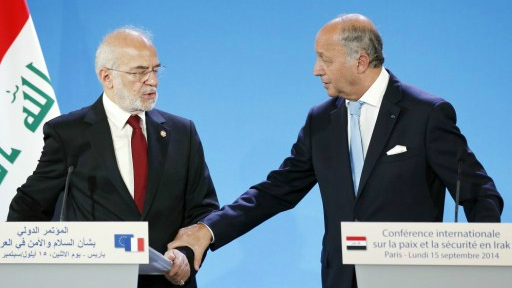
An international conference called to consolidate support for efforts against the Islamic State kicked off in Paris Monday with delegates vowing action against the terror group.
The US has so far been alone in carrying out airstrikes and no country has offered ground troops, but Iraq on Monday won a declaration by the conference’s 24 participant nations to help fight the militants “by any means necessary, including military assistance.”
Neither Iran nor Syria, which together share most of Iraq’s borders, was invited to the international conference in Paris, which opened as a pair of French reconnaissance jets took off over Iraqi skies.
In calling for action, the delegates embraced a UN Security Council resolution adopted last month strongly condemning Islamic State and and Syrian al-Qaeda affiliate al-Nusra Front, and calling upon participating states to prevent their citizens from joining the organizations and to sanction any individual or entity found belonging to or supporting them.
The resolution also calls upon its participants to prevent the payment of ransom to the terror groups, a scenario that was criticized for fueling further kidnappings and financing and giving leverage to extremists in the region.
The conference, officially titled “The International Conference on Peace and Security in Iraq,” is led by French President Francois Hollande and his Iraqi counterpart, Fuad Massoum. Leaders and representatives from the US, UK, Germany, the United Arab Emirates, Egypt, Saudi Arabia and 18 other nations are currently in attendance.
“We are asking for airborne operations to be continued regularly against terrorist sites. We must not allow them to set up sanctuaries. We must pursue them wherever they are. We must cut off their financing. We must bring them to justice and we must stop the fighters in neighboring countries from joining them,” Massoum said.
“The threat is global and the response must be global,” Hollande said, opening the conference. “There is no time to lose.”
The killing of David Haines, a British aid worker held hostage by the militants, added urgency to the calls for a coherent strategy against the brutal and well-organized Sunni group, which is a magnet for Muslim extremists from all over the world. The group rakes in more than $3 million a day from oil smuggling, human trafficking, theft and extortion, according to US intelligence officials and private experts.
Massoum called for a coordinated military and humanitarian approach, as well as regular strikes against territory in the hands of the extremists and the elimination of their funding.
After the conference ended, US Secretary of State John Kerry met privately with Massoum at the Iraqi Embassy in Paris, telling him that the drive for an inclusive Iraq government had been key to Monday’s pledges.
“So I hope you feel that the push and the risk was worth it,” Kerry said.
“We are beginning to feel it,” Massoum said through a translator.
Fighters with the Islamic State group, including many Iraqis, swept in from Syria and overwhelmed the Iraqi military in the Sunni-dominated Anbar province, capitalizing on long-standing grievances against the Shiite-led government in Baghdad.
When the militants arrived in Mosul, Iraq’s second-largest city, the US-trained military crumbled and the militants seized tanks, missile launchers and ammunition, steamrolling across northern Iraq. The CIA estimates the Sunni militant group has access to between 20,000 and 31,000 fighters in Iraq and Syria.
Muslim-majority countries are considered vital to any operation to prevent the militants from gaining more territory in Iraq and Syria. Western officials have made clear they consider Syrian President Bashar Assad part of the problem, and US officials opposed France’s attempt to invite Iran, a Shiite nation, to the conference in Paris.
Iranian Supreme Leader Ayatollah Ali Khamenei, speaking on Iranian state television, said his government privately refused American requests for cooperation against the Islamic State group, warning that another US incursion would result “in the same problems they faced in Iraq in the past 10 years.”
US State Department spokeswoman Jen Psaki declined to comment on specifics of any US approaches to Iran, but said “we are not and will not coordinate militarily.” Psaki said it was possible that US and Iranian officials would be able to touch on the problem of Islamic State militants later in the week in New York.
Russian Foreign Minister Sergei Lavrov insisted Monday that Syria and Iran are “natural allies” in the fight against the extremists, and therefore must be engaged, according to Russian news agencies.
“The extremists are trying to use any disagreements in our positions to tear apart the united front of states acting against them,” he said.
Iraq’s president, who has said he regretted Iran’s absence, appeared ambivalent about Arab participation, saying his country needed the support of its neighbors — but not necessarily their fighter jets or soldiers.
Gulf states, particularly Saudi Arabia and the United Arab Emirates, have some of the region’s best-equipped militaries, and they could theoretically provide air support to a broader international coalition. US officials say the Emirates and Egypt were behind airstrikes against Islamic-backed militants in Libya last month.
Saudi news agency al-Arabiya reported that Great Britain and France have began conducting reconnaissance missions in Iraq in support of the US air campaign.
Speaking in his first interview since becoming Iraqi prime minister, Haider al-Abadi told state-run al-Iraqiyya in comments aired Sunday that he had given his approval to France to use Iraqi airspace and said all such authorizations would have to come from Baghdad.
British Prime Minister David Cameron said his country would continue offering logistical help to US forces and that counterterrorism efforts will increase, describing the Islamic State group as a “massive” security threat. NATO secretary general Anders Fogh Rasmussen said the threat goes beyond just the recent killings.
“This group poses even more of a danger as it risks exporting terrorists to our countries,” he said in his outgoing speech as NATO’s top civilian official. “It also controls energy assets. And it is pouring oil on the fire of sectarianism already burning across the Middle East and North Africa.”


The Times of Israel Community.