

Faltering negotiations and increased hostility
Abbas may be using the threat of his team’s resignation to get the Israelis to stop announcing more settlement construction

 Add ToI as a Preferred Source on Google
Avi Issacharoff, The Times of Israel's Middle East analyst, fills the same role for Walla, the leading portal in Israel. He is also a guest commentator on many different radio shows and current affairs programs on television. Until 2012, he was a reporter and commentator on Arab affairs for the Haaretz newspaper. He also lectures on modern Palestinian history at Tel Aviv University, and is currently writing a script for an action-drama series for the Israeli satellite Television "YES." Born in Jerusalem, he graduated cum laude from Ben Gurion University with a B.A. in Middle Eastern studies and then earned his M.A. from Tel Aviv University on the same subject, also cum laude. A fluent Arabic speaker, Avi was the Middle East Affairs correspondent for Israeli Public Radio covering the Israeli-Palestinian conflict, the war in Iraq and the Arab countries between the years 2003-2006. Avi directed and edited short documentary films on Israeli television programs dealing with the Middle East. In 2002 he won the "best reporter" award for the "Israel Radio” for his coverage of the second intifada. In 2004, together with Amos Harel, he wrote "The Seventh War - How we won and why we lost the war with the Palestinians." A year later the book won an award from the Institute for Strategic Studies for containing the best research on security affairs in Israel. In 2008, Issacharoff and Harel published their second book, entitled "34 Days - The Story of the Second Lebanon War," which won the same prize.
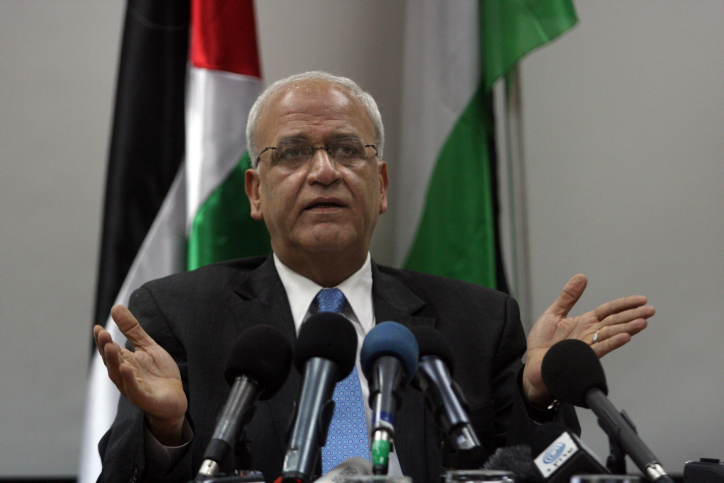
Palestinian Authority President Mahmoud Abbas said Wednesday, in an interview with Egyptian station CBC, that the Palestinian negotiating team had resigned in protest over continued construction in the settlements. The message succeeded, it seems, in surprising even the members of the negotiating team themselves.
Two weeks before, Saeb Erekat and Mohammed Ishtayeh had filed a resignation letter with Abbas, which was leaked to the media. That same evening, one of Abbas’s spokesmen said that he “didn’t know about any such resignation.” The two Palestinian negotiators met again with their Israeli counterparts during US Secretary of State John Kerry’s visit, which was one week ago. And so the question is, have they resigned or not?
The reason given by Abbas for the resignations was construction in the settlements. According to the interview, it was up to him to convince the negotiating team to not resign, or, alternatively, to appoint a new negotiating team. Abbas added that he believed discussions would continue despite the resignations. Erekat then told Reuters that the talks were frozen last week.
Abbas, it seems, decided to go along with Erekat’s actions. Because of the way the Israeli side talks about the settlements, with the right flank of the government (Housing and Construction Minister Uri Ariel and the rest of the Jewish Home party) trying to break the left flank (justice minister and chief negotiator Tzipi Livni, the Yesh Atid party) with myriad announcements about settlement construction, Abbas is using a catch-me-if-you-can policy.
The message he is trying to convey to the Israelis is that if tenders for continued construction in the West Bank continue to be issued, in the end the PA will lose its authority and will no longer be able to conduct negotiations. A break in discussions, in the current climate, would actually be accepted by the international community, and the PA could renew its petitions to the United Nations with stronger international backing.
The next question — and the answer is unclear — is how such a move would affect the reality on the ground. Abbas knows, also, that the West Bank suffers from chronic instability. Relative calm has been maintained, but more and more fuel for a potential fire is being accumulated from the ongoing series of “independent” Palestinian attacks on Israeli targets.
Despite the dismissive response by the Israeli government regarding Secretary of State John Kerry’s warning last week that if negotiations fail, there is a danger of a third intifada, it is not a fictional scenario. Although it might not be a popular national street uprising like the first intifada in 1987, we can certainly expect an upsurge in hostilities similar to the stabbing attack on a bus in Afula on Wednesday, in which IDF soldier Eden Atias was murdered in his sleep by a 16-year-old Palestinian.







The Times of Israel Community.