

Francis seeks a moment of symbolism
No, a planned Peres-Abbas-Francis Vatican prayer meeting won’t produce a peace deal. But it could yield a rare, resonant picture of unity for a common cause

 Add ToI as a Preferred Source on Google
David Horovitz is the founding editor of The Times of Israel. He is the author of "Still Life with Bombers" (2004) and "A Little Too Close to God" (2000), and co-author of "Shalom Friend: The Life and Legacy of Yitzhak Rabin" (1996). He previously edited The Jerusalem Post (2004-2011) and The Jerusalem Report (1998-2004).
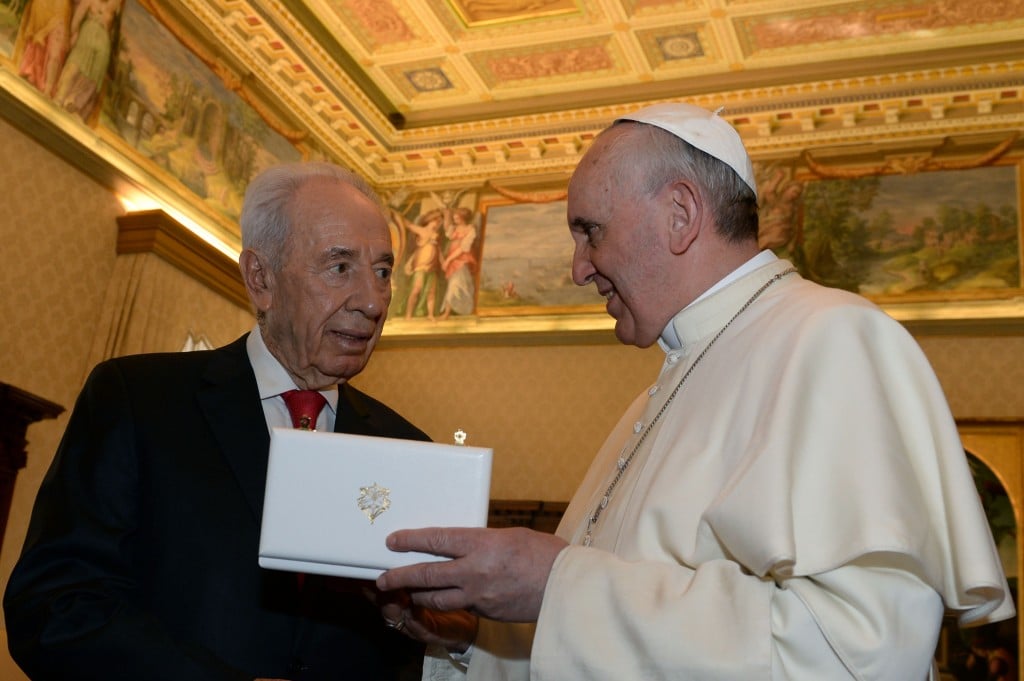
It’s easy to be cynical about the news that Israel’s President Shimon Peres and Palestinian Authority President Mahmoud Abbas have accepted Pope Francis’s invitation to join him in an “encounter of prayer” at the Vatican next month. Yeah, right. Like that’s going to help solve a hundred years of conflict.
Abbas is the perpetually exhausted-looking 79-year-old Palestinian leader — more than nine years into a four-year term — who just threw in the lot of his Fatah political faction with the Islamic extremists of Hamas. Not surprisingly, given that Hamas openly seeks the destruction of Israel, the senior ministers of the Israeli government — already deeply skeptical about Abbas’s peace-making credentials — voted unanimously to suspend negotiations with the PA as soon as the Palestinian unity pact was announced.
And Peres is the 90-year-old state president whose seven-year term comes to a close on July 27, and who in any case holds no direct political power in what is essentially a symbolic position.
Two aging Middle East leaders, brought together by a naive, well-meaning new pope: How on earth could a prayer meeting between this trio have any significant impact on the hostile ground back home?
Well, it’s not going to produce a political breakthrough. White smoke billowing from the Vatican chimney? Absolutely not.
But that, of course, is not the pontiff’s intention. His goal, rather, is to give the Israeli and Palestinian peoples a picture of their representatives, deferential before a higher power, and united in common cause.
It is a central Palestinian claim that the Israelis fail to internalize their legitimacy as a people, deserving of a state. It is a widespread Israeli conviction that the Palestinians refuse to come to terms with the legitimacy of Jewish statehood in the Holy Land. Bringing leaders of the two entities together in Rome, Francis would hope to create a resonant moment of symbolism — a moment to signify that each side has a narrative that must be acknowledged and internalized by the other if an Israeli-Palestinian accommodation is to be achieved.
There are worse goals.



The Times of Israel Community.