

How I helped ‘God’ find his earth
A theatrical deity comes to Jerusalem
 Add ToI as a Preferred Source on Google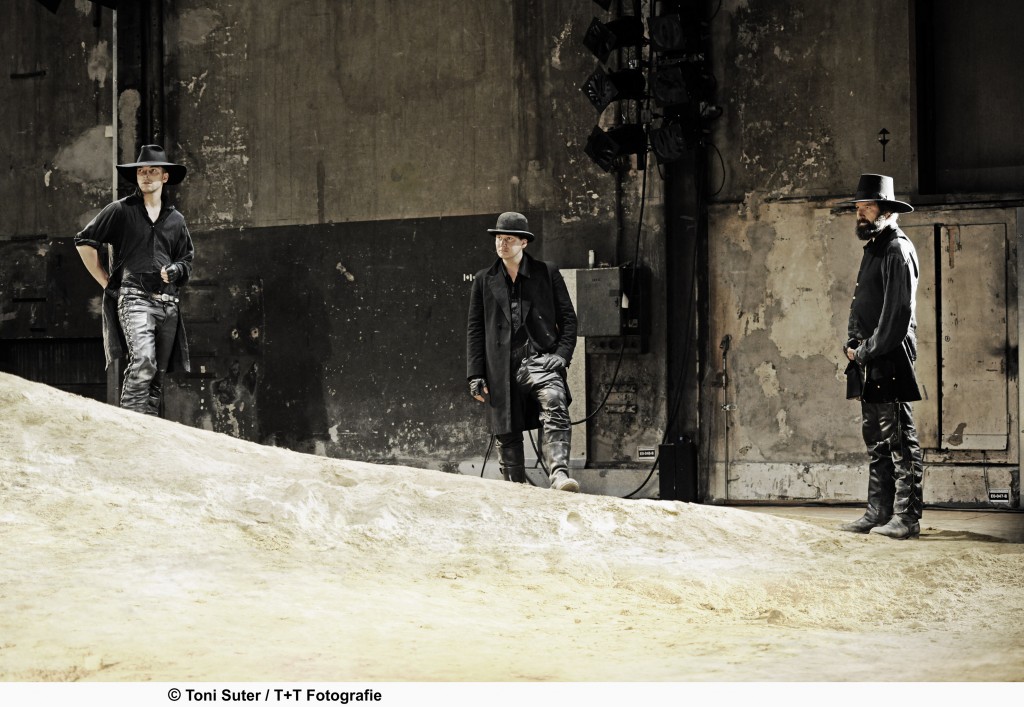
I met God in Jerusalem one morning earlier this month, on a Sunday. Such things happen in this city — not frequently, perhaps, but more frequently than they do elsewhere.
This God was a friendly Swiss man of considerable presence with a bracelet, loafers, and a dark and prophetic-looking beard. He was looking for local dirt and had reached me through a friend, hoping I would be able to help. I was, and when God had finished a light breakfast at his hotel, we set off in his rental car for a paved promenade in southern Jerusalem overlooking the navel of creation, the Temple Mount. He seemed excited to be here.
When we arrived, he opened the trunk and pulled out the metallic suitcase he had brought empty from Zurich. We walked down the promenade until we found a shady patch beside a few hot rosemary bushes, and he began to burrow in the ground with his hands, filling the suitcase with soil. In Switzerland, he said, behavior like this in a public park would cause a stir and we would be questioned within minutes by authorities. But this is Jerusalem, where bearded men engaged in strange projects have been a staple for several millennia; the few passers-by who noticed us paid no mind.
God’s name was Michael Neuenschwander. He was 50 years old and an actor. The institution that had bestowed divinity upon him was the Schauspielhaus, a theater in Zurich.
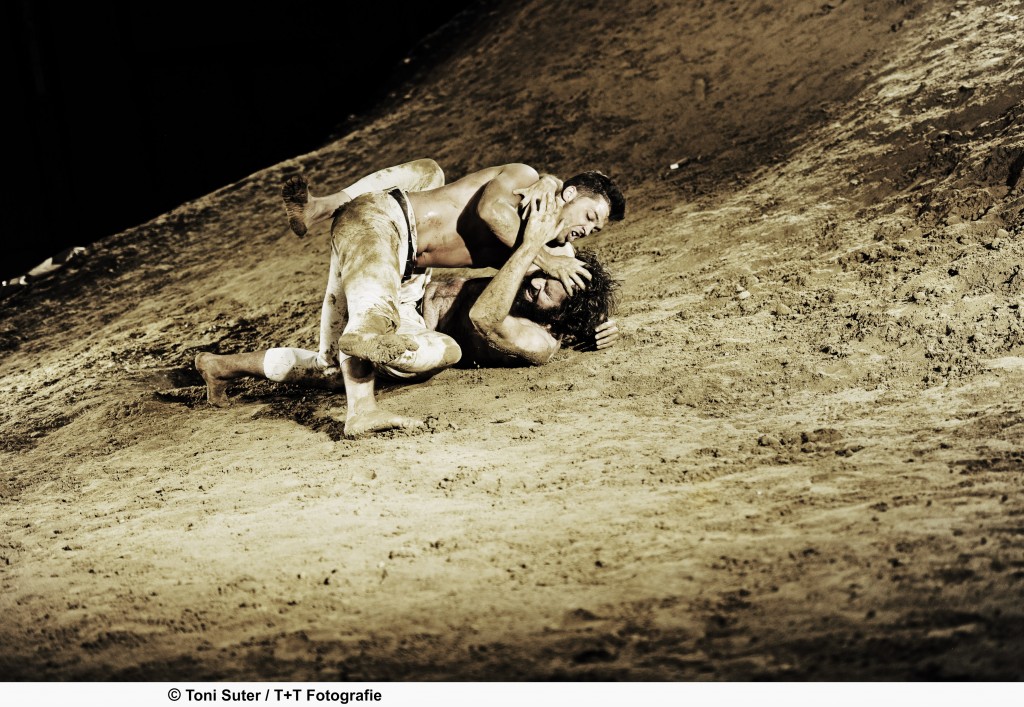
The company was in its final weeks of work on a new play, Genesis, that involved reading and acting out every single word of the biblical book of that name for five hours on a set consisting of an enormous mound of soil. Most of the soil — 44 tons of it — would be trucked over the border from Germany. But some of it, the creative team decided, had to come from the land of the Bible.
They decided to send Neuenschwander for a quick trip, armed with a suitcase and a cameraman named Moritz who would shoot a short film about the quest. Seeking a connection in Israel, the director’s wife asked a writer in New York who happened to be a friend of mine, and I was thus drafted as God’s local soil procurement adviser.
Playing the idiosyncratic deity of the Hebrew Bible, Neuenschwander said, is a unique challenge even for a veteran of the Zurich stage. Part of his character, he said, is a stern father, “someone who would be severe — nice but also severe — someone who gets angry fast and can’t be controlled.” Another part, he said, is that of a “Western bad guy or hero.” In this he was aided by the theater’s costume designer, who outfitted the Lord in leather pants and a black cowboy hat.
He has struggled, he said, with striking a balance between appearing stern without seeming too punishing, and with how to breathe life into lines that can sometimes sound repetitive: In Genesis, God spends quite a bit of time promising the Patriarchs future greatness and darkly predicting retribution for failings. “I haven’t quite found the solution,” he said.
When we were finished in Jerusalem, Neuenschwander proceeded to the Dead Sea for some desert earth, taking the opportunity to float in the salty water in dark-blue trunks. He finished the day on the Mediterranean, topping off his suitcase with sand from the beach at Tel Aviv, before flying out early the next morning.
A superstitious observer might be forgiven for believing that, in the run-up to opening night, this play about the divine was plagued by the devil himself. Last month, the elderly actress who was supposed to play Sarah was forced to seek treatment for exhaustion and resigned. Then Joseph got sick, and a renewed inflammation of an old injury from a car accident knocked out Abraham. On Thursday, the day before the play was to open, the actor who plays both Levi and Ephron the Hittite became ill and required surgery. Four of the play’s 10 actors had to be replaced by the time the curtain went up on Friday night.
The show went on nonetheless, after a ceremony in which the actors and crew sprinkled the 40 pounds or so of earth, which Neuenschwander brought back from Israel, onto the immense pile of local soil.
The pile — my pile, I like to think, by virtue of the one-half of a percent of it that was collected under my direction — was put to striking use by the stage crew: At one point, it was lit up with a blanket of squares so it resembled a giant, uneven and dizzying checkerboard. A different projection turned it into Jacob’s ladder. One of the characters lit a real bonfire on it, and another grazed five live sheep across it.
“Genesis” seems to have elicited strong reactions. “Some scenes get lost in the kitschy depths of a Hollywood bible film, only to be resurrected at the end as a spaghetti Western,” one reviewer wrote on the website of the highbrow German state TV station 3sat. “It includes some striking images — like Jacob’s dream of the ladder toward heaven — but also scenes of helpless boredom.” Five hours is a long time.
Still, the reviewer concluded, the play is “a colossal piece of theater.”
Genesis is not only the “origin of stories in our culture,” but it was also made for the stage, director Stefan Bachmann said. “If you look at this book as a maker of theater, you have the impression it was created for the theater.”
The God at the center of the story is “totally unpredictable,” Bachmann said. “You never know with whom you are dealing — he is a very dangerous father figure.”
Neuenschwander, he said, was a “fantastic actor,” who both played the part of the deity and served the production in a parental capacity as the oldest and most experienced member of the cast. “In these two ways, he was actually very God-like,” Bachmann said.
_________
Find Matti Friedman on Twitter and Facebook.










The Times of Israel Community.