

Speaking truth to the power company
With thousands of homes still unable to turn on the TV, the press turns the Tel Aviv area into Mogadishu, and the Electric Corporation’s grumpy union into the worst thing since unsliced bread
 Add ToI as a Preferred Source on Google
Joshua Davidovich is The Times of Israel's Deputy Editor
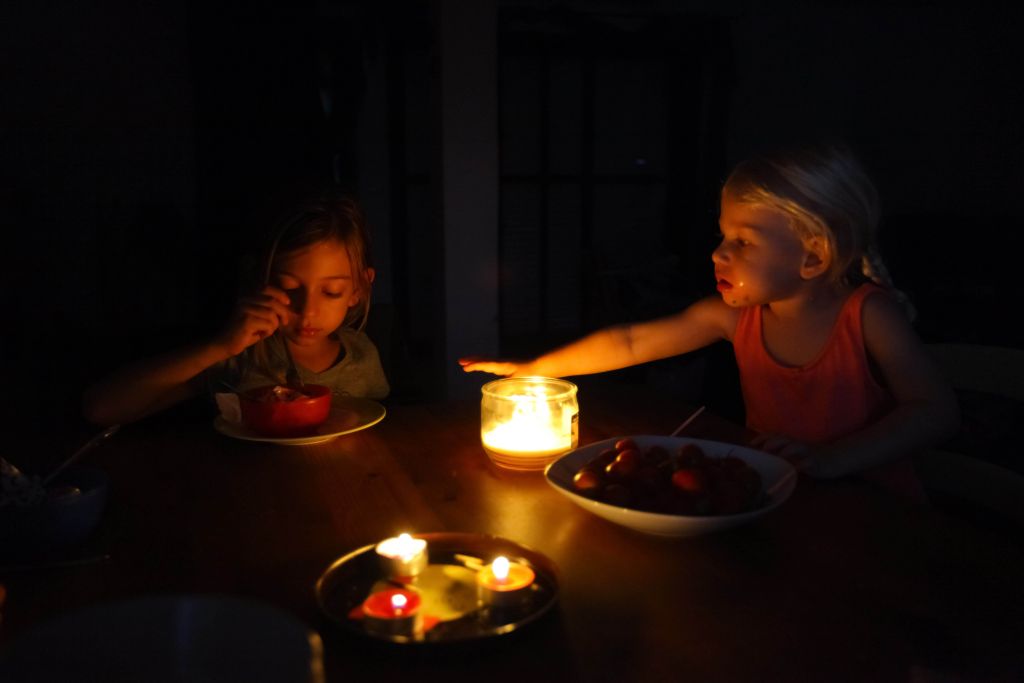
Daily stabbing attacks are bad, but they are apparently nothing compared to having to spend a full day without refrigerators, light switches and a way to charge your iPad to play Candy Birds, or whatever. As the mayor of Herzliya put it Monday, apparently in total earnest, “Before we were afraid of terror; now we are afraid of the dark.”
But quips from the Herzliya mayor are just the tip of the iceberg as the press gives voice to the (quite literally) powerless. Words like “ridiculous,” “disgrace,” and “third-world situation” are batted about to describe ongoing power outages in some parts of central Israel, making it seem like 24 hours without electricity have turned Herzliya Pituah into Mogadishu.
“How is it that tens of thousands of families are cut off for hours and days from the power supply? How is it possible that the weather yesterday improved so much and yet the Electric Corporation still hasn’t managed to fix the problems and restore power?” Yedioth Ahronoth’s Amir Ben David asks. “Yesterday the IEC was busy mostly with excuses.”
Ben David isn’t the only one to point an accusatory finger at the Electric Co. for falling down on the job. Haaretz reports that emergency crews sent out to fix the power outages were told to stand down by their union in a power play to force the management’s hand, or so the company’s management claimed in court. The result was that some 33,000 homes were still without power when the paper went to print at midnight, including the homes of several seniors, who had to be moved for fear they would be unable to call for help in an emergency.
“Many seniors are calling us for help out of fear their panic button won’t work,” a social worker tells the paper. “We’re talking about old people who rely on the button and really fear it won’t work.”
Mogadishu indeed.
Reut, a mother of four in Kfar Saba, brings the weather and the terror fears together in one little package, explaining that the door for her building needs to be kept open because of the lack of power, and her husband is away, leaving her frightened of the dark and things that go stab in the night.
“We live on the first floor. I was so afraid to go to sleep that I put a butcher’s knife under my pillow. I tried to stay calm in front of my kids, but my 14-year-old son saw the knife in the morning and asked about it. I explained mommy is scared. He already understands. You try not to telegraph fear, but you are terrified and the kids get it,” the paper quotes her saying.
The tabloid’s Hezi Sternlicht is steaming mad about the whole affair and uses the opportunity to call for the electricity market to be deregulated and opened to competition quickly, which just happens to be the reform on the table which is apparently making the workers drag their feet in protest.
“The Italian strike on Black Sunday – or to be more exact the lack of correctness of workers to come out to the Sharon region according to the management’s orders to fix the damage from the ‘hurricane,’ which was a bit of hail and rain, and to leave tens of thousands of homes without electricity was spitting in the face of the country. I would use the unfamiliar term ‘customer,’ but I don’t think the monopoly really understands what that is,” he writes.
The power is cut off, and Haaretz reports that had John Kerry not brokered a deal between Israel and Jordan regarding the Temple Mount Saturday, ties with Amman may have been also.
The paper reports that relationships with Sunni states being secretly forged in the wake of the Iran nuclear deal had taken a hit due to the violence, and quotes Prime Minister Benjamin Netanyahu saying that “there had been a period of tension and a disconnect with Jordan,” at a closed Knesset panel meeting on Monday, according to unnamed sources.
The paper also offers a slew of fly-on-the-wall details from diplomatic efforts over the weekend, including such nitty gritty stuff as Kerry losing his voice after catching a cold and needing aides to conduct talks for him, and more substantial points, like US officials confirming there were no side deals reached and details from the agreement to install cameras on the Temple Mount.
“Substantial progress in the US efforts came at the Kerry-Netanyahu Berlin meeting, where Netanyahu surprised Kerry, telling him that in the past the Jordanians had proposed to Israel that cameras be installed on the Temple Mount to ensure that no damage was being done to the mosques, and no violations of the status quo,” the paper reports.
“Netanyahu told Kerry that he liked the idea and urged that it be pursued. The Israeli leader suggested that after the secretary’s meeting in Amman with King Abdullah, Kerry would announce Israel’s agreement, and credit would go to the king for the idea. In the near future, teams from the Israel Police and the Waqf will meet to coordinate the issue of the installation of the cameras on the Mount and to discuss reinforcing security arrangements to head off the entry of provocateurs from either side at the site.”
Who’s inciting against whom?
That peace deal with Jordan is one of the greatest surviving legacies of Yitzhak Rabin, and commemorations of him in the papers continue Tuesday, following a state ceremony to mark the anniversary of his death Monday.
Yedioth quotes an uber depressing Dalia Rabin, who told the memorial of her naivete in thinking that by now the peace process landscape would have changed for the better.
“I thought the darkness that descended upon my family would create a revolution, unity around the goal, to understanding that the shots in the square and the terrible murder would mean more than all the challenges against democracy,” she is quoted saying.
The paper also quotes current Labor leader Isaac Herzog continuing to blast Netanyahu for his failure to act toward peace, reminding people of Netanyahu “standing on the balcony and hearing them call [Rabin] a traitor,” a throwback to what many say was the then-opposition chiefs role in bringing about the prime minister’s murder.
But Israel Hayom’s Haim Shine turns the whole idea on its head, with a full page commentary accusing leftists, and particularly Herzog, of using Rabin’s murder to besmirch the right with a “divisive, inciting speech that arouses not a little bit of anger.”
“On every broadcast we are told about the danger to democracy, and an accusatory finger is pointed at the right, and especially to skullcap-wearers. Those who appropriate his heritage explain to us the righteousness of the Palestinians and their demands for a political horizon and their own state. In their version, the Palestinians were the victims of the War of Independence, which Rabin commanded,” he writes. “In answer to a question if there will be a day off work to mark 20 years for the death of a prime minister, Noa Rothman, the granddaughter of Rabin, said ‘Maybe for Netanyahu there will be.’ Make no mistake. This wasn’t a typo or even a dark joke. And don’t believe the apologies. This is part of the poison of polarization, which every year, for 20 years now, is injected into Israeli society. Shimon Peres remembers well who was on the balcony, but it’s a shame he doesn’t remember who stood behind the distribution of the terrible picture of him in a Nazi uniform. A picture which has recently been repeated with Netanyahu. Leftist pundits didn’t care and didn’t raise a ruckus. In the scrum against Netanyahu there are no limits. Anything is allowed.”


The Times of Israel Community.