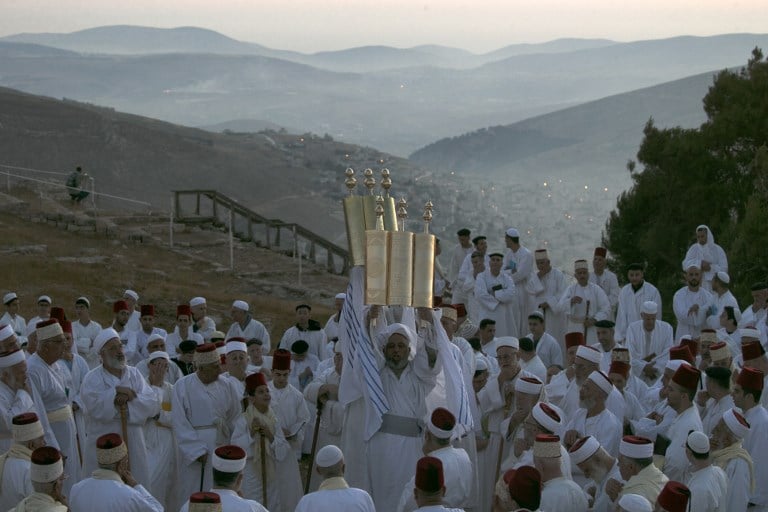
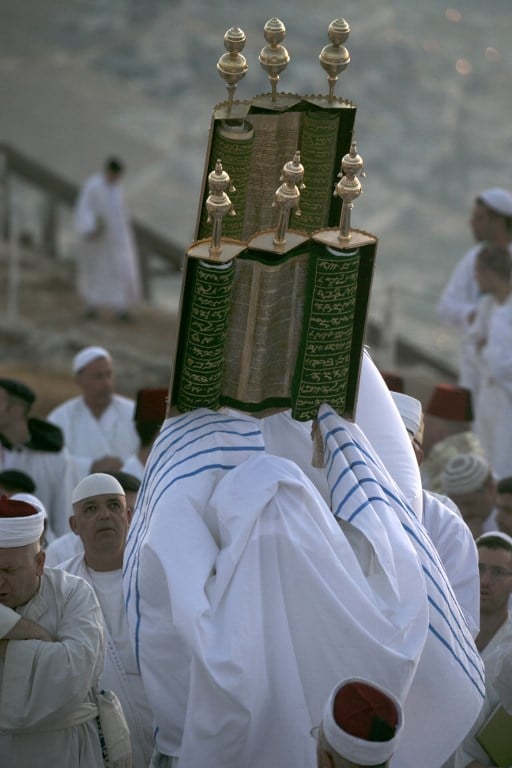
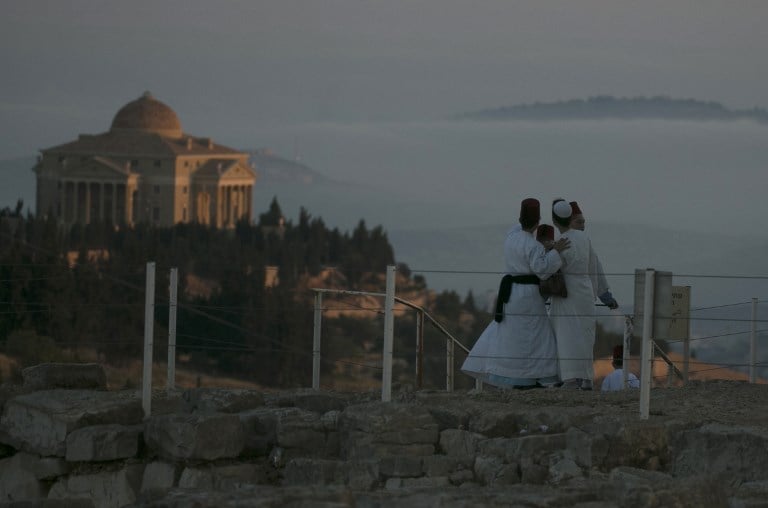
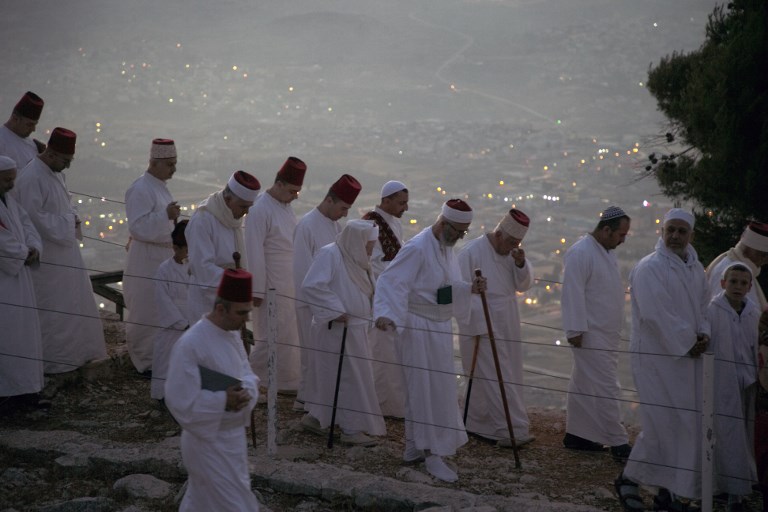
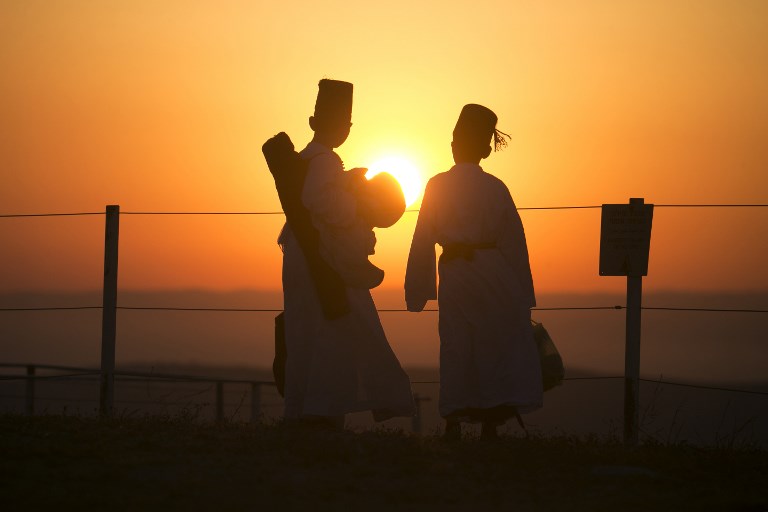
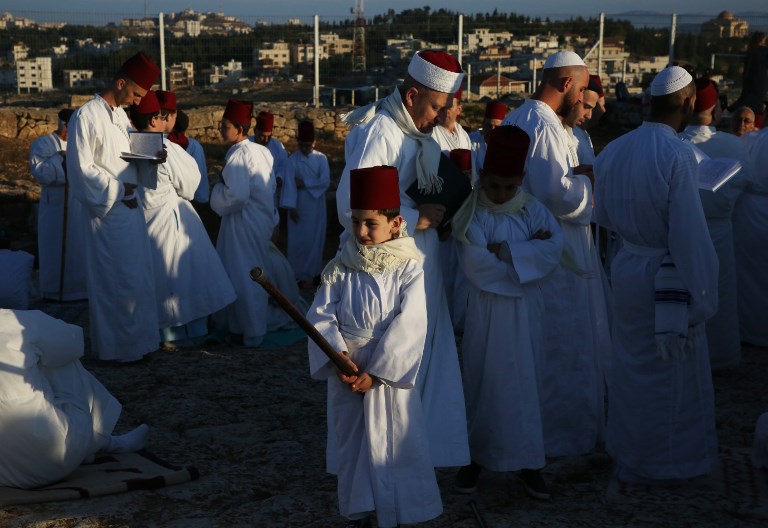
Samaritan worshipers pray on top of Mount Gerizim near the northern West Bank city of Nablus as they celebrate the Shavuot festival at dawn, on June 4, 2017. (AFP PHOTO / JAAFAR ASHTIYEH)
The tiny community of Samaritans in Israel and the West Bank gathered on Sunday to celebrate the biblical festival of Shavuot, the anniversary of the day when they believe Moses received the Torah on Mount Sinai.
Rejecting the rabbinic traditions of the oral law, the Samaritans, whose sect number some 750 members, derive their religious customs straight from their version of the Torah or Pentateuch, which parallels closely the story of the Five Books of Moses.
But whereas Jews celebrated Shavuot last Wednesday, the Samaritans marked the festival, as always, on Sunday. The discrepancy comes from the verse which says that, “You shall count for you from the day after the Sabbath… seven complete weeks, until the day after the seventh Sabbath you shall count fifty days,” (Leviticus 23:15-16).
Rabbinic Judaism interprets “the day after the Sabbath” as referring to the day after the first day of the Passover festival. However, the Samaritans understand it to literally mean Shabbat, so they begin counting their seven weeks only from the Saturday during the intermediate days of Passover, and therefore Shavuot always occurs on a Sunday.
Samaritan worshipers pray on top of Mount Gerizim near the northern West Bank city of Nablus as they celebrate the Shavuot festival at dawn, on June 4, 2017. (AFP PHOTO / JAAFAR ASHTIYEH)
Unlike Jews, for the Samaritans Shavuot is a seven-day festival, and as one of the three pilgrimage festivals, the faithful all gather on Mount Gerizim, near the West Bank city of Nablus, which they believe is God’s chosen site, rather than Jerusalem, and where layers of the ancient Samaritan temple destroyed and rebuilt over millennia still exist today.
Get The Times of Israel's Daily Editionby email and never miss our top stories
Samaritan worshipers gather to pray on top of Mount Gerizim near the northern West Bank city of Nablus as they celebrate the Shavuot festival at dawn, on June 4, 2017. (AFP PHOTO / JAAFAR ASHTIYEH)
Samaritans in general trace their lineage back to the biblical tribes of Menashe and Ephraim, the sons of Joseph. They defied imperial conquests and clung to the land while much of the population of the Northern Kingdom of Israel was exiled to Assyria — presently northern Iraq — by King Sargon II in 722 BCE.
Samaritan worshipers gather to pray on top of Mount Gerizim near the northern West Bank city of Nablus as they celebrate the Shavuot festival at dawn, on June 4, 2017. (AFP PHOTO / JAAFAR ASHTIYEH)
When exiled Jews began returning to Jerusalem from Babylon in the 6th century BCE and building the Second Temple, they refused to recognize the Samaritans as coreligionists.
Samaritan worshipers gather to pray on top of Mount Gerizim near the northern West Bank city of Nablus as they celebrate the Shavuot festival at dawn, on June 4, 2017. (AFP PHOTO / JAAFAR ASHTIYEH)
From the nearly 1,000,000 strong Samaritan kingdom that existed in the Roman period, only 750 Samaritans populate the earth today. Half live in the Samaritan village on Mount Gerizim and the other half live in the Israeli city of Holon.
Advertisement
Samaritan worshipers gather to pray on top of Mount Gerizim near the northern West Bank city of Nablus as they celebrate the Shavuot festival at dawn, on June 4, 2017. (AFP PHOTO / JAAFAR ASHTIYEH)
Help us report truthfully on social media
As a multimedia journalist, my job is to take the quality, fact-based journalism produced by The Times of Israel newsroom and make it accessible across every platform — from Instagram posts to podcasts to short-form videos.
This is how many, especially young people, consume news these days. But misinformation is rampant on social media. Our team at ToI produces accurate, responsible short-form reporting on Israel and the Jewish world.
If you believe in the importance of factual social media journalism, please consider joining our reader support group, The Times of Israel Community. Your financial support is essential to sustain responsible multimedia reporting.
We’re really pleased that you’ve read X Times of Israel articles in the past month.
That’s why we started the Times of Israel - to provide discerning readers like you with must-read coverage of Israel and the Jewish world.
So now we have a request. Unlike other news outlets, we haven’t put up a paywall. But as the journalism we do is costly, we invite readers for whom The Times of Israel has become important to help support our work by joining The Times of Israel Community.
For as little as $6 a month you can help support our quality journalism while enjoying The Times of Israel AD-FREE, as well as accessing exclusive content available only to Times of Israel Community members.
Thank you, David Horovitz, Founding Editor of The Times of Israel


 Add ToI as a Preferred Source on Google