

(Big) sticks and (throwing) stones
Continuing violence, including a ‘near lynch,’ dominates coverage of Arab protests, but anger is bubbling on both sides
 Add ToI as a Preferred Source on Google
Joshua Davidovich is The Times of Israel's Deputy Editor
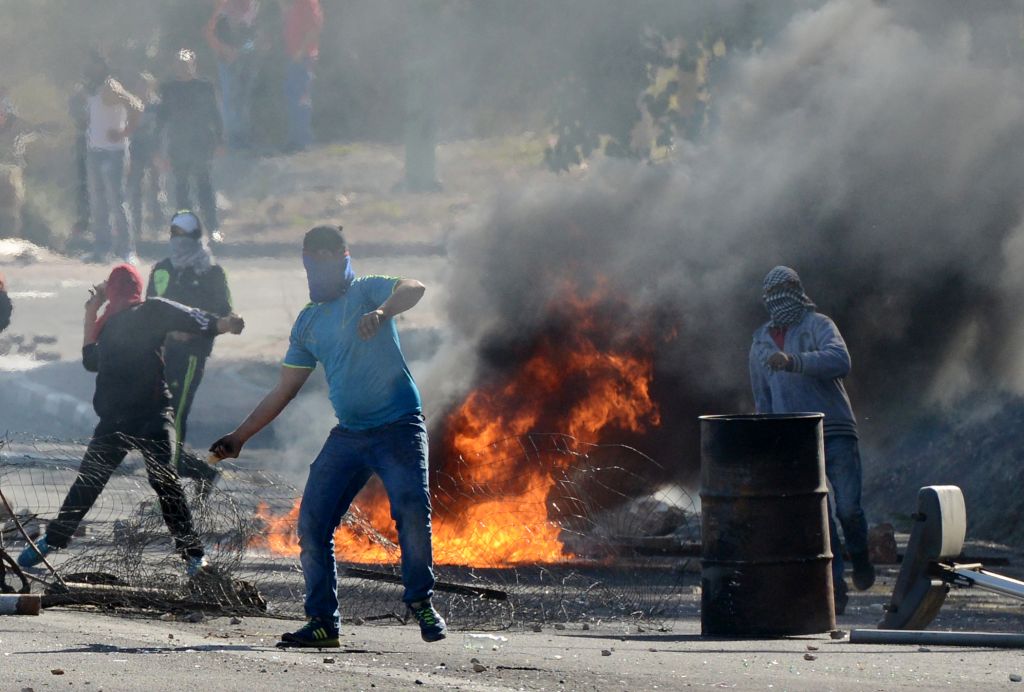
The protests in a number of Arab towns sparked by the shooting death of a knife-wielding man did not quite die down Sunday, and Monday’s papers reflect the ongoing wave of unrest shaking the country.
Yedioth Ahronoth takes a generalized view of the violence, which it terms “the stone protest” (as opposed to other protests) and Haaretz is still mostly focused on the Friday night shooting itself (relegating the story to second place behind coalition jibber-jabber) but Israel Hayom zooms in what may have been the most violent incident during Sunday’s protests, what it terms a “near lynch” near the Arab city of Taibe.
“That was really scary. I hope this doesn’t repeat itself to anyone else,” Moshe German, a Netanya resident whose car was attacked and set ablaze, and who managed to escape with only light injuries, tells the paper.
Lest you think Taibe was the only place that saw disturbances, Yedioth whips out a neat little map showing all the various hotspots from Rahat in the south to Acre in the north. But, the paper reports, make no mistake that the anger was centered in Kafr Kanna, where 22-year-old Kheir Hamdan was shot by police Friday night, and where cops and protesters faced off in a day-long battle for control of a nearby highway.
“The center of the worst unrest was in Kafr Kanna. Throughout the day, hundreds of police clashed with hundreds of youths, who tried time and again to go to the Beit Rimon Junction on Route 77 and stem the flow of traffic, but were stopped. All business were closed as part of a general strike called by the heads of the Arab community. The protesting youths threw stones and explosives and called for ‘death to the Jews.’”
Haaretz leads its coverage with the news that the police opened an investigation into the killing, with the shooter policeman saying he was trying to neutralize Hamdan but not kill him. “The bullet, unluckily, hit him in the hip, and caused heavy bleeding in his artery, which caused him to die,” the cop is quoted as saying.
In the paper’s op-ed page, Oudeh Basharat angrily sums up the rage on the Arab street over the shooting, accusing the police of caring little about the Arab community, and the country of backing those same low-down, dirty coppers.
“This is the way things are: When the victim is an Arab, an entire country devotedly protects the murderers. Then they wonder why the police officers are trigger-happy. It happens because Arab blood is less valuable,” he writes. “Since October 2000 and the daring report by the Or Commission, which spoke about the police’s hostile treatment of the Arab population, more than 30 young people have been killed by police gunfire. Only in very few cases were files opened against those responsible for the killings. In most of the cases, the incidents went by quietly.”
On the other side of the political spectrum, Prof. Alexander Bly writes in Israel Hayom that the police and government officials need to do more to crack down on violence in the Arab community and elsewhere: “It needs to be said that the Israeli government has not set down a clear and unmistakable policy on political violence and its penalties, so that at times a citizen could mistakenly think that he won’t pay for violent actions. The government needs to push zero-tolerance policies for violence of any type, without any special connection to the Arab community — but also on them there needs to be strong-fisted enforcement.… It needs to be that anybody who attacks any target – whether innocent citizens, women, babies, up to police and security forces – will not get away with it.”
Enforcement may be an issue going forward though, as Yedioth reports on a new army plan, to presented in the coming days and implemented starting next year, that will see Israel’s standing military contract significantly. Among the shrinkage, the paper reports, will be 4,500 career military positions, which will be cut, though the Iron Dome, submarine and cyber defense units won’t be affected. Officers will now be forced out of the Kirya by age 47, and will get a one-time parting payment instead of the bridge pension their predecessors enjoyed. For new recruits, instead of doing the standard three years, most will end their service after 32 months. And the army will also stop spending manpower and money on chasing down reserves dodgers.
Speaking of cutting and running, the resignation of Environment Minister Amir Peretz (a former defense minister considered the grandfather of Iron Dome) reverberates through the press. Haaretz sees it as a “crack” in an ever-weakening coalition, and the paper’s Yossi Verter handicaps where the next coalition kerfuffle will come from.
“Now, 24 hours later, eight days after the resignation of Interior Minister Gideon Sa’ar, the fractious, shrunken and cantankerous government is waiting for developments: Where will the next conflict erupt, weakening its immune system further,” he asks. “Economy Minister Naftali Bennett is hinting at a crisis over his objection to the proposed zero-VAT law, the darling of Finance Minister Lapid. … Netanyahu himself sharply criticized Lapid on Sunday for refusing to take certain economic steps. Foreign Minister Avigdor Liberman hasn’t yet been heard from. He was seen in a lengthy huddle with Lapid outside the cabinet room. Justice Minister Tzipi Livni joined from time to time as the prime minister’s associates looked on with displeasure.”








The Times of Israel Community.