

Columbia suspends deadline-defying anti-Israel protesters; arrests at other campuses
University says move aims ‘to ensure safety on our campus,’ after its president refused to divest from Israel, highlighted Jewish students’ plight; ‘Columbia will burn,’ warns SJP
 Add ToI as a Preferred Source on Google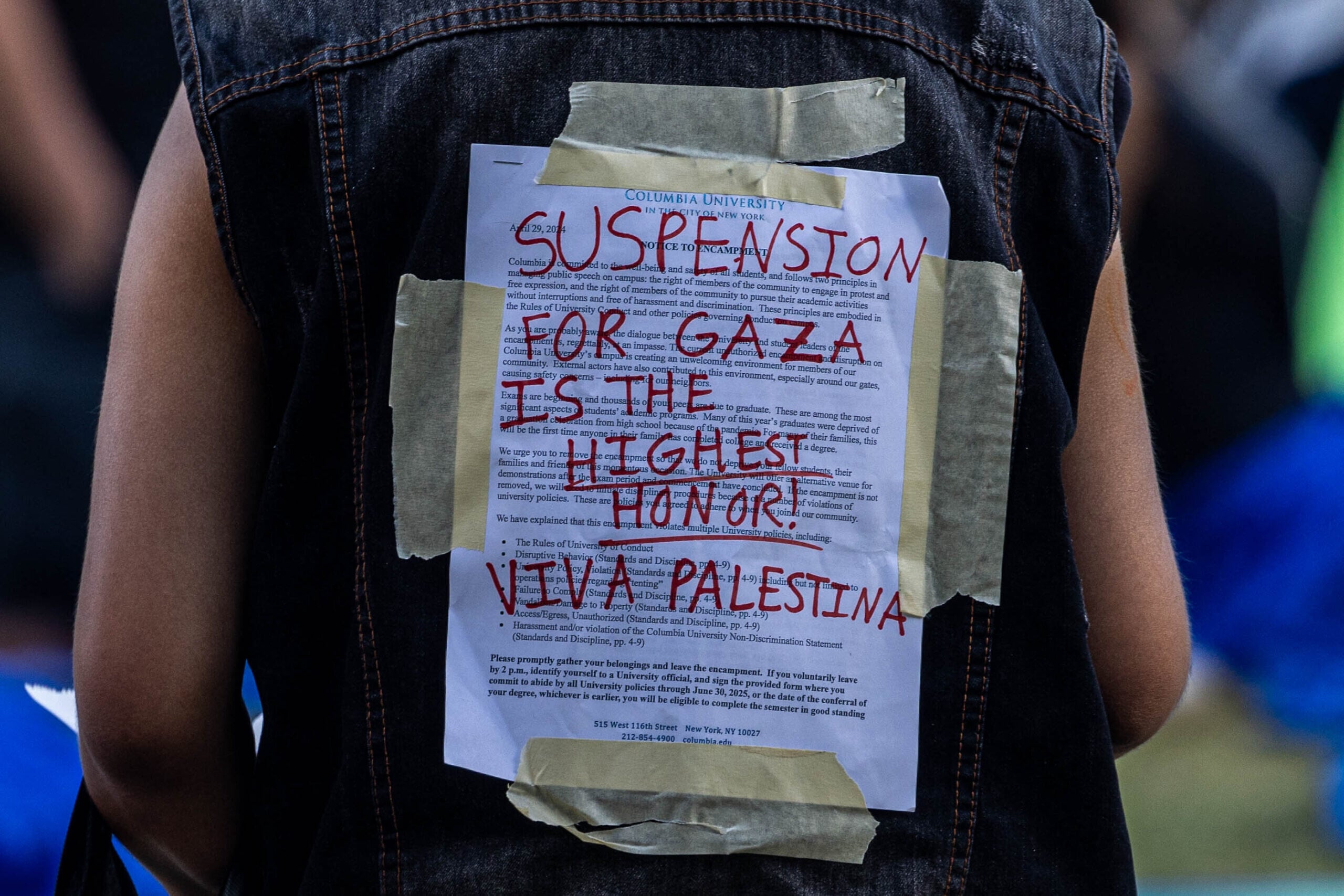
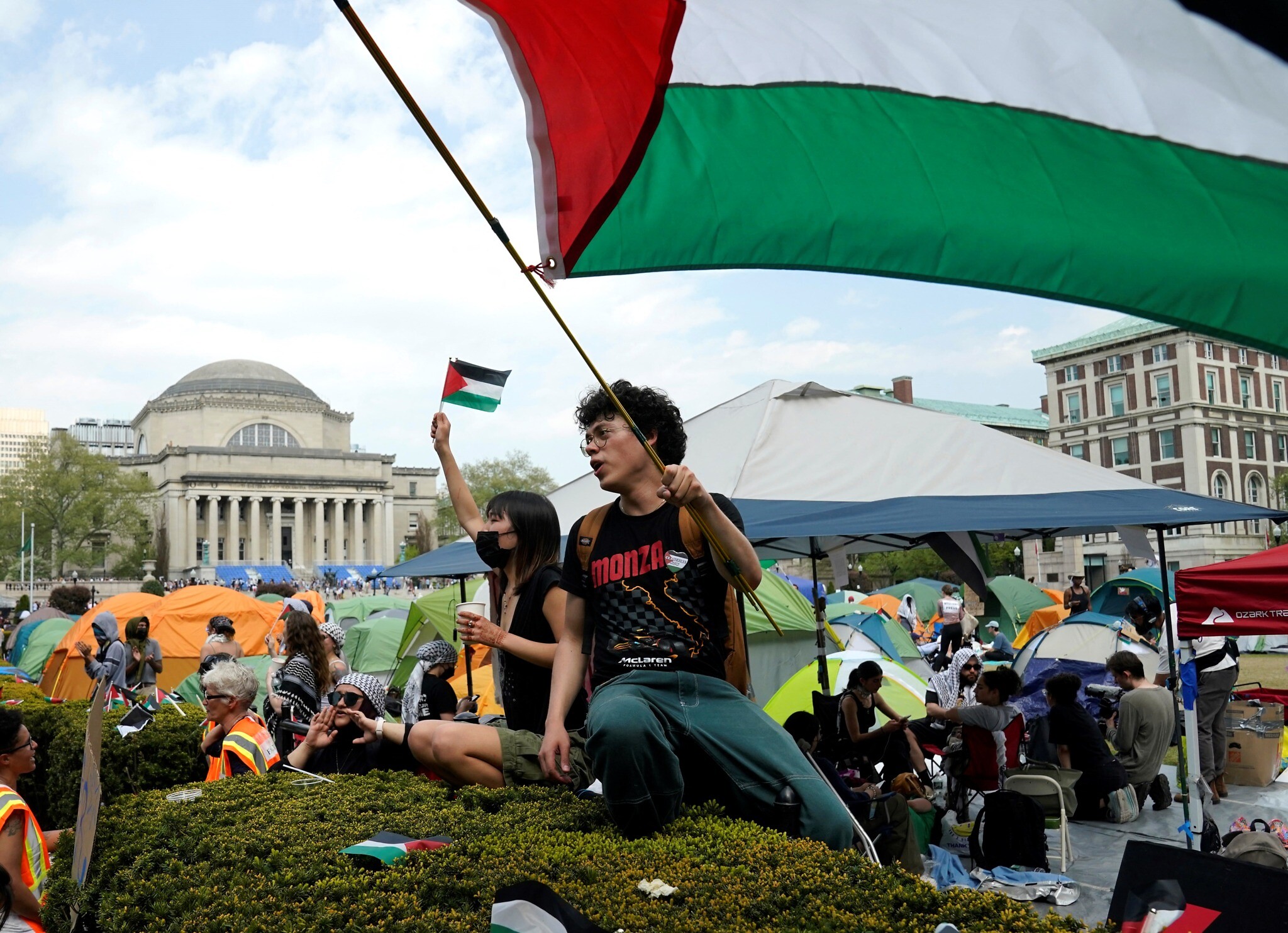
NEW YORK — Columbia University, the epicenter of anti-Israel protests that have upended college campuses across the United States, began suspending student demonstrators on Monday after they defied an ultimatum to disperse.
The move follows almost two weeks of protests against Israel’s war against the Hamas terror group in Gaza — which have sometimes veered into antisemitism and intimidation of Jewish students — that have swept through higher education institutions from coast to coast, after around 100 protesters were first arrested at Columbia on April 18.
In the latest crackdown, authorities at the prestigious university in New York demanded that the protest encampment be cleared by 2:00 p.m. local time, or students would face disciplinary action.
The deadline, which had previously been repeatedly delayed, was openly defied.
Pictures shared by the local branch of Students for Justice in Palestine, which despite being suspended has been calling for its supporters to flock to the encampment, showed paper copies of the ultimatum with “Columbia will burn” and “I aint [sic] reading all that Free Palestine” written on them.
“These repulsive scare tactics mean nothing compared to the deaths of over 34,000 Palestinians,” said a statement, read out by a student at a press conference after the deadline, referring to an unverified Hamas-issued death toll in Gaza that doesn’t differentiate between terror group members and civilians.
Columbia Students for Justice in Palestine:
“Columbia will burn.” pic.twitter.com/pDb2Jv7Xq9
— Steve McGuire (@sfmcguire79) April 29, 2024
“We will not move until Columbia meets our demands or… are moved by force,” said the student, who would not give his name.
A few hours later, Columbia Vice President of Communications Ben Chang said the university had “begun suspending students as part of this next phase of our efforts to ensure safety on our campus.”
He said students had been warned they would be “placed on suspension, ineligible to complete the semester or graduate, and will be restricted from all academic, residential and recreational spaces.”
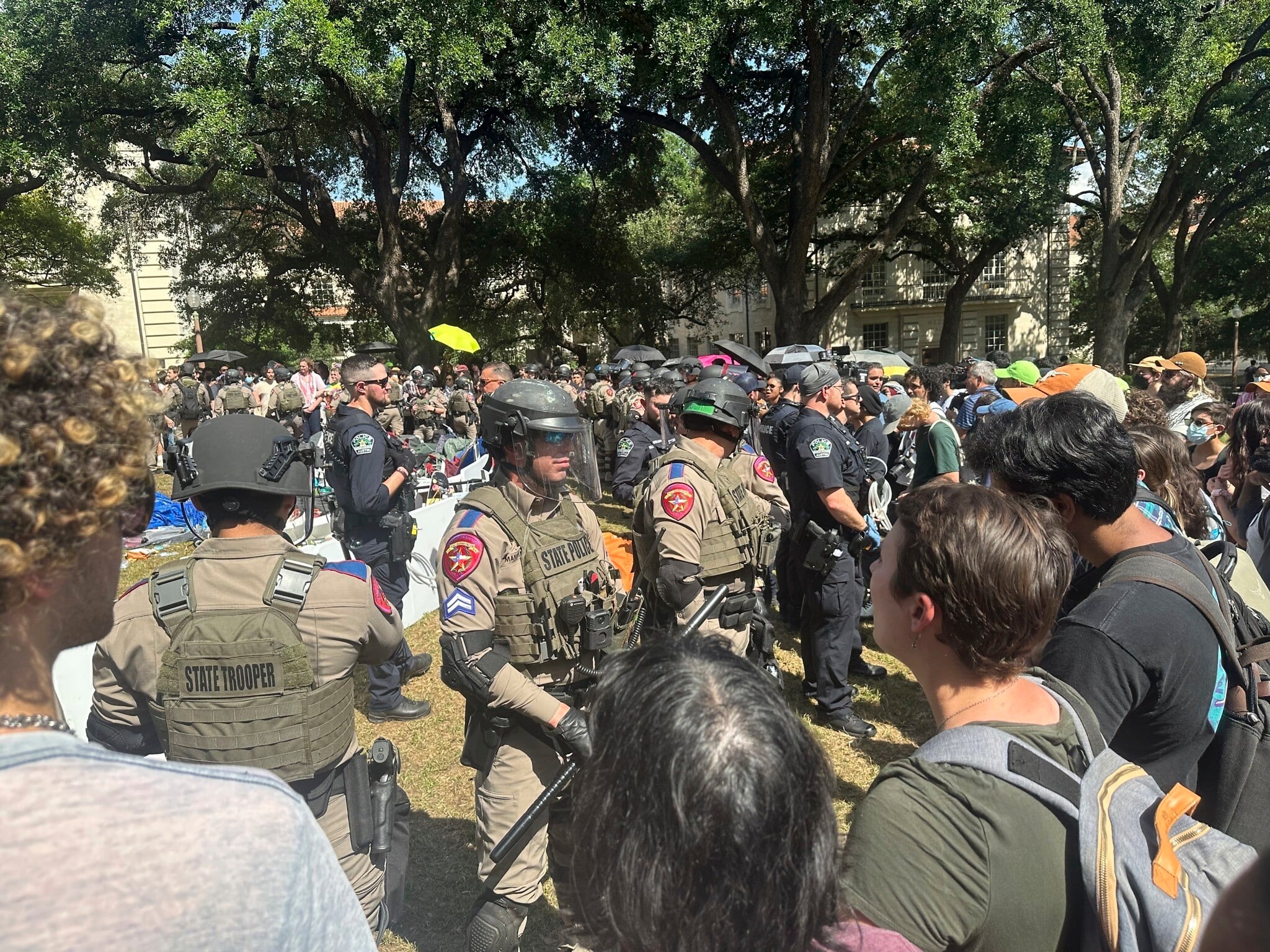
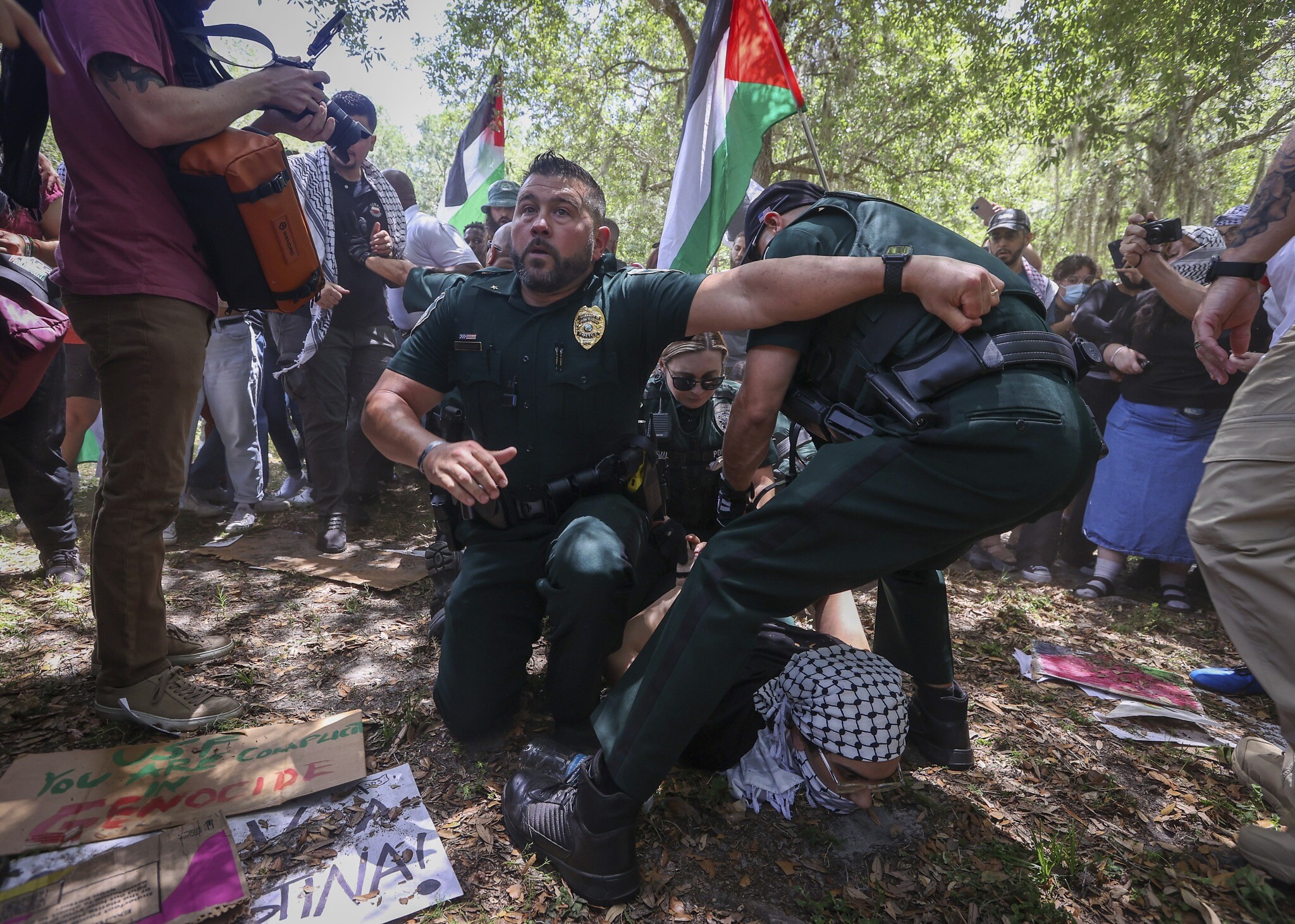
Meanwhile, at the University of Texas at Austin, at least 100 pro-Palestinian protesters were arrested as police dismantled an encampment, according to a local report, with demonstrators rallying for their release outside Travis County jail.
The Austin American-Statesman cited three county officials saying at least 100 protesters are expected to be booked and charged, though only 25 have been processed thus far, a local lawyer said.
Charges may include evading arrest and assault, according to the report, though those booked so far have only been charged with criminal trespassing — the same charge leveled against 57 protesters last week, which the county attorney’s office dropped due to lack of probable cause.
Police have 24 hours to submit probable cause affidavits for those arrested Monday, the newspaper reported.
A Palestine Solidarity Committee member told the paper that dozens of protesters gathered outside the Travis County jail plan to continue rallying there until all those arrested have been released.
“No encampments will be allowed,” Texas Governor Greg Abbott said on social media. “Instead, arrests are being made.”
No encampments will be allowed.
Instead, arrests are being made. https://t.co/GlmMXxAuqY
— Greg Abbott (@GregAbbott_TX) April 29, 2024
The arrests in Texas added to the more than 350 people detained nationwide over the weekend.
The protests have posed a challenge to university administrators trying to balance free speech rights with complaints and documentation that the rallies have veered into antisemitism and hate.
????A Jewish Berkeley Law student, Noah Cohen, is punched in the face by a sort of security guard at the Israel protest encampment, after he refused to stop filming and leave. He said the punch grazed the left side of his face. 1/x pic.twitter.com/dXHtCfzthE
— Gabe Stutman (@jnewsgabe) April 29, 2024
Protesters have made three demands: divestment from Israel, transparency in Columbia’s finances, and amnesty for students and faculty disciplined for their part in the protests.
Footage of police in riot gear summoned at various colleges to break up rallies have been viewed around the world, recalling the protest movement that erupted during the Vietnam War.
Talks collapse
Columbia University president Minouche Shafik, in a statement Monday announcing talks had broken down, said “many of our Jewish students, and other students as well, have found the atmosphere intolerable in recent weeks.
“Many have left campus, and that is a tragedy. Antisemitic language and actions are unacceptable and calls for violence are simply abhorrent,” she wrote after videos taken inside the encampment at various times showed some students chanting “Zionists not allowed here,” “Go back to Poland,” and other students calling for “10,000 October 7ths.”
Heard outside Columbia University last night: "Never forget the 7th of October. That will happen not 1 more time, not 5 more times, not 10, not 100, not 1,000, but 10,000 times! The 7th of October is going to be every day for you" pic.twitter.com/7rYJTwlz4x
— Eitan Fischberger (@EFischberger) April 19, 2024
Shafik went on to say that it was a tragedy that Jewish students had felt the need to leave campus in recent weeks due to the “intolerable” atmosphere. Classes were moved online after many Jewish students left campus, saying they felt unsafe.
“To those students and their families, I want to say to you clearly: You are a valued part of the Columbia community. This is your campus too. We are committed to making Columbia safe for everyone, and to ensuring that you feel welcome and valued,” she wrote.
“One group’s rights to express their views cannot come at the expense of another group’s right to speak, teach and learn,” Shafik said.
Shafik wrote that despite the protesters’ demands, the university would not divest from Israel but that it had offered to compromise with protesters by making “investments in health and education in Gaza, including supporting early childhood development and support for displaced scholars.”
She also offered “a process for students to access a list of Columbia’s direct investment holdings, and to increase the frequency of updates to that list.
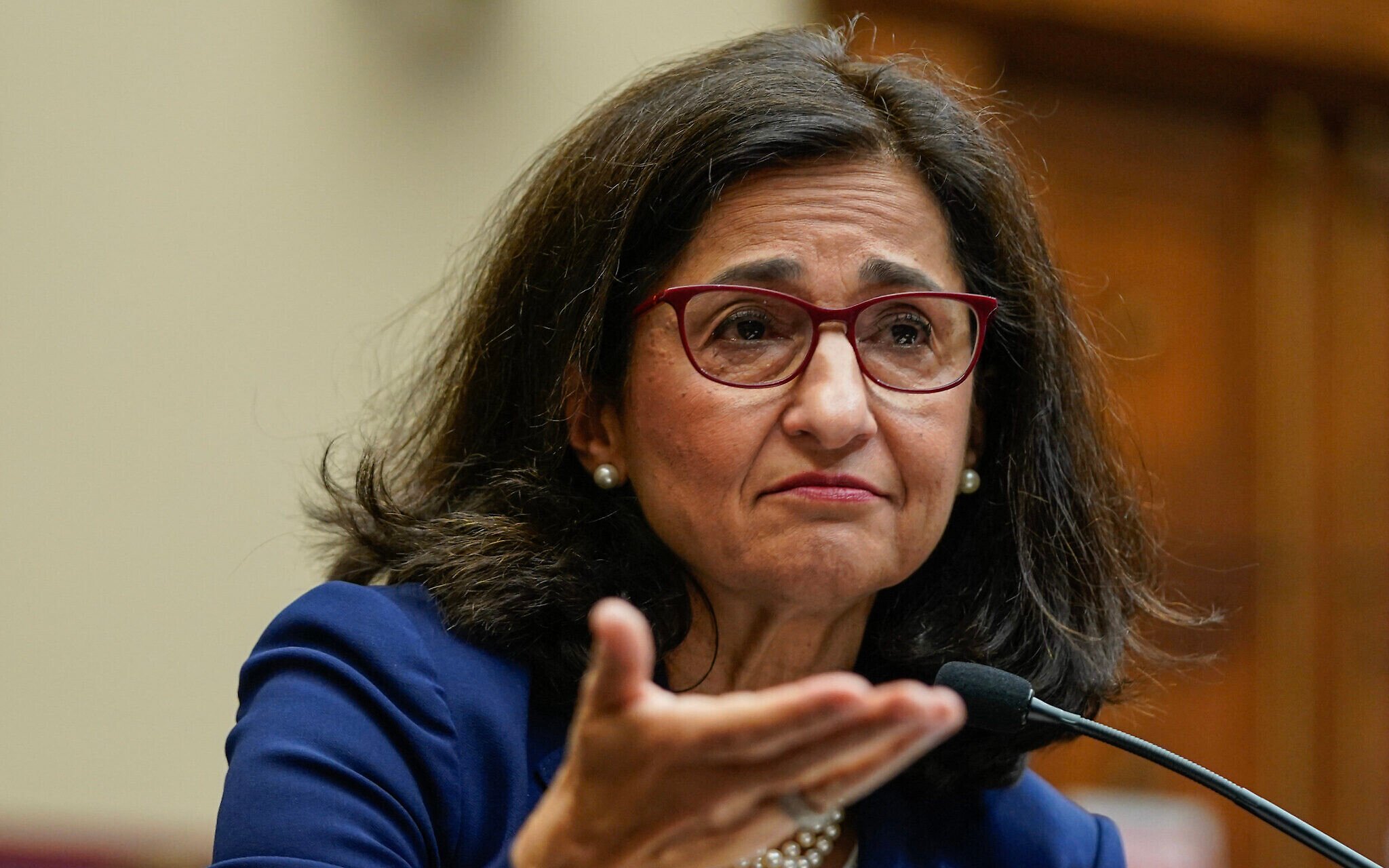
Since the encampment and protests have created an “unwelcoming environment” for Jewish students and faculty and a distraction for students who are trying to complete the academic year, Shafik said the protest no longer complied with guidelines. She pledged that they could continue after exams and Commencement “with two day’s notice in authorized locations.”
With the school year wrapping up, administrators point to the need to maintain order on campus for exam studies.
One graduate student protester, who asked to be identified only as “Z,” told AFP: “It’s finals week, everyone is still working on their finals, I still have finals to do. But at the end of the day, school is temporary.”
US President Joe Biden’s White House has also attempted to walk a fine line of defending the right to protest while condemning reported acts of antisemitism.
“We get that it is a painful moment that Americans are dealing with, and free expression has to be done within the law,” Press Secretary Karine Jean-Pierre said Monday.
However, Biden’s Republican opponents have seized on the issue, casting the protests as antisemitic and threatening to pull federal funding if they aren’t stopped.
“What continues to transpire at Columbia is an utter disgrace. The campus is being overrun by antisemitic students and faculty alike,” House Speaker Mike Johnson said on X, reiterating his call for Shafik to resign.
Meanwhile, suspensions were also ongoing at Cornell University in Ithaca, New York, where president Martha Pollack said student protesters had been “dishonest” by saying they did not intend to form a tented encampment on campus.
Over days of negotiations, students were offered multiple opportunities to move the encampment, or face sanctions.
“They declined,” Pollack wrote. “Therefore, more temporary suspensions… are forthcoming.”
While pro-Palestinian and anti-Israel protests have been held regularly on US campuses since the Israel-Hamas war broke out on October 7 with the terrorist organization’s unprecedented attack on Israel in which 1,200 people, mostly civilians, were murdered and 253 were taken hostage, the demonstrations sparked renewed attention after Columbia protesters set up their encampment earlier this month.
After the NYPD removed the encampment and arrested more than 100 protesters, demonstrators at other universities around the country and in Europe were inspired and erected their own encampments while the Columbia one was reassembled.
Protest organizers deny accusations of antisemitism, arguing that their actions are aimed at the Israeli government and its prosecution of the conflict in Gaza. They also claim the more threatening incidents have been engineered by non-student agitators.






The Times of Israel Community.