

Cops enter Jerusalem neighborhood to seal off terrorist’s home
Police prepare to fill with concrete Jabel Mukaber home of man who rammed his truck into soldiers, killing 4
 Add ToI as a Preferred Source on Google
Judah Ari Gross is The Times of Israel's religions and Diaspora affairs correspondent.

Police officers and border guards entered the Jabel Mukaber neighborhood of East Jerusalem on Wednesday to seal off the home of a terrorist who killed four soldiers and injured many more in a truck ramming attack earlier this year, police said.
On January 8, Fadi al-Qanbar drove his truck into a group of army cadets and their civilian guides during a tour of Jerusalem’s promenade in Armon Hanatziv.
Four soldiers were killed — three women and one man — and 16 were injured in the attack.
The driver accelerated as he struck the group then, after hitting the soldiers, put the vehicle into reverse and began to run them over a second time, amateur video footage showed.

Shortly thereafter the government announced its intention to seal off, but not demolish, al-Qanbar’s home in the Arab neighborhood in southeast Jerusalem.
A petition to stay the order was dismissed by the High Court of Justice last month.
The troops who entered Jabel Mukaber on Wednesday morning were there to “maintain order and security, and to prevent violence” against the workers who would be filling al-Qanbar’s home with concrete, police said.
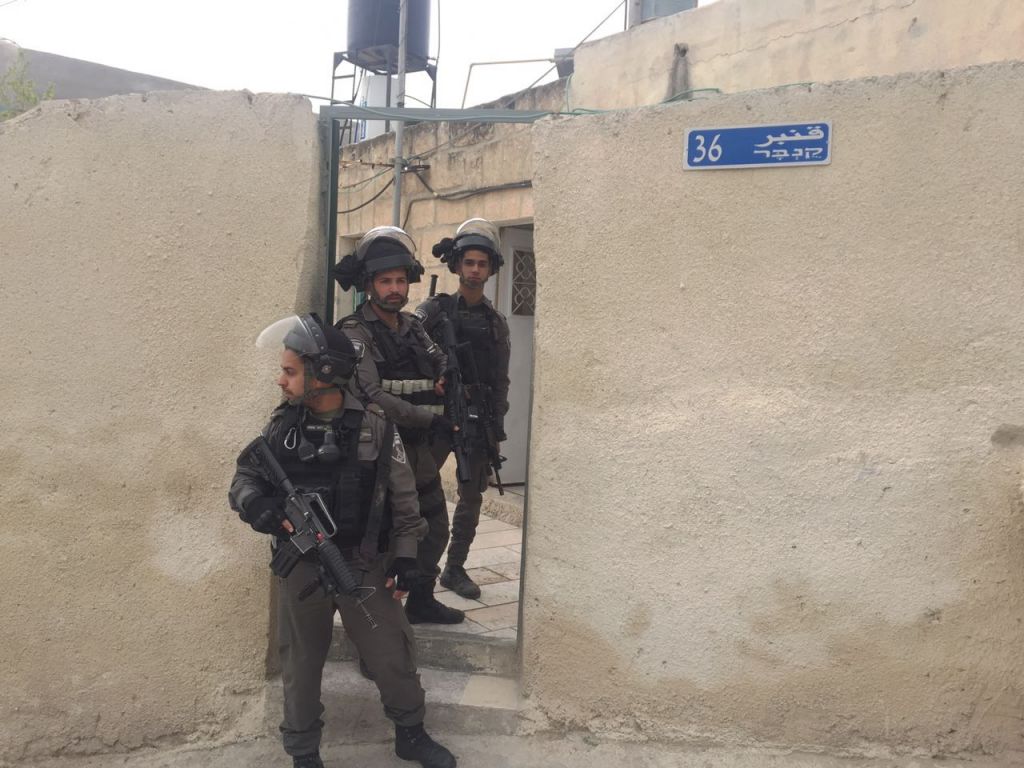
The border guards and police officers would use “all the tools and powers at their disposal” in order to ensure the order is carried out, police said.
The police did not say exactly when the process of sealing off al-Qanbar’s home would begin.
Soon after the attack, local media said al-Qanbar, 28, was in his 20s, married with four children, and had served time in Israeli prison.
He was shot by soldiers and a civilian guide, according to police, and died of his wounds.

Shortly afterwards, Public Security Minister Gilad Erdan vowed Israel would never return the terrorist’s body and that al -Qanbar would be buried by security forces in a place to which his family would not have access to prevent the holding of a funeral where his acts would be celebrated.
In the High Court’s ruling last month, the judges noted the hardship that the sealing of al-Qanbar’s home would cause the family, but accepted the state’s position that the order was legal and said there was significant legal precedent for it to be carried out.

Home demolitions as a tactic to prevent terror, or the sealing of homes in cases where there are other apartment owners in a building not connected with an attack, has long been a point of controversy both within and outside of Israel.
Between 1987 and 2005, a period encompassing two Palestinian uprisings known as the first and second intifadas, Israel destroyed 1,115 Palestinian homes as punishment, partially demolished 64 and sealed or partially sealed 417, according to the left-wing Israeli rights organization B’Tselem.
In 2005, then-defense minister Shaul Mofaz ordered an end to the demolitions after security services concluded that they have a minimal deterrent effect.
The debate over the years within the security establishment has continued to tilt against the practice, but it was revived with the surge in stabbings, car-rammings and shooting attacks that began in September 2015. It remains a controversial practice approved by courts only in cases where there is a reason to believe that it might deter future attacks.
Despite Mofaz’s order, the IDF did demolish two and four housing units in 2009 and 2014 respectively. The wave of violence that began in 2015 led to a slight spike in demolitions, with 11 homes being destroyed that year followed by the bulldozing of 23 in 2016, according to B’Tselem.
Israel punitively seals Jabal al-Mukabbir home with concrete, displacing 5 Palestinians https://t.co/MaMXwCj6aE pic.twitter.com/0uQj9mi8fc
— Ma'an News Agency (@MaanNewsAgency) March 22, 2017
Times of Israel staff contributed to this report.










The Times of Israel Community.