

Dutch official: Netherlands, Israel ‘good for each other’
Dozens of Dutch business people and government ministers are in Israel seeking new business opportunities, illustrating a relationship that is stronger than most realize
 Add ToI as a Preferred Source on Google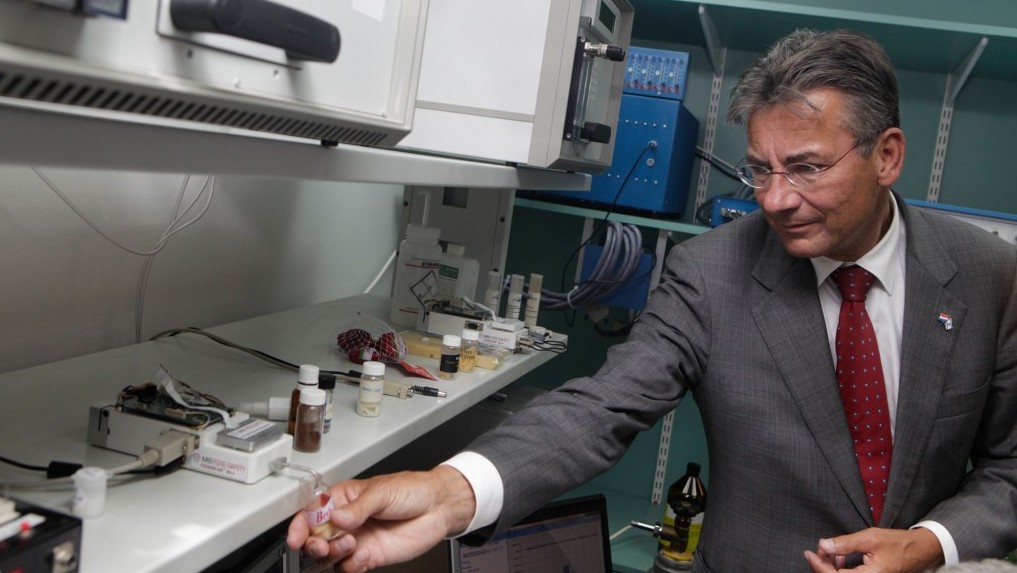
Though the population of the Netherlands is only a modest 16 million, Holland is nonetheless one of Israel’s two largest trading partners in Europe, and the Dutch appear to be looking for even more Israeli connections. That’s one of the reasons why over 60 business officials from the country came to Israel this week, accompanying Maxime Verhagen, the Dutch Vice Prime Minister and Minister of Economic Affairs, Agriculture and Innovation. The companies represented included those in a wide variety of fields, including agriculture and food, water, energy (including clean tech and gas), high-tech, and other areas where trade between the two countries is booming.
One way the Dutch government hopes to attract more Israeli partners is by opening offices dedicated to encouraging those relationships. On his visit here, Verhagen officially opened the local offices of the Netherlands Foreign Investment Agency (NFIA) and the Netherlands Office for Science and Technology (NOST) . Directing the NOST office’s efforts to attract tech companies to joint research and development projects with Dutch groups will be Paul Jansen, whose official title is Innovation Advisor at the Economic Section of the Netherlands Embassy in Tel Aviv.
Speaking to The Times of Israel, Jansen said that although his country outclasses Israel on most key indicators, like GDP and per capita income (22nd and 9th in the world respectively, as opposed to Israel’s 50th and 26th place), Holland and Israel need each other. A recent study indicated that Holland is much more competitive than Israel, number six in competitiveness as opposed to Israel’s number 22, he said. “But I believe that Israel is more innovative than we are. In a sense, I believe that the Israeli economy is stronger than ours, since innovation is a big part what makes a country strong,” he said.
While the Dutch don’t have the same “hutzpa” level that Israelis do, they are very direct, like Israelis, Jansen said, so the match between the two groups is a good one, at least for work purposes. Both are also very entrepreneurial, Jansen said, adding that he couldn’t think of any particular Israeli personality trait — not even that patented Sabra hutzpa –that he thought his countrymen would have trouble with. Jansen did not want to relate to the political aspects of a business relationship with Israel, and there was no indication during the days that the delegation was in Israel that politics would be a factor.
There are numerous large Israeli companies with a significant presence in Holland — the pharmaceutical giant Teva, for example, has a large facility there — and a surprising number of Israeli start-ups working in the country as well, Jansen said. Holland’s economic policy, he said, is generally geared to encouraging its top-tier industries, such as agriculture and food, water, energy, life-science, high-tech, and so on. Many Israeli start-ups have been developing innovations in these areas, and Jansen said that corporate executives in his country are anxious to cooperate on these innovations for the benefit of both countries.
“Both our markets are relatively small, so it’s not about selling each other things. What we can do is help bring Israeli products and technologies to the wider world,” Jansen said.
“Holland is a good place to do business and target the rest of Europe,” he continued. “We have the experienced personnel who know how to move in world markets, and if we cooperate on innovations we can develop new products and bring them to market. We’re good for each other that way.”






The Times of Israel Community.