

France must ‘make an example’ of anti-Semites, former PM urges
Manuel Valls calls for tougher implementation of anti-hate laws, distances himself from last year’s Paris peace summit, says Jerusalem is Israel’s capital
 Add ToI as a Preferred Source on Google
Raphael Ahren is a former diplomatic correspondent at The Times of Israel.

France has tough laws against anti-Semitism but needs to better apply them, according to former French prime minister Manuel Valls.
In a wide-ranging interview conducted two days before the gruesome murder of a Parisian Holocaust survivor, Valls urged French society not to shy away from saying publicly that most anti-Semitic attacks are perpetrated by Arab Muslims and called on authorities to better treat victims of such hate crimes.
“Yes, France has laws against anti-Semitism, but they need to make an example and be harsh,” Valls said, speaking to The Times of Israel on the sidelines of an anti-Semitism conference in Jerusalem. “Anti-Semitism, like all other kinds of racism, is a crime and not an opinion.”
Indeed, he added, anti-hate laws are “already very harsh, but the law needs to be applied, and better applied.
“There is an enormous amount of work to be done,” he said, especially vis-a-vis the internet and social media, where racism and anti-Semitic conspiracy theories abound.
On Friday, 85-year-old Mireille Knoll was stabbed to death and then burned in her Paris apartment in what appears to have been an anti-Semitic attack. Two suspects, one of whom is reportedly Muslim, were said to have been planning to rob the elderly Holocaust survivor, thinking that she must have money because she was Jewish.
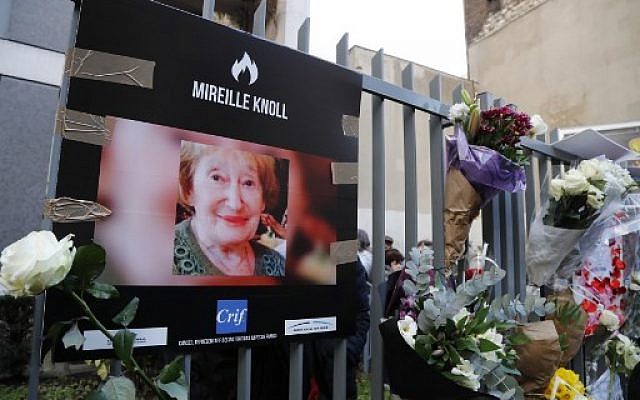
Knoll’s brutal murder shook French society; President Emmanuel Macron attended her funeral, while a march in her memory was attended by tens of thousands, including, controversially, the leaders of France’s far-left and far-right parties.
One should not be afraid to say that anti-Semitism is the fruit, first of all, of the behavior of Arab Muslims — young and old
Asked what could be done concretely to fight anti-Semitism, Valls, 55, who served as France’s prime minister between March 2014 and December 2016, replied, “First of all, we must not deny the facts. We must tell the truth: Anti-Semitism exists, and it is very important to make the correct diagnosis. We have to recognize that, even if our [government’s] actions helped to lower anti-Semitism in recent years, very violent acts against French Jews have increased.”
Today’s anti-Semitism in France originates from within the country’s Muslim communities, said Valls, whose wife, Anne Gravoin, is Jewish.
“One should not be afraid to say that anti-Semitism is the fruit, first of all, of the behavior of Arab Muslims — young and old,” he said. “One has to name the sources, and justice has to be extremely harsh.”
Society needs to do more for the victims of anti-Semitic hate crimes, many of whom feel alone and isolated, Valls said.
“One has to attend to them constantly, because they very often feel abandoned,” he said. “Victims of anti-Semitism have to be taken care of just as much as victims of terrorism.”
Families that experienced verbal or physical violence are deeply traumatized, he continued. “Those who were beaten or insulated or had to move — we have to attend to them, psychologically and morally.”
The state’s actions are improving. The awareness of the French is there, fortunately. The battle against anti-Semitism is yielding results
While he acknowledged that it was dangerous to wear a kippah in certain parts of France, such as northern Paris, Valls was confident that, overall, things were moving in the right direction.
“The state’s actions are improving. The awareness of the French is there, fortunately. The battle against anti-Semitism is yielding results,” he said.
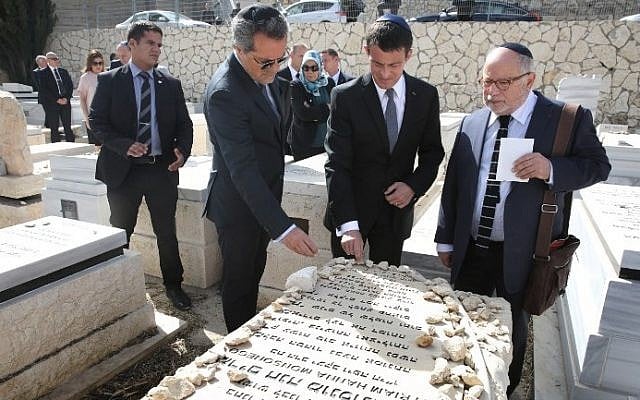
Valls has become a darling of the French Jewish community for his positions on issues of Jewish concern, especially for his much-quoted dictum that anti-Zionism is another form of anti-Semitism.
Yet he struggled somewhat when asked where he would draw the line between illicit hate speech and legitimate criticism of Israeli policies. Comparing Israeli policies vis-a-vis the Palestinians with Nazism, calling for boycotts of Israel or shouting “Death to Jews” were clearly off limits, he said. But he did not provide a straightforward answer on whether the claim that Israel was an apartheid state crossed the border from legitimate criticism to anti-Semitism.
“That’s an excellent question,” he said, merely indicating that he was disinclined to bring legal action against people for saying outrageous things.
“The line is negating the State of Israel,” he then said. “For example, when you have political actors in France who participate in demonstrations where people yell about their hate for Israel with photos of Hitler and scream ‘Death to Jews,’ as occurred in 2014. Then you’ve reached the limit. But yes, it’s true that it’s not always clear where the limit is.”
Valls, who last year tried but failed to become the Socialist Party’s presidential candidate, traveled to Israel last week to participate in the Foreign Ministry’s Global Forum on Combating anti-Semitism, where he delivered the keynote address.
He came to the confab with a message of “fight and hope,” he told The Times of Israel. “Because I think that our values are stronger. I don’t think for a second that the Islamists are ever going to be in power in France.”
Peace summits ‘not viable’
Valls also took issue with the French government’s January 2017 Paris peace conference, which was conceived while he was prime minister.

“France sometimes considers trying to bring together the different parties,” he said, noting Paris had good relations with both Israelis and Palestinians.
“But I think this method is behind us,” he said, referring to the peace conference, which was formally launched in June 2016 and culminated in a larger summit in January 2017.
Valls stepped down as prime minister in December 2016 to run in the Socialist Party’s primaries.
“I don’t condemn [these conferences], and I am not saying there cannot be initiatives of this sort. But I don’t think they’re viable, I don’t think they’re efficient,” he said, “and I think it has to be done differently. One has to realize that today the only path [to progress in the peace process] is through direct negotiations between Israel and the Palestinians.”
Jerusalem is the capital of the Jews and of Israel — historically, religiously, and politically
With that comment, Valls aligned himself with the Israeli government, which consistently condemned the French initiative as counterproductive, arguing that international conferences only embolden the Palestinians’ belief that they can reach their goals without having to negotiate with Israel.
Valls’s comments on Jerusalem would also be music to Israeli ears.
“I am very clear on this subject: Jerusalem is the capital of the Jews and of Israel — historically, religiously, and politically,” he said.
Asked if that statement would be followed by a “but,” he replied, “No. It’s at the heart of the foundation of the State of Israel.”
He then noted that the Knesset, the President’s Residence and almost all ministries are located in the city, adding, “For Israelis, Jerusalem is the capital. I believe that one must always start by evoking the political and historical reasons for that.”

At the same time, the former prime minister said that recognizing Jerusalem as Israel’s capital does not exclude that the city or part of it might also become the capital of a future Palestinian state.
“There is an enormous passion for Israel and Jerusalem, because everything emanates from it, at least for our European civilization, the Middle East and a part of Asia. Every time someone touches anything here, it’s like nitroglycerin,” he said. “Israeli governments know this very well. This dimension needs to be clear to the entire world.”
Valls would not say whether he believes Israelis are right in demanding their country be recognized as a Jewish state. The issue is “abrasive and sensitive,” he said, indicating that he is somewhat uncomfortable with applying religious terms to modern nation states.
“I’m a French politician, a Republican attached to secularism,” he said. “But who will deny the reality of the foundations of the creation of the State of Israel in 1948, even if it was founded by atheist socialists, bearing arms? But this subject really is more the concern of the people living in this region.”







The Times of Israel Community.