

Gaza’s architectual heritage fades, but one man resists
A middle-aged Palestinian university professor gives ‘second life’ to 430-year-old Levantine-style house
 Add ToI as a Preferred Source on Google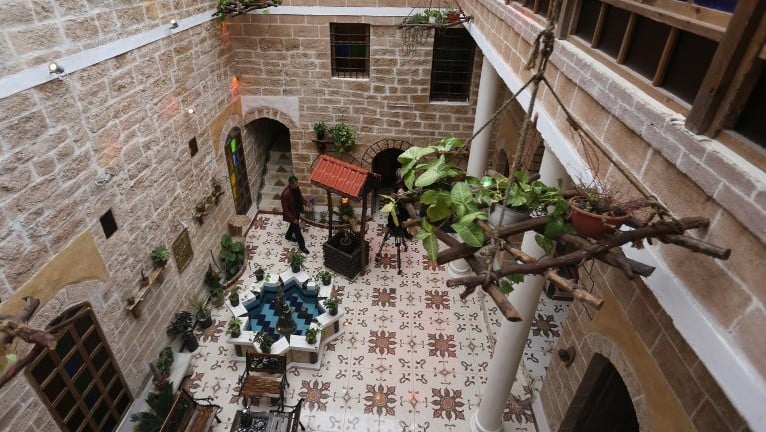
AFP — A surprise awaits beyond a black door adorned with a silver lotus flower at the end of a tangle of alleyways in Gaza’s chaotic Old City.
Through it and behind imposing stone walls sits a small, Levantine-style palace, some 430 years old and recently painstakingly restored.
It is among the rare vestiges of Gaza City’s architectural heritage, battered by war, time, population pressure and simple indifference.
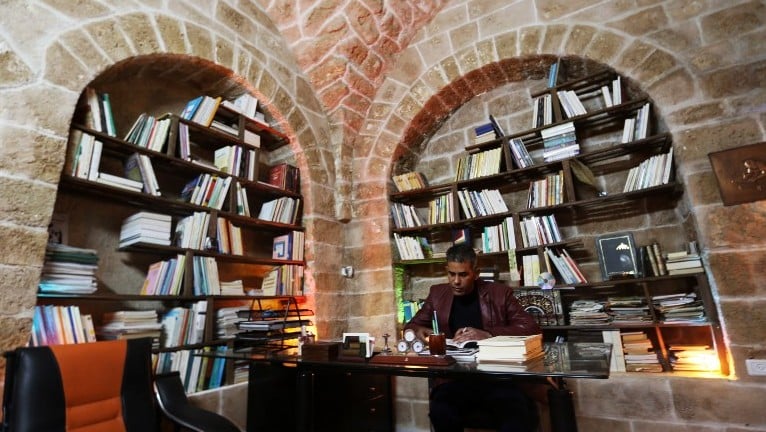
The palace that had been missing part of its roof and located in what had been the Old City’s Christian quarter was rescued by a 46-year-old university professor.
Less than a year ago, the professor, Atef Salama, decided to take action. His wife Kawtar said the idea was “kind of crazy.”
But the house has now been given a second life, unlike others around it.
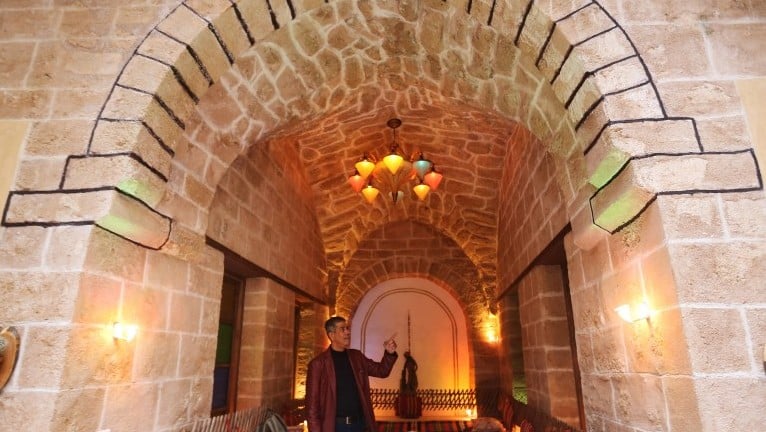
Salama spent lots of his savings to make it happen — an amount he preferred not to discuss.
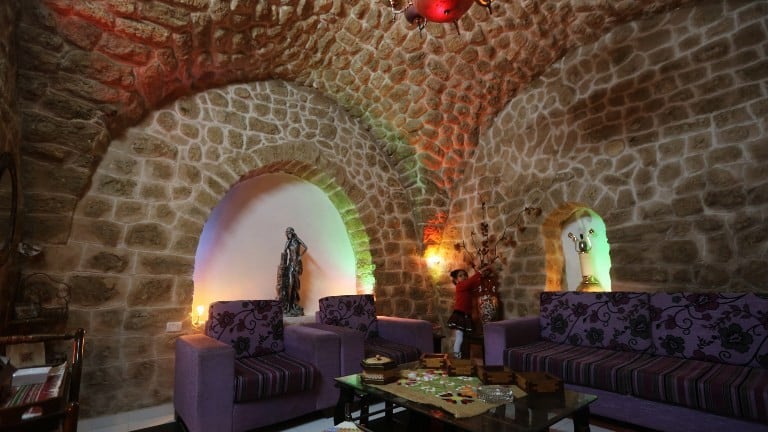
“People didn’t say it to our face, but we could tell they were thinking ‘either they’re crazy or they were scammed’,” said Kawtar while receiving guests in her living room with ocher stone walls.
Nearby sits a decrepit church. A traditional house across the street has crumbled and is overgrown with weeds.
One of world’s oldest cities
Other historic buildings have disappeared under new construction in the small coastal enclave of some 1.8 million people, run by Islamist movement Hamas and cut off by an Israeli blockade and a closed border with Egypt.
“In Gaza, we like to have large families,” said Fadel al-Otol, a Gazan heritage specialist.
“When children become parents, they build another floor on top of the family house. Either that or they leave the traditional house to move into a new building.”
It is especially worrisome in Gaza, where the Egyptians, Romans, Byzantines and Ottomans have all ruled at various times, among others.
Its port on the eastern shores of the Mediterranean has served as a crossroads.
“Gaza is one of the oldest cities in the world,” said Otol. “Remnants dating back to 3,500 BC along with traces of all eras since then can be found there.”
Otol wants to see what remains of those civilizations preserved to give Gazans a sense of their history.
“Without the past, we have no future, so we want to show young people what Gaza has been,” he said.
“They are delighted to discover that once upon a time Gaza was rich.”
One site he encourages visits to is the ruins of the ancient Saint Hilarion monastery, one of the oldest in the region and located south of Gaza City.
School children regularly visit the wooden passageways at the site installed by UNESCO, but a long-term commitment is needed to maintain it.
Test of time
That’s a tall order in the Gaza Strip, with the coastal enclave battered by wars with Israel, two Palestinian Intifadas and a conflict between Hamas and the Palestinian Authority.
When it is not bombs obliterating the past, it is the result of Palestinians fighting within themselves or neglect.
In one example, the whereabouts of a bronze statue of Apollo discovered in 2013 are unclear.
Earlier this month, what is thought to be the remains of a Byzantine-era church were uncovered during a construction project to build a shopping center in central Gaza City.
The ministry of antiquities sought to stop the work that had moved marble columns discovered in the sand, with at least one broken in the process.
A dispute broke out between the ministry of Islamic affairs, which owns the land and wanted the work to move ahead, and Palestinian Christian leaders who argued that the site would be treated differently if it housed an ancient mosque.
Otol said that with humanitarian needs so great in Gaza, preservation concerns have been set aside.
“All efforts are focused on the reconstruction of destroyed infrastructure and houses,” he said.
As a result, Gazans must depend on international institutions such as UNESCO or private initiatives, like that of the Salama family.
Salama said his project aimed to “mix modernity and tradition, while preserving our heritage.”
Such Levantine houses once stood from Syria and Lebanon to ancient Palestine, said Salama.
It includes an “iwan,” a traditional space with three walls opening onto a courtyard housing a fountain, a well and a reservoir.
Salama says it has survived the test of time — unlike the new buildings surrounding them.
“A house like this has lived for 1,000 years, unlike new apartments — just cardboard boxes.”










The Times of Israel Community.