

Iraqi activists end protest in Baghdad’s Green Zone
After storming parliament, anti-government demonstrators temporarily disband months-long rallies demanding political reform
 Add ToI as a Preferred Source on Google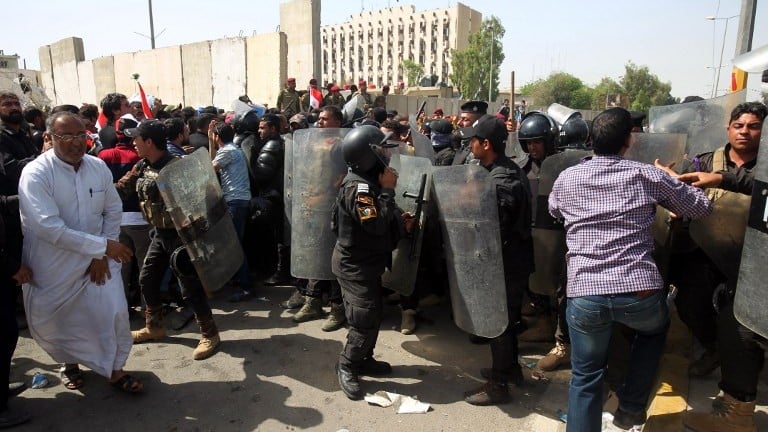
BAGHDAD (AP) — Anti-government protesters temporarily ended their mass demonstration in Baghdad’s Green Zone on Sunday and began an orderly withdrawal a day after tearing down walls around the government district and invading parliament.
Loudspeakers manned by followers of Shiite cleric Muqtada al-Sadr, who has led the protest movement, announced the disbanding of the protests, which had marked the culmination of months of sit-ins and demonstrations demanding the overhaul of a political system widely seen as corrupt and ineffectual.
“We decided to end it now because of the anniversary of Imam (Moussa) al-Kadhim,” said Sadiq al-Hashemi, a representative of al-Sadr’s office in Baghdad who was present at the protests.
Al-Hashemi said al-Sadr made the decision in order to allow Iraqi security forces to protect the thousands of pilgrims who are expected to walk from across Iraq to the shrine of the 8th-century Imam in Baghdad.
Earlier on Sunday, car bombs in the southern Iraqi city of Samawah killed 31 people and wounded dozens, the latest in a series of large attacks claimed by the Islamic State group as the country grapples with the worsening political crisis.
A police officer said two parked cars filled with explosives were detonated within minutes of each other around midday, the first near government offices and the second at an open-air bus station less than a kilometer (mile) away.
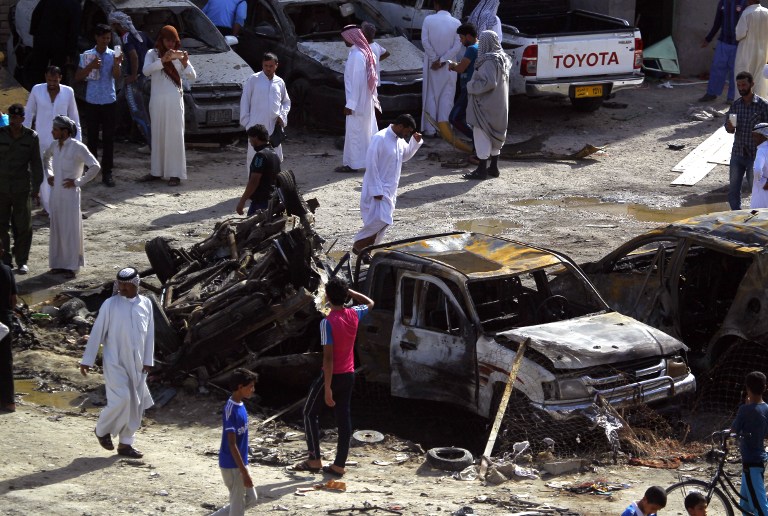
At least 52 people were wounded in both explosions, and the police official said the death toll was expected to rise. A medical official confirmed the casualty figures. Both officials spoke on condition of anonymity as they were not authorized to release information.
IS claimed the bombings in an online statement, saying they were carried out by suicide attackers targeting police. It was not immediately possible to reconcile the competing claims.
The Shiite-dominated city is located some 370 kilometers (230 miles) south of the capital, Baghdad. The extremists have repeatedly targeted Iraq’s Shiite majority — which they view as apostates — as well as the Shiite-dominated security forces.
Earlier on Sunday, Prime Minister Haider al-Abadi ordered authorities to arrest and prosecute those among the protesters who had attacked security forces, lawmakers and damaged state property after breaking into the Green Zone.
Videos on social media had showed a group of young men surrounding and slapping two Iraqi lawmakers as they attempted to flee the crowd, while other protesters mobbed lawmakers’ motorcades.
Jubilant protesters were also seen jumping and dancing on the parliament’s meeting hall tables and chairs and waving Iraqi flags. No one was seriously wounded. The protesters left parliament late Saturday and had been rallying in a nearby square.
“We are fed up, we are living a humiliated life,” Rasool Hassan, a 37-year old father of three told The Associated Press from inside the Green Zone before the protest was disbanded.
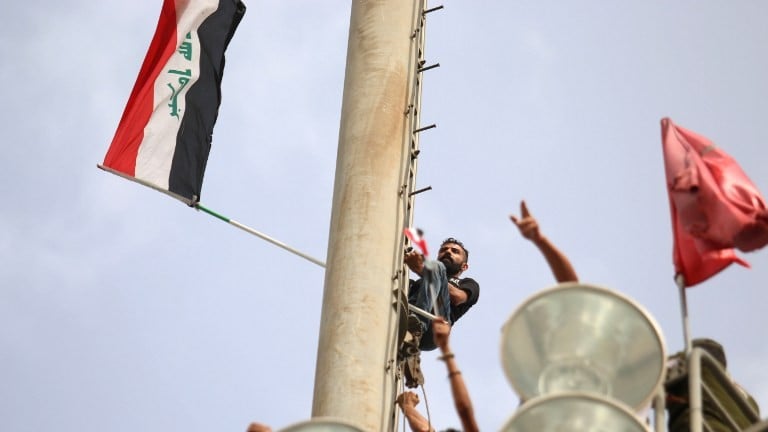
Al-Hashemi, the al-Sadr representative, said the protests would resume after the Imam al-Kadhim pilgrimage ends this week. Al-Hashemi said the al-Sadr movement would also give Iraqi lawmakers one more chance to vote in new reforms.
“We have achieved something here,” al-Hashemi said. “We got our message out from the Iraqi street.”
Also on Sunday, the United Nations said at least 741 Iraqis were killed in April due to ongoing violence, a sharp decline from the previous month. In its monthly report, the UN mission to Iraq put the number of civilians killed at 410, while the rest were members of the security forces. A total of 1,374 Iraqis were wounded that month, it added.
In March, at least 1,119 people were killed and 1,561 wounded.
The capital, Baghdad, remains the worst-hit area, with 232 civilians killed and 642 wounded in April, followed by the northern province of Ninevah, which is almost entirely controlled by the Islamic State group, with 72 killed and 30 wounded.
“It pains us to see the continuing bloodletting and loss of life, particularly among civilians who are paying a high price as a result of bombings and the armed clashes,” UN envoy Jan Kubis said.
Copyright 2016 The Associated Press.







The Times of Israel Community.