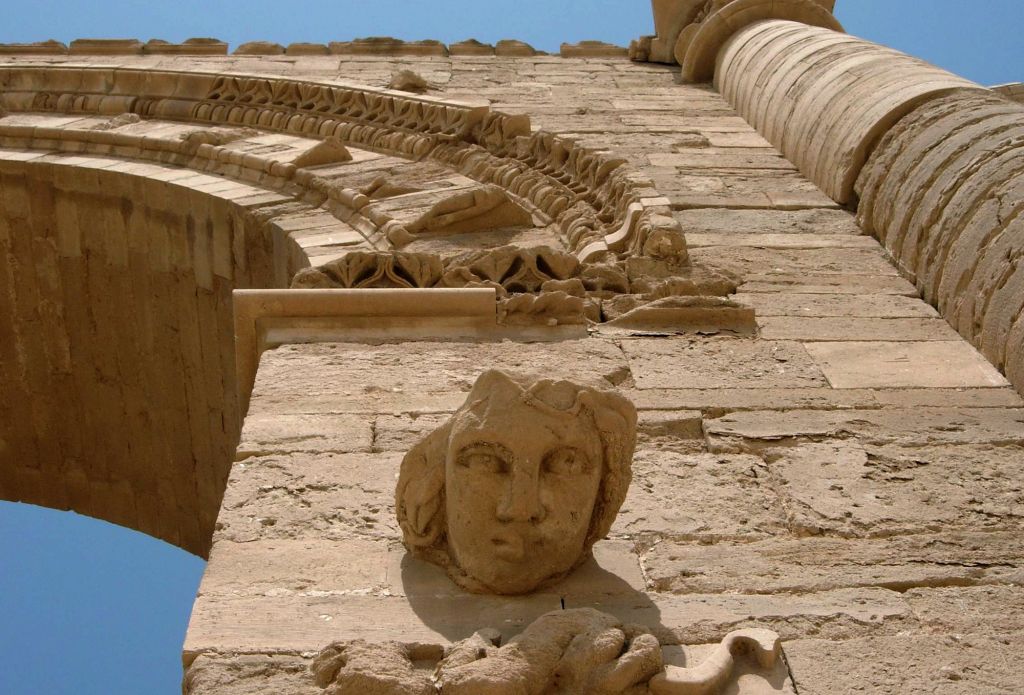
In this July 27, 2005 file photo, the face of a woman stares down at visitors in the Hatra ruins, 320 kilometers (200 miles) north of Baghdad, Iraq. Iraq's minister of tourism and antiquities told The Associated Press, Saturday, March 7, 2015, that the government is investigating reports that the ancient archaeological site of Hatra in northwestern Iraq is being demolished by militants from the Islamic State group (photo credit: AP Photo/Antonio Castaneda)
BAGHDAD (AP) — Iraqi officials in the northern city of Mosul said Saturday that militants with the Islamic State group have begun demolishing the ancient archaeological site of Hatra in northern Iraq in a push to rid its territory of symbols it says promote idolatry.
An official with the ministry of tourism and antiquities’ archaeological division in Mosul told The Associated Press that multiple residents living near Hatra heard two large explosions Saturday morning, then reported seeing bulldozers begin demolishing the site. He spoke anonymously for fear of reprisal.
Saeed Mamuzini, a Kurdish official from Mosul, told the AP that the militants had begun carrying away artifacts from Hatra as early as Thursday and on Saturday, began to destroy the 2,000-year-old city.
Hatra, located 110 kilometers (68 miles) southwest of the city of Mosul, was a large fortified city during the Parthian Empire and capital of the first Arab kingdom. The ancient city, a UNESCO world heritage site, is said to have withstood invasions by the Romans in A.D. 116 and 198 thanks to its high, thick walls reinforced by towers.
The ancient trading center in Hatra spanned 6 kilometers (4 miles) in circumference and was supported by more than 160 towers. At its heart are a series of temples with a grand temple at the center — a structure supported by columns that once rose to 100 feet.
Get The Times of Israel's Daily Editionby email and never miss our top stories
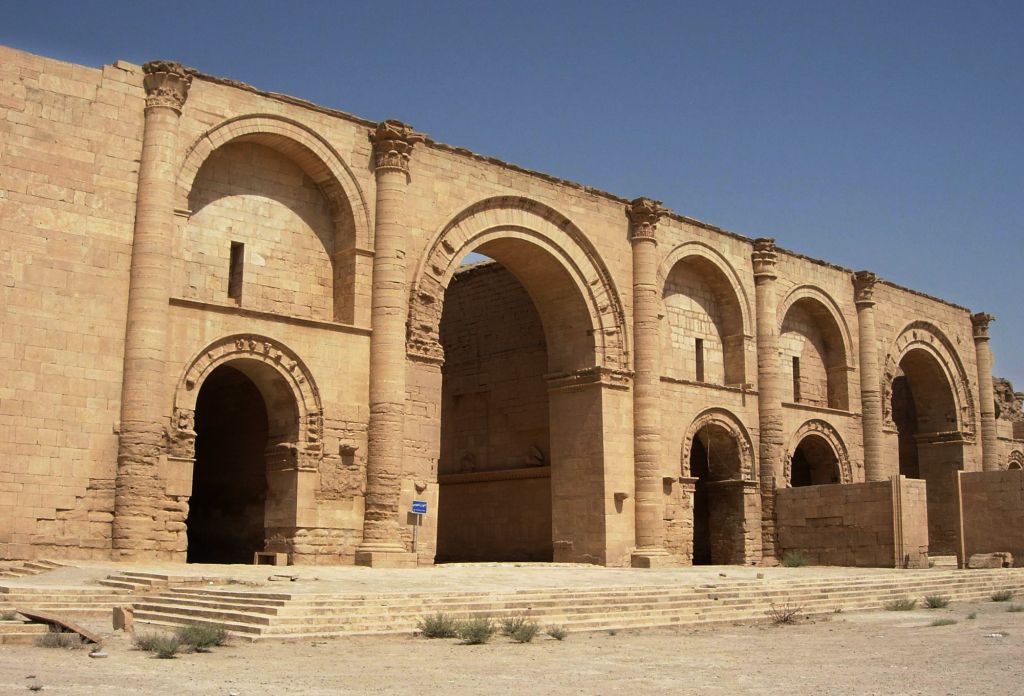
In this July 27, 2005 file photo, a temple to the Shamash sun god still stands over 1,750 years after the Sassanian empire razed the Mesopotamian city of Hatra, 320 kilometers (200 miles) north of Baghdad, Iraq. Iraq’s minister of tourism and antiquities told The Associated Press, Saturday, March 7, 2015, that the government is investigating reports that the ancient archaeological site of Hatra in northwestern Iraq is being demolished by militants from the Islamic State group. The group looted artifacts from Nimrud, another ancient archaeological site, on Friday and bulldozed it in a move UNESCO deemed “a war crime.” (photo credit: AP Photo/Antonio Castaneda, File)
The Sunni extremist group has been campaigning to purge ancient relics they say promote idolatry that violates their fundamentalist interpretation of Islamic law. A video they released last week shows them smashing artifacts in the Mosul museum and in January, the group burned hundreds of books from the Mosul library and Mosul University, including many rare manuscripts.
The majority of the artifacts destroyed in the Mosul Museum attack were from Hatra.
On Friday, the group looted artifacts from Nimrud, a 3,000-year-old city in Iraq, and bulldozed it in a move United Nations Secretary-General Ban Ki-Moon declared “a war crime.”
Advertisement
Iraqi Tourism and Antiquities Minister Adel Shirshab told the AP Saturday that many feared Hatra would suffer the same fate as Nimrud. “This is not unusual (behavior) for Daesh,” Shirshab said, using the Arabic acronym for the group.
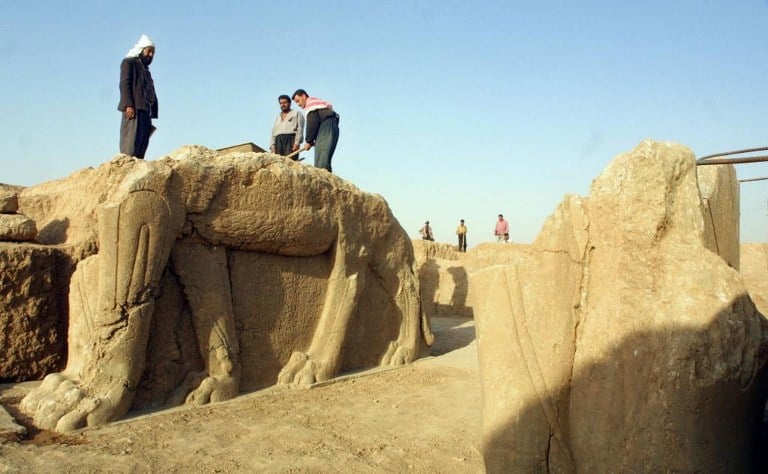
A file picture taken on July 17, 2001 shows Iraqi workers cleaning a statue of winged bull at an archeological site in Nimrud, 35 Kilometers (22 miles) southeast of the northern city of Mosul. The Islamic State group has begun bulldozing the ancient Assyrian city of Nimrud in Iraq, the government said, in the jihadists’ latest attack on the country’s historical heritage. (photo credit: AFP/Karim SAHIB)
A statement on the ministry’s Facebook page Saturday said the government is investigating reports of the attack on Hatra, noting that the global community should hasten its response to the crisis in Iraq in order to prevent these types of atrocities.
Last year, the militants destroyed the mosque believed to be the burial place of the Prophet Younis, or Jonah, as well as the Mosque of the Prophet Jirjis — both revered ancient shrines in Mosul. They also threatened to destroy Mosul’s 850-year old Crooked Minaret, but residents surrounded the structure, preventing the militants from approaching.
A US-led coalition has been striking the Islamic State group since August and is preparing a large-scale operation to retake the city of Mosul. But US and Iraqi officials have been cautious about setting a timeline for preparing Iraq’s embattled military for the campaign.
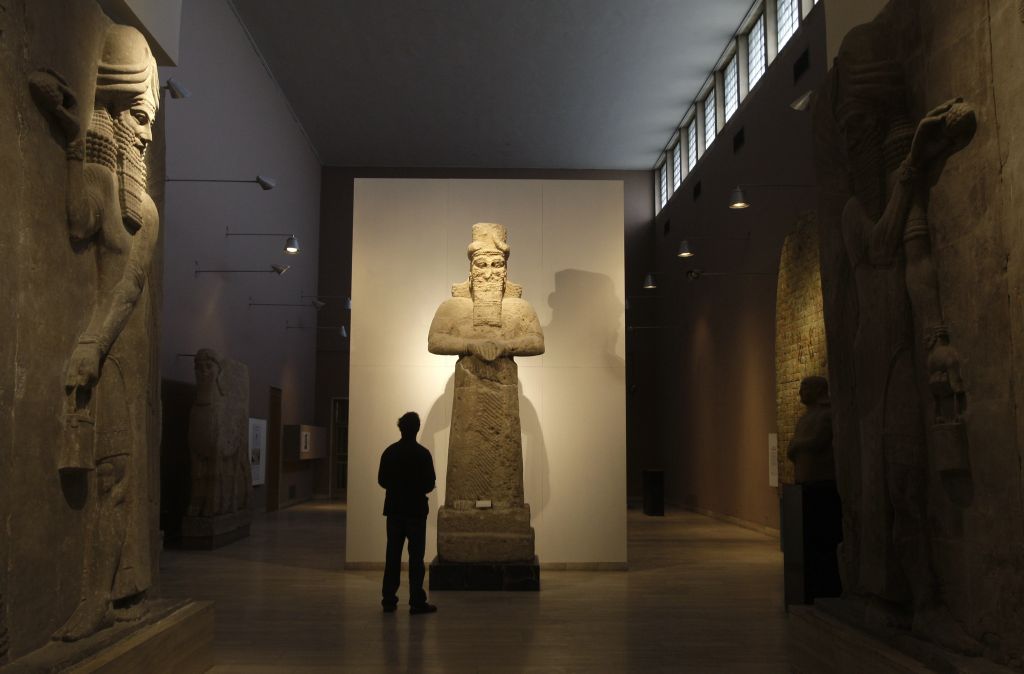
In this Nov. 24, 2009 file photo, a journalist looks at an Assyrian statue, center, in front of two Assyrian human-headed winged bulls at Iraq’s national museum, in Baghdad. Islamic State militants “bulldozed” the renowned archaeological site of the ancient city of Nimrud in northern Iraq on Thursday, March 5, 2015 using heavy military vehicles, the government said. Nimrud was the second capital of Assyria, an ancient kingdom that began in about 900 B.C., partially in present-day Iraq, and became a great regional power. The city, which was destroyed in 612 B.C., is located on the Tigris River just south of Iraq’s second largest city, Mosul, which was captured by the Islamic State group in June(photo credit: AP Photo/Petros Giannakouris, File)
Help us report truthfully on social media
As a multimedia journalist, my job is to take the quality, fact-based journalism produced by The Times of Israel newsroom and make it accessible across every platform — from Instagram posts to podcasts to short-form videos.
This is how many, especially young people, consume news these days. But misinformation is rampant on social media. Our team at ToI produces accurate, responsible short-form reporting on Israel and the Jewish world.
If you believe in the importance of factual social media journalism, please consider joining our reader support group, The Times of Israel Community. Your financial support is essential to sustain responsible multimedia reporting.
We’re really pleased that you’ve read X Times of Israel articles in the past month.
That’s why we started the Times of Israel - to provide discerning readers like you with must-read coverage of Israel and the Jewish world.
So now we have a request. Unlike other news outlets, we haven’t put up a paywall. But as the journalism we do is costly, we invite readers for whom The Times of Israel has become important to help support our work by joining The Times of Israel Community.
For as little as $6 a month you can help support our quality journalism while enjoying The Times of Israel AD-FREE, as well as accessing exclusive content available only to Times of Israel Community members.
Thank you, David Horovitz, Founding Editor of The Times of Israel


 Add ToI as a Preferred Source on Google