

Islamic State has used chemical weapons 71 times, group charges
Analysts warn liberation forces approaching jihadist-held Mosul could face chlorine and mustard gas attacks
 Add ToI as a Preferred Source on Google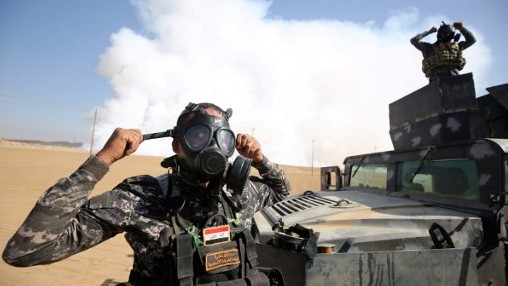
A new analysis has found that the Islamic State group has used chemical weapons at least 71 times since 2014 in Iraq and Syria.
IHS Markit, an information and analysis company based in London, released the analysis on Tuesday. It said there’s a high risk that the group will deploy the weapons in the Iraqi city of Mosul against civilians or the military forces trying to retake the city.
The analysis also said that Mosul was a center for chemical weapons production for the Sunni militant group, but experts believe the Islamic State group moved the materials and experts to Syria ahead of the offensive that began in October.
IHS concluded that chlorine and mustard agents are the most likely chemicals to be used in Mosul.
More than 25,000 Iraqi troops have mobilized for the Mosul fight, a massive operation that’s expected to take weeks, if not months.
Islamic State used chemical weapons 52 times in Syria and 19 times in the Mosul area since 2014, when the group swept through large parts of Iraq and Syria.
In September US-led coalition warplanes destroyed a factory near Mosul suspected of being used by IS to make chemical weapons. Observers have repeatedly alleged IS has used chemical weapons, and the Pentagon has confirmed the jihadists have deployed chlorine and sulfur mustard devices.
Earlier this month the executive body of the global chemical arms watchdog condemned Syria and Islamic State jihadists for using toxic weapons.
The leading body of the Organization for the Prohibition of Chemical Weapons also voiced concern about “gaps and discrepancies” in Syria’s 2013 declaration about the size of its toxic arms stockpile.
A resolution, adopted by a rare majority vote, “condemns in the strongest possible terms the use of chemical weapons in the Syrian Arab Republic,” the OPCW said in a statement.
It pointed to findings by a recent joint UN and OPCW investigation which concluded that “the Syrian Arab Armed Forces and the so-called Islamic State … have been involved in the use of chemical weapons.”






The Times of Israel Community.