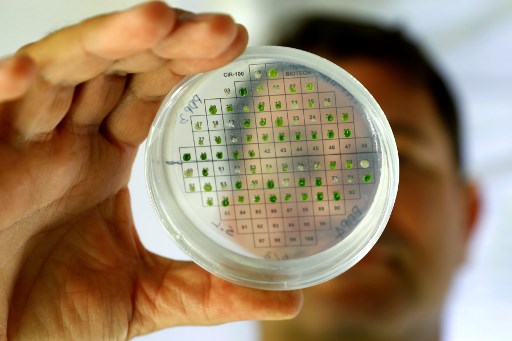
Iftach Yacoby, head of the Tel Aviv University's renewable energy laboratory, examines micro algae samples during research to demonstrate the evolutionary capacities of plants with the sun to produce energy on June 11, 2020. (JACK GUEZ / AFP)
Israeli scientists said this week they have succeeded in producing hydrogen from plants in a development that they hope could eventually lead to using vegetation to produce electricity.
The discovery was made by using microscopic algae, an aquatic plant, in research carried out at a Tel Aviv University laboratory.
“To link a device to electricity, you just have to connect to a power point. In the case of a plant, we didn’t know where to connect,” said Iftach Yacoby, who heads the university’s renewable energy laboratory.
Researchers planted an enzyme into samples of the algae and observed it producing hydrogen, a source of energy already used to fuel some vehicles.
“We didn’t know if this would work, but we believed that it had potential,” said Yacoby during a laboratory visit.
Sign up for the Tech Israel Dailyand never miss Israel's top tech stories
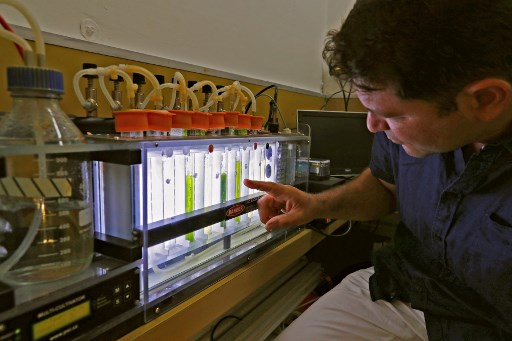
Iftach Yacoby, head of the Tel Aviv University’s renewable energy laboratory, examines a photobioreactor on June 11, 2020. (JACK GUEZ / AFP)
Findings of the study, a collaborative project with Kevin Redding at the University of Arizona, were published in April in the Energy & Environmental Science journal.
“From the moment we found how to use plants to produce a source of energy, the options were open,” said Yacoby.
The nascent research shows that plants have the potential to produce electricity, he said, while cautioning it will take up to 20 years for the world to benefit from the findings.
Advertisement
“There are lots of things that we can consider doing thanks to the results of our research. The future will tell us what will come of it,” he said.
Help us report truthfully on social media
As a multimedia journalist, my job is to take the quality, fact-based journalism produced by The Times of Israel newsroom and make it accessible across every platform — from Instagram posts to podcasts to short-form videos.
This is how many, especially young people, consume news these days. But misinformation is rampant on social media. Our team at ToI produces accurate, responsible short-form reporting on Israel and the Jewish world.
If you believe in the importance of factual social media journalism, please consider joining our reader support group, The Times of Israel Community. Your financial support is essential to sustain responsible multimedia reporting.
We’re really pleased that you’ve read X Times of Israel articles in the past month.
That’s why we started the Times of Israel - to provide discerning readers like you with must-read coverage of Israel and the Jewish world.
So now we have a request. Unlike other news outlets, we haven’t put up a paywall. But as the journalism we do is costly, we invite readers for whom The Times of Israel has become important to help support our work by joining The Times of Israel Community.
For as little as $6 a month you can help support our quality journalism while enjoying The Times of Israel AD-FREE, as well as accessing exclusive content available only to Times of Israel Community members.
Thank you, David Horovitz, Founding Editor of The Times of Israel


 Add ToI as a Preferred Source on Google