Israeli war veterans, relatives and victims of attacks on civilians received free tattoos in Jerusalem on Thursday, in an initiative to use art to heal both mental and physical wounds.
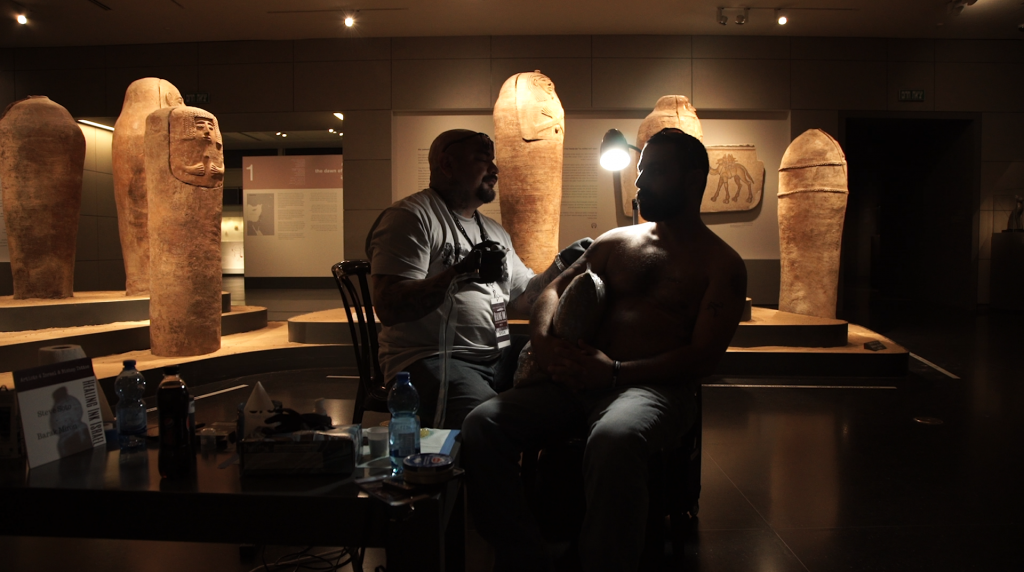
Eleven Israelis whose injuries ranged from lost limbs to mental health trauma were inked by well-known tattoo artists, mainly from the United States, at the Israel Museum in Jerusalem in the evening.
The men and women told their stories, which ranged from being ambushed during Israel’s occupation of southern Lebanon to losing a partner in war.
British-Israeli Kay Wilson was hiking with an American Christian friend near Jerusalem in 2010 when they were kidnapped by two Palestinian men.
Israeli veteran Barak Miron, injured in Lebanon in 1999, is tattooed by world-famous tattoo artist Steve Soto at the Israel Museum, October 20, 2016. (Luke Tress/Times of Israel)
Her friend was murdered while Wilson was stabbed 13 times before managing to escape.
Get The Times of Israel's Daily Editionby email and never miss our top stories
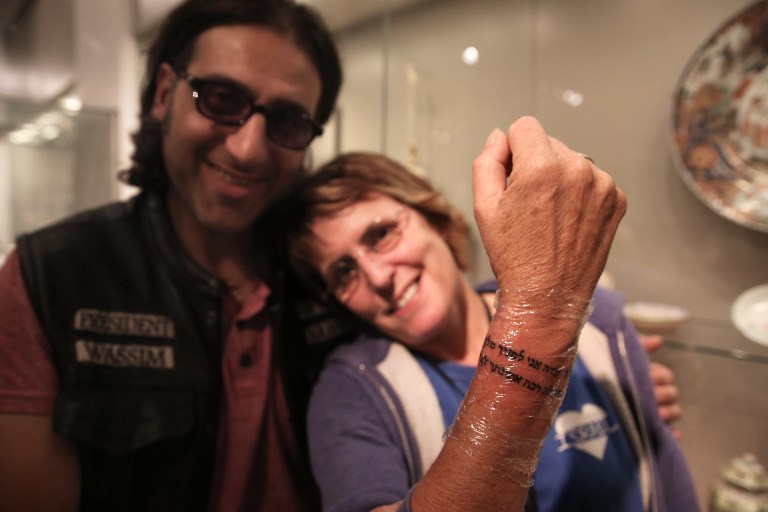
On Thursday she was having a Jewish prayer tattooed on her wrist and explained that part of the reason was to help her “recognize I don’t know why this stuff happened.
“It is not a question of why, it is a question of how I am going to carry this cosmic event with dignity and not live in hatred,” she said.
British-Israeli Kay Wilson displays the Hebrew prayer tattoo on her wrist, made by tattoo artist Wassim Razzouk, a Palestinian Christian from Jerusalem’s Old City, as part of an initiative to use art to heal both mental and physical wounds at a modern art exhibition hall in the Israeli museum in Jerusalem on October 20, 2016. (AFP PHOTO / MENAHEM KAHANA)
She was keen to stress that one of the surgeons who saved her life was an Arab and she was being tattooed by Wassim Razzouk, a Palestinian Christian from Jerusalem’s Old City.
Advertisement
“Peace is not an easy word, peace is a very political word,” Razzouk said.
Craig Dershowitz, executive director at the Artists 4 Israel charity which organized the event along with the museum, said its purpose was to help the men and women learn to cope.
“The most important part is they are taking control of their bodies again,” he told AFP.
He said many people who are scarred “look in the mirror and feel uncomfortable because of a disfiguration, not feeling at peace in your own skin.”
But after getting a tattoo, he said, “now when you see (the scar) you don’t see it anymore, you see art.”
Help us report truthfully on social media
As a multimedia journalist, my job is to take the quality, fact-based journalism produced by The Times of Israel newsroom and make it accessible across every platform — from Instagram posts to podcasts to short-form videos.
This is how many, especially young people, consume news these days. But misinformation is rampant on social media. Our team at ToI produces accurate, responsible short-form reporting on Israel and the Jewish world.
If you believe in the importance of factual social media journalism, please consider joining our reader support group, The Times of Israel Community. Your financial support is essential to sustain responsible multimedia reporting.
We’re really pleased that you’ve read X Times of Israel articles in the past month.
That’s why we started the Times of Israel - to provide discerning readers like you with must-read coverage of Israel and the Jewish world.
So now we have a request. Unlike other news outlets, we haven’t put up a paywall. But as the journalism we do is costly, we invite readers for whom The Times of Israel has become important to help support our work by joining The Times of Israel Community.
For as little as $6 a month you can help support our quality journalism while enjoying The Times of Israel AD-FREE, as well as accessing exclusive content available only to Times of Israel Community members.
Thank you, David Horovitz, Founding Editor of The Times of Israel


 Add ToI as a Preferred Source on Google