

JNF workers protest at PM’s office against bill forcing handover of its cash
Demonstrators say legislation will lead to the ‘elimination of Zionism,’ but also say the money is meant to fund their pensions
 Add ToI as a Preferred Source on Google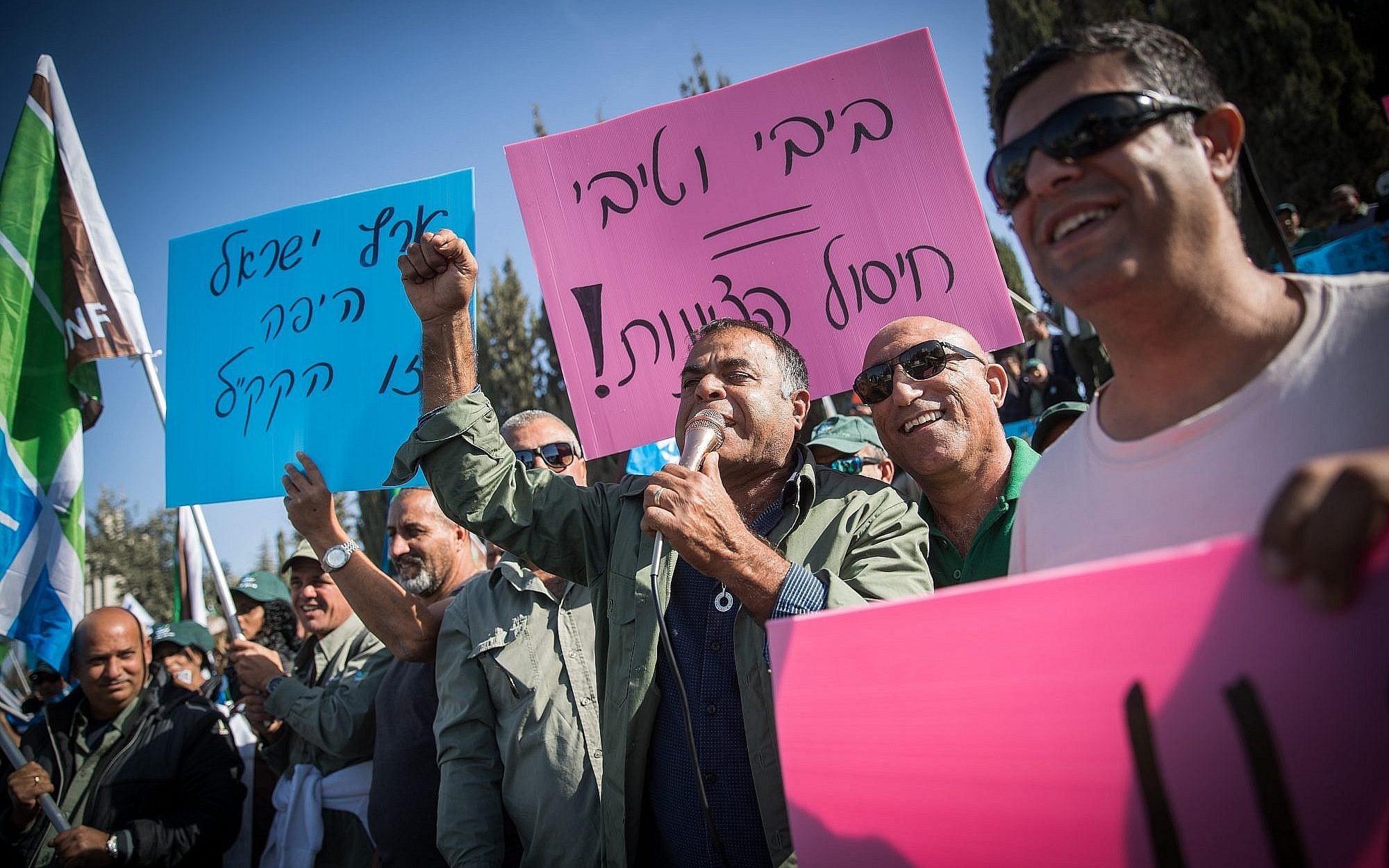
Employees of the Jewish National Fund on Sunday protested outside the Prime Minister’s Office against legislation that would require the body to transfer the majority of its revenues to the state in return for keeping its tax-exempt status.
Some 800 JNF workers were at the protest, with demonstrators holding up signs accusing the government of the “elimination of Zionism.”
“The workers will call on [Prime Minister Benjamin] Netanyahu, [Finance Minister Moshe] Kahlon, [Education Minister Naftali] Bennett, [Interior Minister Aryeh] Deri, [Defense Minister Avigdor] Liberman and the rest of the government ministers not to fulfill the dream of the Joint [Arab] List and Zionism’s enemies, and not execute a fatal blow to the most important Zionist organization,” a spokesperson for JNF said ahead of the protest.
One JNF employee said he was protesting against “the foolish decision to hurt the absolute, most significant body for the state of Israel, the most Zionistic, the one that established Israel by acquiring lands.”
“This is the most socially-minded organization there ever was, that operates today with no political considerations, for the general public – both Jewish and non-Jewish, investing immensely in reducing social gaps,” said Saer Ismael.

However, chairman of the KKL workers committee Yisrael Cohen told Israel Radio they were mostly concerned about the workers’ pensions.
“We are worried about our pension funds. We have defined benefit pensions with an obligation of some NIS 2 billion that comes from the KKL budget, not from state funds,” he said.
About 15 years ago, most of the public sector in Israel moved from defined pensions, which are based on a percentage of an employee’s salary before retirement, to a more sustainable contribution pension, where the employer and employee put aside an amount each month.
“If we don’t have it in the reserve we have no guarantee of our pensions. So if we don’t have that we will have to sell more lands, and you know who will buy it? Those we bought it from,” Cohen said, apparently referring to Arabs.
Under the legislation, which is expected to be approved by the Knesset in its second and third readings this week, JNF will be required to pay 65 percent of its revenues in return for tax exemption until 2023.
The legislation came after the JNF board of directors rejected a deal reached by its chairman that would have seen it hand over to Israel’s state coffers NIS 2 billion, or $570 million, of its assets in two installments — one this year and one the next. The board of directors instead offered to make just the first payment.
In response to the legislation, JNF has said that it will file a High Court appeal against the bill.
Last week, JNF said that it would freeze billions of shekels in funding to local authorities and development programs while it assesses the legislation.
Despite being backed by Netanyahu and Kahlon, the bill has several influential opponents, including Likud’s own Welfare Minister Haim Katz, Agriculture Minister Uri Ariel of the Jewish Home party, and MK Bezalel Smotrich, also of Jewish Home.
The JNF, known in Hebrew as Keren Kayemeth LeIsrael, owns 13 percent of all the land in the country and brings in some $3 billion a year, most of it from land sales.
Founded in 1901, it bought land and founded settlements on which Israel was established in 1948. Famed for planting hundreds of millions of trees in Israel, the not-for-profit group also focuses on land reclamation and development of communities outside central Israel.
In January State Comptroller Joseph Shapira published a report that slammed the JNF as a bloated organization with little transparency that may have mishandled funds and acted out of conflicts of interest.
The bombshell report, the first ever on the JNF by the state comptroller, focused much of its attention on alleged conflicts of interest and lack of oversight at the organization’s operational branch, the Land Development Administration.
JTA contributed to this report.









The Times of Israel Community.