

LISTEN: Rebrand Trump plan as Road Map ‘Phase 2,’ says ‘Catch-67’s Micah Goodman
As the philosopher/author strives to take the decades-old conflict out of stalemate, it just may behoove Israeli and American politicians to listen to this out-of-the-box thinker
 Add ToI as a Preferred Source on Google
Deputy Editor Amanda Borschel-Dan is the host of The Times of Israel's Daily Briefing, What Matters Now and The Reel Schmooze podcasts, and heads up The Times of Israel's features.
As a peace plan, US President Donald Trump’s recently unveiled “Peace to Prosperity: A Vision to Improve the Lives of the Palestinian and Israeli People” appears to be dead in the water. But what if it were rebranded as Phase 2 of the 2003 Roadmap for Peace, wondered philosopher Dr. Micah Goodman in conversation with The Times of Israel this week.
Goodman is the author of the 2017 instant Israeli bestseller “Catch-67” about the Israeli political left and right’s debate over the ongoing Israeli-Palestinian conflict. After initial study, he does not dismiss the Trump plan out of hand. But he also doesn’t think it can work.
To salvage the plan, Goodman recommended a practical reorganization — and rebranding — which will give Israelis and Palestinians the means to reframe the ongoing conflict as a path to move forward.
“This should be a deal, but not a peace deal. It is not an end of conflict deal,” said Goodman.
Rather, he suggested, let the Trump plan be the much-delayed implementation of the Road Map, an agreement drawn up under the George W. Bush administration, which was aimed at halting the raging Second Intifada. Goodman counseled immediate implementation of Trump’s Palestinian “almost sovereignty,” as well as the economic portion of the plan, but preferred to leave to the side — for now — the questions of annexation and the end of the conflict.
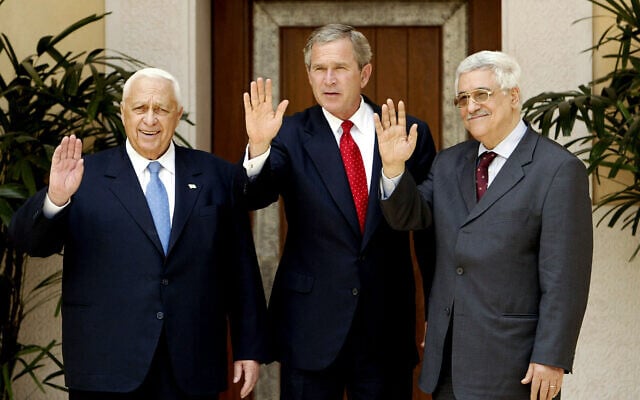
There have been 17 attempts at peace until today, which are outlined and discussed in Goodman’s book. The Road Map is the final internationally recognized peace agreement between the two peoples, and both sides signed onto it before it quickly fell apart. The agreement’s demise led prime minister Ariel Sharon to declare the Palestinians were not a partner in peace negotiations, and to Israel’s eventual 2005 unilateral withdrawal from the Gush Katif settlements in the Gaza Strip.
Since the Road Map’s failure, there have been almost two decades of stalemate, mostly due to what Goodman calls “Catch-67,” or a paralyzing circle of unresolved issues on the political right and left that feed upon each other and grow exponentially.
“It was very smart, the Road Map,” said Goodman, because it said that a Palestinian state is needed to start negotiations, instead of the opposite. “It reverses it. How about — this is the equation I’m thinking about working on — maybe we should think about the Deal of the Century, the Trump plan, as Stage 2 in the Bush Plan,” said Goodman.
Phase 2 of the Road Map was to have led to the the creation of an independent Palestinian state with provisional borders as a step toward beginning long-term negotiations. Goodman hears echoes of this in the Trump plan.
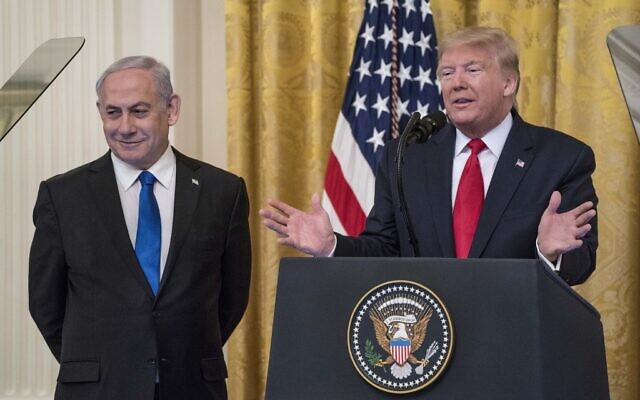
“Maybe the Trump plan is implementation of Stage 2 of the Road Map? So Trump, plus Bush, equals reorganizing the conflict,” he said.
Goodman’s book was resonant in the highest echelons of Israeli politics. In the week since the unveiling of the new Trump plan, Goodman has broken it down into four pieces, which he labels the end of conflict piece, the annexation piece, the sort-of sovereign Palestinian piece, and the economic piece.
“I think we should change the Trump plan in the following way: Let’s do the state part right now. No preconditions, just do it. And the economic part, right now. And the end of conflict part and annexation, let’s negotiate that in the future,” said Goodman. “Let’s reverse it.”
Conventional Israeli wisdom holds up Palestinian sovereignty as the juicy “carrot” leading the Palestinians toward final negotiations. Goodman would flip that paradigm.

“This state, the Palestinian state, is not the price we pay, it’s the prize we get,” said Goodman. After discussions with Israeli security officials, he is convinced that the security arrangements will keep Israelis safe. At the same time, Palestinian sovereignty eliminates the demographic threat looming over a potential one-state, bi-national Israel.
“Boom, we’ve just escaped Catch-67,” said Goodman.
However, he said, it is important to implement the “almost statehood” without the Trump plan’s checklist of preconditions, in the same way that Israelis’ core religious and nationalist values are respected.
Goodman explained that according to Sharia (Muslim) law, giving up any part of the land of Israel is forbidden to Muslim Palestinians. Likewise, forfeiting the Right of Return would run counter to their national narrative.
“So we’re asking them to turn their backs on their religion and their nation for independence,” he said. “In other words, we’re asking them to turn their backs on their identity to achieve liberty. And they always say no and I understand them. We should understand that and respect the refusal to turn their backs, to trade identity for liberty.”
Goodman suggested that through implementation of the Trump plan, the Palestinians do not make any concessions that conflict with their national identity, yet still get liberty — “but not complete liberty.”
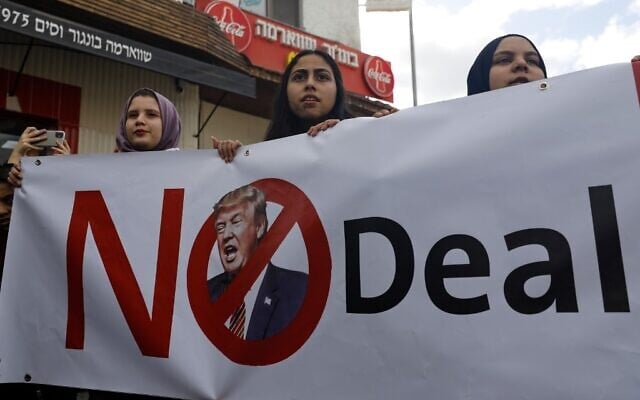
“Where will this take us? And on this I am always misunderstood. This will not end the conflict, this will not bring peace. It will do something completely different. It will reorganize the conflict,” he said.
“Right now the conflict is poisonous,” he said. He urged Israel to change the power balance and give Palestinians — right now — three core freedoms: ease of movement domestically and travel abroad, natural residential growth, and economic independence and expansion.
While the Israeli religious right and settler movement are the natural opposition to such a “reorganization,” according to Goodman, “Catch-67 is a halachic catch.” The continued military control of the Palestinian people goes directly against Jewish law, he said.
Clearly, he said, Jewish law would prioritize the mandate to save Jewish lives over the prohibition against controlling another people. However, said Goodman, if there could be a way to shrink the control without being threatened further by that people, “we are halachically [religiously] obligated to do that.”
“So my proposal is like this: To take the Trump plan, tweak it, change it from a plan to end the conflict to a plan to change the conflict. To change the character of the conflict. If we reorganize the conflict as a conflict between neighbors, that’s a healthier conflict for Israel. We Israelis do not want to control the Palestinians,” said Goodman.
The Times of Israel podcast is available for download on iTunes, Soundcloud, TuneIn, Pocket Casts, Stitcher and PlayerFM.







The Times of Israel Community.