Trump said to soon decide whether to release peace plan before Israeli election
Report says US president’s decision will be influenced by impeachment trial, Davos trip, feedback from Arab leaders and Kushner’s expected meetings this week with Netanyahu, Gantz
US President Donald Trump speaks during an event honoring the 2019 college football national champions, the Louisiana State University Tigers, in the East Room of the White House in Washington, January 17, 2020. (Mandel Ngan/AFP)
The Times of Israel liveblogged Sunday’s events as they happened.
KYIV, Ukraine — The flag-draped coffins of the 11 Ukrainians who died in a plane mistakenly shot down by Iran during a spike in tensions with Washington arrive in Kyiv.
Ukrainian President Volodymyr Zelensky, Prime Minister Oleksiy Goncharuk and other officials attend the solemn ceremony at Kiev’s Boryspil airport to see caskets with the remains of the downed plane’s nine Ukrainian flight crew and two passengers being removed from the aircraft.
Ukraine International Airlines staff, some in tears, stand on the tarmac clutching flowers, according to live video footage.
The airline staff and relatives form two lines to make a corridor through which the honor guard carried the caskets draped in the yellow-and-blue flag of Ukraine.
Some men fall to one knee to honor the victims.
The honor guard also holds flags of the countries whose citizens perished in the crash.
An honor guard carries a coffin of the one of the eleven Ukrainian victims of the Ukrainian 737-800 plane that crashed on the outskirts of Tehran, at Borispil international airport outside Kyiv, Ukraine, January 19, 2020. (Ukrainian Presidential Press Office via AP)
The Kyiv-bound UIA Boeing 737 crashed shortly after taking off from Tehran on January 8, killing all 176 people on board, mostly Iranian and Canadian citizens.
The funerals are expected to be held tomorrow.
The Boeing crashed shortly after Iran launched missiles at US forces in Iraq in response to the killing of top Iranian general Qasem Soleimani in a US drone strike in Baghdad on January 3.
Tehran admitted it had mistakenly shot down the plane several days later.
Ukraine’s leader has demanded that Iran punish those guilty for the downing of the airliner and compensate the victims.
BAGHDAD — Protests escalate across Iraq’s south and its capital Baghdad today as demonstrators seal off streets with burning tires in outrage at the government’s slow pace of reform.
The youth-dominated rallies demanding an overhaul of the ruling system have rocked Shiite-majority parts of Iraq since October, but had thinned out in recent weeks amid the geopolitical storm of rising Iran-US tensions.
Today the anti-government protest movement was reignited with hundreds of angry young people descending on the main protest camp in Baghdad’s Tahrir Square as well as the nearby Tayaran Square.
Others burn tires to block highways and bridges, turning back cars and leading to traffic jams across the city.
Iraqi anti-government demonstrators march during a protest at Tayaran Square, near Tahrir Square in the center of the capital Baghdad, on January 19, 2020. (Sabah Arar/AFP)
Security forces use tear gas to try to clear out the protesters, who respond by throwing rocks.
At least 10 people including police officers are wounded in the resulting skirmishes, a medical source tells AFP.
Protesters are demanding early elections based on a reformed voting law, a new prime minister to replace current caretaker premier Adel Abdel Mahdi and that officials deemed corrupt be held to account.
Abdel Mahdi resigned nearly two months ago, but political parties have thus far failed to agree on a successor and he has continued to run the government as a caretaker.
TEHRAN, Iran — Iran accuses Asian soccer’s governing body of bias for a mooted ban on it hosting club matches, after a spate of security incidents including the downing of an airliner.
“It appears that the decision of your Competitions Committee was influenced by foreign media hostile” toward Iran, Sports Minister Masoud Soltanifar tells the head of the Asian Football Confederation, according to the ministry’s news agency.
“Iran is a safe and powerful country… We have no problems regarding the security of aviation,” he is quoted as saying in the call with AFC chief Salman Bin Ibrahim al-Khalifa.
The minister says that in addition he would “personally guarantee the security of visiting soccer teams.”
The row comes as tensions soar between the West and Iran following the killing of top commander Qasem Soleimani in a US air strike in Baghdad on January 3.
Iran retaliated five days later by launching a wave of missiles at US troops stationed in neighboring Iraq.
It had still been on high alert hours later when its armed forces mistakenly shot down a Ukraine International Airlines Boeing 737 soon after takeoff from Tehran, killing all 176 people on board.
The four soccer teams representing Iran in the AFC Champions League — Esteghlal, Persepolis, Sepahan and Shahr Khodro — have all threatened to pull out if the ban is confirmed.
But a non-Iranian source close to the issue tells AFP the ban “is not an official decision yet.”
The final decision is expected “in the coming hours,” the source adds.
Lawmakers from the Yisrael Beytenu and United Torah Judaism trade accusations over a request to disqualify an Arab MK from running in the upcoming elections for her alleged support of terror.
Yisrael Beytenu MK Oded Forer shares an article from Actualic, an ultra-Orthodox new site, quoting an unnamed UTJ source saying the party would not participate in Central Elections Committee hearings on Joint List MK Heba Yazbak’s candidacy.
“For whoever was anxious, the deal between United Torah Judaism and the Arab parties is alive and well. The main thing is that the [Knesset] Finance Committee will stay in the hands of MK [Moshe] Gafni with the help of [Ahmad] Tibi and Bibi [Netanyahu],” tweets Forer.
Gafni, the No. 2 in UTJ, hits back at Forer.
“Yisrael Beytenu continues to spread lies. We’re fed up, the public is fed up,” he is quoted saying by Army Radio.
The secularist Yisrael Beytenu and the ultra-Orthodox UTJ have been key parts of Prime Minister Benjamin Netanyahu’s past governments, but the parties fell out after elections in April over legislation to boost ultra-Orthodox conscription and other matters of religion and state, preventing the premier from putting together a ruling majority in the Knesset.
After a second round of elections in September, Yisrael Beytenu ruled out joining a Netanyahu-led government that included religious parties or one headed by Blue and White chair Benny Gantz that was backed by the Joint List, whose lawmakers have been called a “fifth column” by party leader Avigdor Liberman.
Blue and White is expected to back the request to bar Yazbak from running, which is set to be filed by Likud MK Ofir Katz this week.
AMMAN, Jordan — The Jordanian parliament votes in favor of a law to ban gas imports from Israel, weeks after the Jewish state began pumping it to the kingdom in a $10 billion deal.
It remains unclear however whether the government in Amman will back the legislative push against an agreement which it has said improves energy security for Jordanians.
Earlier this month Israel began exporting gas from the offshore Leviathan field to neighbors Jordan and Egypt — the only two Arab countries it has peace treaties with — under a 15-year agreement.
The deal struck with the Amman government sparked streets protests in Jordan, where many consider Israel as an enemy.
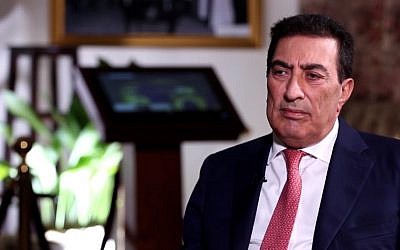
Screen capture from video of Atef Tarawneh, the Speaker of the Lower House of the Jordanian parliament. (YouTube)
“The majority has voted to send an urgent motion to the government” requesting a law banning Israeli gas imports to Jordan, parliamentary speaker Atef Tarawneh says, in remarks carried live by state television.
TV footage shows a majority of MPs in parliament’s lower house stand up to back the motion, which is decided after 58 out of the 130-strong legislature last month demanded such a ban in a letter to the legislature.
The motion passed today will be sent to the government for its approval and must be sent back to the legislature for a formal vote.
The text states that “the government, its ministries and state institutions and companies are prohibited from importing gas from Israel.”
NICOSIA, Cyprus — Cyprus denounces Turkey as a “pirate state” that flouts international law as Turkey’s bid to drill for natural gas in waters where Cyprus has economic rights rekindled tensions over energy reserves in the eastern Mediterranean.
Cyprus says Turkey is now attempting to drill inside an exploration area, or block, south of the ethnically split Mediterranean island nation that’s already licensed to energy companies Eni of Italy and Total of France.
This would be Turkey’s fourth such drilling effort since last July when it dispatched a pair or warship-escorted drill ships to the island’s west and east. It would also mark the second time a Turkish ship was drilling in a block licensed to Eni and Total.
Overall, the two energy companies hold licenses to carry out a hydrocarbons search in seven of Cyprus’ 13 blocks off its south coast. Other companies holding such licenses include ExxonMobil and partner Qatar Petroleum, as well as Texas-based Noble Energy and Israeli partner Delek.
Cyprus says despite emerging energy-based partnerships among the countries in the eastern Mediterranean, Turkey has opted to “go down a path of international illegality” of its own accord. It says Turkey has “provocatively ignored” repeated European Union calls to stop its illegal activities.
MOSCOW — More than a thousand opposition activists of various stripes march in central Moscow today after Russian President Vladimir Putin proposed re-drafting the constitution, unleashing political upheaval.
Protesters — mostly young anti-fascist activists — chant “Revolution” and “No to dictatorship” and some carry copies of the constitution.
The annual sanctioned march was called to commemorate the memory of lawyer Stanislav Markelov and journalist Anastasia Baburova who were gunned down in Moscow by ultra-nationalists in 2009.
A number of independent local deputies including Yulia Galyamin and opposition-minded Russians join the march, carrying copies of the constitution and chanting “Putin leave!”
Several people including a protester carrying a placard urging Putin to quit power are detained by police.
More than 1,400 people are taking part in the march, according to the White Counter group which monitors political protests.
Russian opposition protestors march in central Moscow on January 19, 2020. (Alexander Nemenov/AFP)
The march takes place after Putin stunned the nation on Wednesday, proposing sweeping amendments to the constitution, the first major changes to the country’s basic law since it was adopted under Boris Yeltsin in 1993.
The move triggered the resignation of his government.
Many observers have said Putin’s proposals are designed to ensure his grip on power after he leaves the Kremlin and his critics have accused him of orchestrating a “constitutional coup.”
The Sderot Municipality says it has received reports that residents of the Gaza-area city heard an explosion but that security forces have been unable to locate the source of the blast.
Initial Hebrew media reports attributed the blast to an explosives-laden balloon launched from the Gaza Strip.
The Israeli military fires a shell at a Hamas observation post along the Gaza border, apparently in response to the launching of balloon-borne explosive devices from the Strip, Palestinian media reports.
There are no immediate reports of Palestinian injuries.
Earlier this afternoon, one such explosives-laden balloon reportedly detonated over Sderot in southern Israel, causing no injuries or damage.
The Israeli retaliatory attack is not immediately confirmed by the military.
Balad reacts to reports that Blue and White will back a motion to disqualify its MK Heba Yazbak over her alleged support of terrorism.
“Blue and White’s decision to support the request to disqualify MK Heba Yazbak again proves it is a second Likud party… and is being dragged after [Likud] in the campaign of delegitimizing the Arab public and its representatives,” Balad says in a statement.
Balad, the only sub-faction in Joint List not to recommend that Blue and White chair Benny Gantz form a government after September’s elections, says “it turns out that everything we in Balad said about Blue and White is correct.”
“It is not an alternative to Netanyahu but rather the other side of the same coin,” the party says.
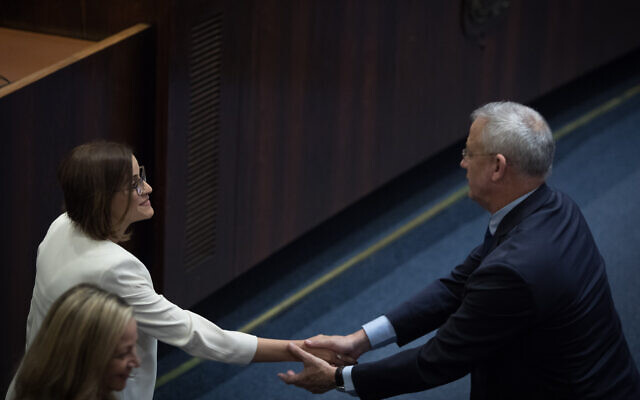
MK Heba Yazbak shakes hands with Blue and White MK Benny Gantz at the Knesset on May 13, 2019. (Noam Revkin Fenton/Flash90)
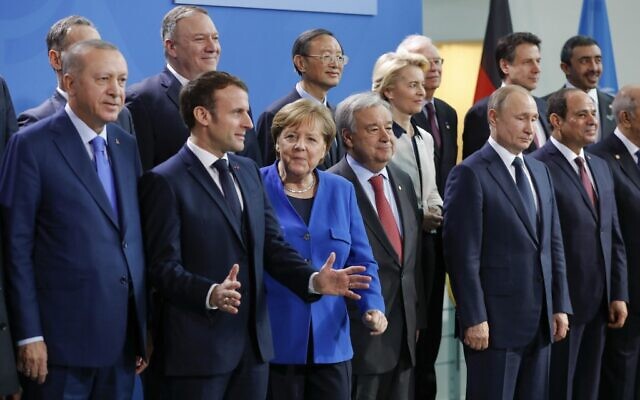
BERLIN — World leaders, including the presidents of Turkey, Russia and France, open talks today at a summit hosted by German Chancellor Angela Merkel aimed at ending the war in Libya.
Held under the auspices of the United Nations, the summit’s main goal is to get foreign powers wielding influence in the region to stop interfering in the war — be it through the supply of weapons, troops or financing.
— AFP
Left to right in first row: Turkish President Recep Tayyip Erdogan, French President Emmanuel Macron, German Chancellor Angela Merkel, UN Secretary-General Antonio Guterres, Russian President Vladimir Putin and Egyptian President Abdul Fattah el-Sissi and (top row left to right) US Secretary of State Mike Pompeo, Chinese politburo member Yang Jiechi, EU Commision President Ursula von der Leyen, EU High Representative for Foreign Affairs and Security Policy Josep Borrell, Italian Prime Minister Giuseppe Conte and United Arab Emirates Foreign Minister Sheikh Abdullah bin Zayed Al Nahyan pose for a photograph during a peace summit on Libya at the Chancellery in Berlin, January 19, 2020. (Odd Andersen/AFP)
The mother of Naama Issachar, an Israeli-American woman jailed in Russia on drug charges, touches down in Israel amid growing optimism that Russian President Vladimir Putin will pardon her daughter when he visits Jerusalem this week.
“This is the moment of truth. This week we’ll know when she is being released,” Yaffa Issachar tells reporters at Ben Gurion Airport.
“I believe [Putin] will pardon her and that he’ll send her home as soon as possible,” she adds.
Yaffa Issachar has been in Russia to be near here daughter, who in October was sentenced to 7.5 years in prison after some 10 grams of cannabis were found in her luggage during a stopover in Moscow.
“I left [Russia] in tears because I left her there and if there are no surprises I’ll go bring her [back],” she says.
Naama Issachar and her mom Yaffa in a post to Issachar’s Instagram page in July 2018.
BUDAPEST, Hungary — Hungary’s Jewish community commemorates the 75th anniversary of the liberation by Soviet troops of the Budapest ghetto, where over 70,000 Jews were confined near the end of World War II.
While some 550,000 Hungarian Jews were killed during the Holocaust in Nazi-run death camps, in forced labor battalions or by the Nazis’ Hungarian allies, many Budapest Jews survived the war. They went into hiding in the ghetto or were helped by sympathetic foreign diplomats like Sweden’s Raoul Wallenberg.
Hundreds of people attend the commemoration today at Budapest’s Dohany Street Synagogue, the largest in Europe, including Holocaust survivors, diplomats and politicians.
Robert Frolich, the synagogue’s chief rabbi, speaks of “ambivalent feelings” surrounding the commemoration, which contains pain and mourning, but also the “celebration of life.”
“Seventy-five years ago, Europe’s last ghetto, the Budapest ghetto, was liberated. This is what we remember today,” Frolich says. “Ambivalent feelings gather inside us, because the reason for the event, the liberation of the ghetto, is itself ambivalent.”
“It contains pain, it contains tragedy and the mourning which cannot be put into words, which is unspeakable and can only be experienced. At the same time, it contains joy, relief and the celebration of life.”
— AP
People attend a ceremony that commemorates the 75th anniversary of the liberation of the Budapest Jewish ghetto in Dohany Street Synagogue in Budapest, Hungary, January 19, 2020. (Tibor Illyes/MTI via AP)
The Tel Aviv Magistrate’s Court rules police can search the phone of a top aide to Prime Minister Netanyahu suspected of harassing a state’s witness.
While approving a warrant for Likud campaign manager Ofer Golan’s phone, the court blocks police from searching the phones of other aides, including party spokesman Jonatan Urich.
Golan and Urich are under investigation for allegedly harassing Shlomo Filber, a former Netanyahu confidant who turned state’s witness in a graft case implicating the prime minister.
They have argued that search warrants for their phones were based on information obtained during previous, allegedly illegal searches, invalidating the warrants.
(R-L) Ofer Golan, Likud campaign manager, Prime Minister Benjamin Netanyahu, digital adviser Topaz Luk and Likud spokesman Jonatan Urich at the Prime Minister’s Residence in Jerusalem on March 20, 2019. (Yonatan Sindel/Flash90)
CAIRO — US Secretary of State Mike Pompeo “expressed outrage” to Egypt’s president at the death of an American citizen who insisted he had been wrongfully held in Egyptian prison, according to a State Department spokeswoman.
Pompeo’s sharp remarks signal the US government intended to place the death of Mustafa Kassem, 54, following his protracted hunger strike last week, high on the diplomatic agenda.
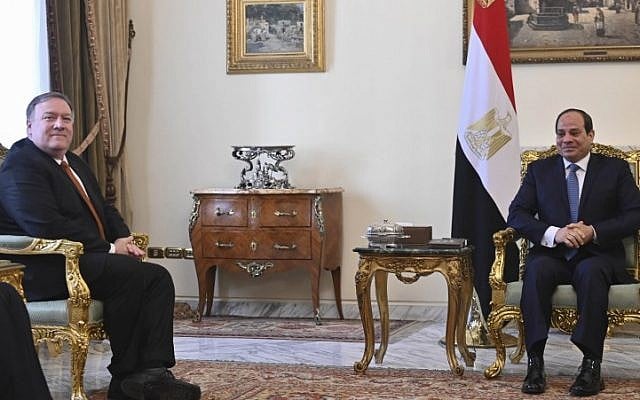
Pompeo raises his concerns to Egyptian President Abdel-Fattah el-Sissi about Kassem’s “pointless and tragic death” on the sidelines of an international peace summit in Berlin that aims to end Libya’s civil war.
The death of the auto parts dealer from Long Island, New York, prompted an outcry from human rights groups, as well as accusations of medical negligence in Egypt’s prisons.
The case also touched a nerve in Washington, which has cultivated close security and diplomatic ties with Egypt despite growing unease over its human rights violations under general-turned-president Sissi.
— AP
US Secretary of State Mike Pompeo meets with Egyptian President Abdel Fattah el-Sissi in Cairo on January 10, 2019 (ANDREW CABALLERO-REYNOLDS / POOL / AFP)
The Likud party cheers a court ruling blocking police from searching the phones of a number of Prime Minister Benjamin Netanyahu’s aides, except for campaign manager Ofer Golan.
“Concerning the warrant issued in relation to Ofer Golan’s mobile [phone], the lawyers plan to appeal the decision,” a statement from the party says.
The ruling means police cannot search the phones of Likud spokesman Jonatan Urich or party officials Yossi Shalom and Yisrael Einhorn, who argued the warrants were based on information obtained in allegedly illegal police searches of their phones.
The aides are suspected of harassing state witness Shlomo Filber, a former Likud campaign manager and longtime confidant to Netanyahu.
BEIRUT — Hundreds of anti-government protesters converge on the center of the Lebanese capital, a day after violent clashes between demonstrators and security forces that injured more than 400 people.
Unprecedented protests have rocked Lebanon since October 17, with Lebanese from all political and religious backgrounds demanding the wholesale ouster of a political class they view as inept and corrupt.
Despite rainfall, hundreds keep up the demonstrations in central Beirut, gathering by the barricaded road leading to parliament amid a heavy deployment by security forces.
“Revolutionaries, free people, we will complete this path,” they chant, some wearing colorful waterproof ponchos or clutching umbrellas.
A protester called Mazen says he and others were “fed up with politicians.”
“After three months of revolution, they have proven to us that they don’t change, don’t listen, and have nothing to give,” the 34-year-old says.
In a nearby street earlier, a tea pot lay among black cinders on the pavement where unidentified assailants had set fire to protesters’ tents the night before.
Yesterday, 377 people were injured — both protesters and members of the security forces — according to a toll compiled by AFP from figures provided by the Red Cross and Civil Defense.
Knesset Speaker Yuli Edelstein announces that the Knesset plenum will convene next week to vote on forming the panel that will deliberate Prime Minister Benjamin Netanyahu’s request for parliamentary immunity.
“Even though I disagree with the position of the Knesset legal adviser, I believe that in order to maintain trust in the institution of Knesset speaker by all the factions it is important to accept it,” Edelstein says in a statement.
Edelstein is referring to a legal opinion last week by Eyal Yinon that says the House Committee can be convened despite the Knesset being in recess ahead of the March 2 election.
The committee is widely expected to reject Netanyahu’s request for immunity from graft charges in three criminal cases.
Edelstein says the vote will take place after January 27, International Holocaust Remembrance Day, but doesn’t specify an exact date. He explains the vote will not be this week due to the arrival of world leaders in Jerusalem for commemorations marking 75 years since the liberation of Auschwitz.
“In an important diplomatic week for Israel… I will not allow a brawl in the Knesset building,” he says.
Blue and White MK Meir Cohen praises Knesset Speaker Yuli Edelstein for announcing a plenum vote next week on the formation of the committee that will debate Prime Minister Netanyahu’s request for parliamentary immunity.
“I know what pressures Yuli faced from within his own camp. It was possible to do this early, but I praise Yuli for choosing the right path,” Cohen says in a statement.
“A majority is a majority and it must be respected,” he adds.
Cohen’s name has been floated as a potential Knesset speaker if Edelstein were replaced, which Blue and White has reportedly been threatening if he puts off the vote.
While welcoming Edelstein’s decision, Blue and White MK Moshe Ya’alon tells Channel 13 that “if we see him dragging his feet, we’ll need to replace him.”
WASHINGTON — Donald Trump’s defenders and supporters skirmish over the airwaves, a day after the US president’s legal team dismissed his impeachment trial as unconstitutional and dangerous.
Coming two days before Trump’s trial opens in the Senate, the clashing arguments offer an early taste of the historic drama to play out in coming weeks.
Beginning Tuesday, the chamber will meet six hours a day for six days a week in only the third impeachment trial of a US president, with lofty constitutional issues brushing up against raw partisan politics.
Celebrity attorney Alan Dershowitz, a recent addition to Trump’s legal team, argues today that even if every charge sent by the House to the Senate for the president’s trial were accepted as true, it would not rise to the level of impeachable behavior.
“The [House] vote was to impeach on abuse of power, which is not within the constitutional criteria for impeachment, and obstruction of justice,” Dershowitz, a Harvard law professor emeritus, says on ABC.
A politically motivated impeachment, he adds, was the “greatest nightmare” of the country’s founders.
Adam Schiff, the California lawmaker chosen by House Democrats as lead manager of the impeachment trial, dismisses the notion that abuse of power was not impeachable.
Another House impeachment manager, Jerrold Nadler, calls Dershowitz’s argument “arrant nonsense.”
The Blue and White party issues a response to Yuli Edelstein’s announcement that he’ll convene the Knesset plenum next week to vote on forming the committee that will deliberate Prime Minister Benjamin Netanyahu’s immunity request.
“Netanyahu is applying all possible pressure to prevent the deliberation on the immunity request, but despite the delay efforts, the immunity debates will start next week, [they] will be conducted matter-of-factly and fairly and finish before the elections,” the party says in a statement.
The Blue and White leader also weighs in.
“Netanyahu requested a debate on immunity — Netanyahu will get [a debate]. We’ll prevent an extreme immunity coalition from continuing to drag down Israel solely for the personal interests of Netanyahu,” Gantz writes on Twitter.
Prime Minister Benjamin Netanyahu is not happy about Knesset Speaker Yuli Edelstein’s announcement a vote will be held next week on forming the committee that will weigh the premier’s request for parliamentary immunity.
“It’s sad to see how Edelstein fell into the trap laid by the left. With his own hands he is allowing the Knesset to became a political circus during elections by lending a hand to the tricks of the left, which is trying to use the Knesset to neutralize Netanyahu,” associates of the prime minister are quoted saying by Hebrew media.
US President Donald Trump is expected to decide in the coming days whether to release his plan for Israeli-Palestinian peace before upcoming elections in Israel, Channel 13 reports.
According to the network, Trump has been holding talks with his peace team on whether to roll out the plan before the March 2 vote in Israel, a move that could shake-up the election campaign.
Quoting sources involved with the matter, the report says Trump’s decision will be impacted by how his impeachment trial develops in the Senate; his and senior adviser Jared Kushner’s meetings at Davos this week with world leaders; and what Arab states have to say about the plan.
The decision could also be impacted by Kushner’s expected meetings later this week with Prime Minister Benjamin Netanyahu and Blue and White chair Benny Gantz in Jerusalem.
Netanyahu would like to see the plan released before the elections, according to the report, while Gantz opposes doing so on the grounds it would interfere with the vote.
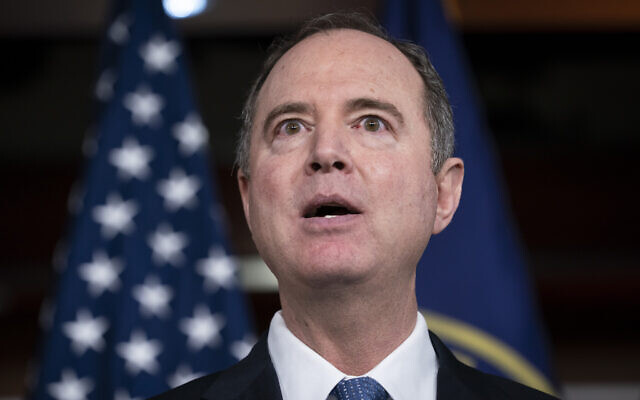
WASHINGTON — The chairman of the House Intelligence Committee is accusing US intelligence agencies of withholding documents from Congress on Ukraine that could be significant to US President Donald Trump’s impeachment trial.
“They appear to be succumbing to pressure from the administration,” Representative Adam Schiff says Sunday on ABC’s “This Week.” Schiff was selected by House Speaker Nancy Pelosi as the lead impeachment manager for Trump’s Senate trial.
Schiff, a California Democrat, contends that the National Security Agency “in particular is withholding what are potentially relevant documents to our oversight responsibilities on Ukraine, but also withholding documents potentially relevant that the senators might want to see during the trial. That is deeply concerning.” He also says “there are signs that the CIA may be on the same tragic course.”
The NSA and CIA don’t immediately respond to a requests for comment.
Trump’s impeachment trial resumes Tuesday.
Democrats have previously criticized the State Department for withholding relevant documents to the impeachment inquiry. In the weeks since Trump was impeached, Democrats have sought to focus on new evidence about Trump’s effort to pressure Ukraine to investigate his political rivals and are pushing the Senate to consider new documents and testimony, such as from former national security adviser John Bolton.
— AP
House Intelligence Committee Chairman Adam Schiff takes a reporter’s question at the Capitol in Washington, January 15, 2020. (AP Photo/J. Scott Applewhite)
As a multimedia journalist, my job is to take the quality, fact-based journalism produced by The Times of Israel newsroom and make it accessible across every platform — from Instagram posts to podcasts to short-form videos.
This is how many, especially young people, consume news these days. But misinformation is rampant on social media. Our team at ToI produces accurate, responsible short-form reporting on Israel and the Jewish world.
If you believe in the importance of factual social media journalism, please consider joining our reader support group, The Times of Israel Community. Your financial support is essential to sustain responsible multimedia reporting.
We’re really pleased that you’ve read X Times of Israel articles in the past month.
That’s why we started the Times of Israel - to provide discerning readers like you with must-read coverage of Israel and the Jewish world.
So now we have a request. Unlike other news outlets, we haven’t put up a paywall. But as the journalism we do is costly, we invite readers for whom The Times of Israel has become important to help support our work by joining The Times of Israel Community.
For as little as $6 a month you can help support our quality journalism while enjoying The Times of Israel AD-FREE, as well as accessing exclusive content available only to Times of Israel Community members.
Thank you, David Horovitz, Founding Editor of The Times of Israel


 Add ToI as a Preferred Source on Google