As Israel and Hamas continue to strike while ceasefire talks are in the air, they might be continuing a pattern seen in recent conflicts — an increase in attacks right before a deal to end hostilities is set to take place.
In the 2006 Second Lebanon War, Israel tripled its forces in Lebanon on August 11, despite a UN security council ceasefire that was set to go into effect on August 14 at 8 a.m. On the last day of the war, Hezbollah fired 250 rockets into Israel, as it sought to demonstrate that it was still standing and punching back.
During Operation Pillar of Defense in 2012, it appeared by November 20 that a ceasefire was close. US Secretary of State Hillary Clinton was in Israel, and both Egypt and Hamas declared that a deal was in the works.
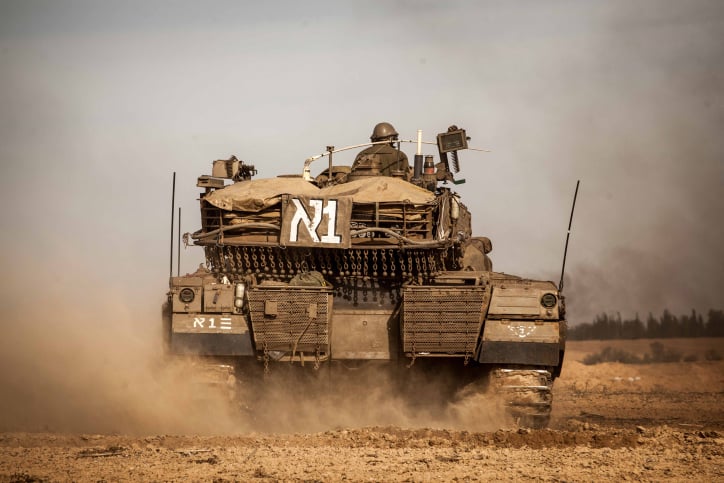
Israeli soldiers preparing their tanks along the Israel-Gaza border on the third day of Operation Pillar of Defense, November 16, 2012. (photo credit: Uri Lenz/ Flash90)
But November 21 saw 116 rockets fired into Israel from Gaza, compared to 80 the day before. Meanwhile, Israel struck rocket-launching squads in Jabalya and Khan Younis, and hit tunnels and underground rocket launchers. Israeli strikes that day also killed several civilians in Gaza.
Only hours before the ceasefire went into effect at 9 p.m., an 18-year-old Israeli Arab left a bomb on a Tel Aviv bus, which exploded and wounded 28 people. Israel stepped up attacks in response.
Even after the ceasefire went into effect in 2012, over a dozen rockets were shot at Israel, with at least two hitting homes in Ashdod and Beersheba, as terror groups attempted to get off their last shots.
Help us report truthfully on social media
As a multimedia journalist, my job is to take the quality, fact-based journalism produced by The Times of Israel newsroom and make it accessible across every platform — from Instagram posts to podcasts to short-form videos.
This is how many, especially young people, consume news these days. But misinformation is rampant on social media. Our team at ToI produces accurate, responsible short-form reporting on Israel and the Jewish world.
If you believe in the importance of factual social media journalism, please consider joining our reader support group, The Times of Israel Community. Your financial support is essential to sustain responsible multimedia reporting.
We’re really pleased that you’ve read X Times of Israel articles in the past month.
That’s why we started the Times of Israel - to provide discerning readers like you with must-read coverage of Israel and the Jewish world.
So now we have a request. Unlike other news outlets, we haven’t put up a paywall. But as the journalism we do is costly, we invite readers for whom The Times of Israel has become important to help support our work by joining The Times of Israel Community.
For as little as $6 a month you can help support our quality journalism while enjoying The Times of Israel AD-FREE, as well as accessing exclusive content available only to Times of Israel Community members.
Thank you, David Horovitz, Founding Editor of The Times of Israel


 From the Liveblog of
Tuesday, July 15, 2014
From the Liveblog of
Tuesday, July 15, 2014
 Add ToI as a Preferred Source on Google