Britain’s government has bowed to a lobbying effort led by a Labour peer rescued from the Nazis by a “kindertransport” in the 1930s and agreed to take in some unaccompanied children from Syria who have made their way to Europe.
Prime Minister David Cameron’s office says children who registered in Greece, Italy or France before March 20 — when the European Union struck a deal to return many migrants to Turkey — would be eligible to come to the UK. It did not specify how many Britain would accept.
Britain has already agreed to resettle up to 3,000 vulnerable child refugees from the Middle East and Africa by 2020, as well as 20,000 Syrians from Middle Eastern refugee camps.
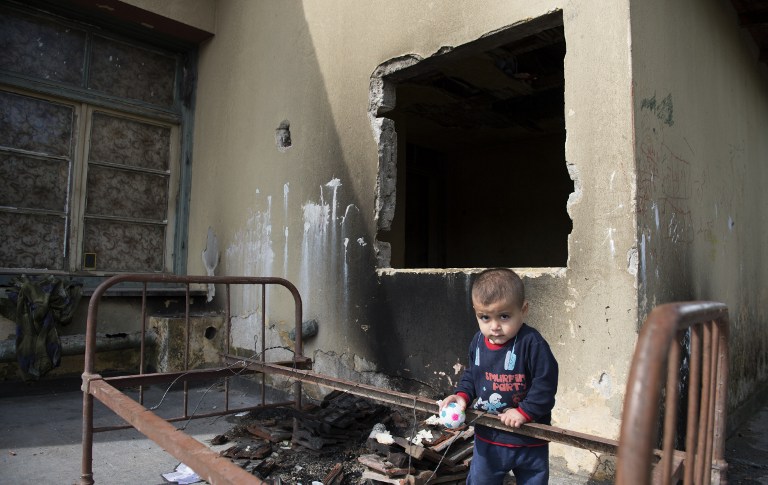
A boy plays outside a shelter in a makeshift camp for migrants and refugees at the the Greek-Macedonian border near the village of Idomeni on May 3, 2016. (AFP Photo/Tobias Schwarz)
But the government had argued that accepting children already in Europe would encourage others to make the dangerous journey.
People look at flowers laid in memory of Britain’s Sir Nicholas Winton on German-born Jewish sculptor Frank Meisler’s ‘Kindertransport’ (German for children transport) memorial statue outside Liverpool Street Station in London, Thursday, July 2, 2015. (AP Photo/Matt Dunham)
Labour peer Alf Dubs, who came to Britain on the 1930s “kindertransports” of Jewish children from Nazi-occupied Europe, led a campaign to get Cameron’s Conservative government to change its mind.
“I trust the prime minister will be true to his word and move swiftly to ensure the Home Office works closely with local authorities to find foster families to give these young people a stable and secure home,” Dubs says.
— AP
Help us report truthfully on social media
As a multimedia journalist, my job is to take the quality, fact-based journalism produced by The Times of Israel newsroom and make it accessible across every platform — from Instagram posts to podcasts to short-form videos.
This is how many, especially young people, consume news these days. But misinformation is rampant on social media. Our team at ToI produces accurate, responsible short-form reporting on Israel and the Jewish world.
If you believe in the importance of factual social media journalism, please consider joining our reader support group, The Times of Israel Community. Your financial support is essential to sustain responsible multimedia reporting.
We’re really pleased that you’ve read X Times of Israel articles in the past month.
That’s why we started the Times of Israel - to provide discerning readers like you with must-read coverage of Israel and the Jewish world.
So now we have a request. Unlike other news outlets, we haven’t put up a paywall. But as the journalism we do is costly, we invite readers for whom The Times of Israel has become important to help support our work by joining The Times of Israel Community.
For as little as $6 a month you can help support our quality journalism while enjoying The Times of Israel AD-FREE, as well as accessing exclusive content available only to Times of Israel Community members.
Thank you, David Horovitz, Founding Editor of The Times of Israel


 From the Liveblog of
Wednesday, May 4, 2016
From the Liveblog of
Wednesday, May 4, 2016
 Add ToI as a Preferred Source on Google